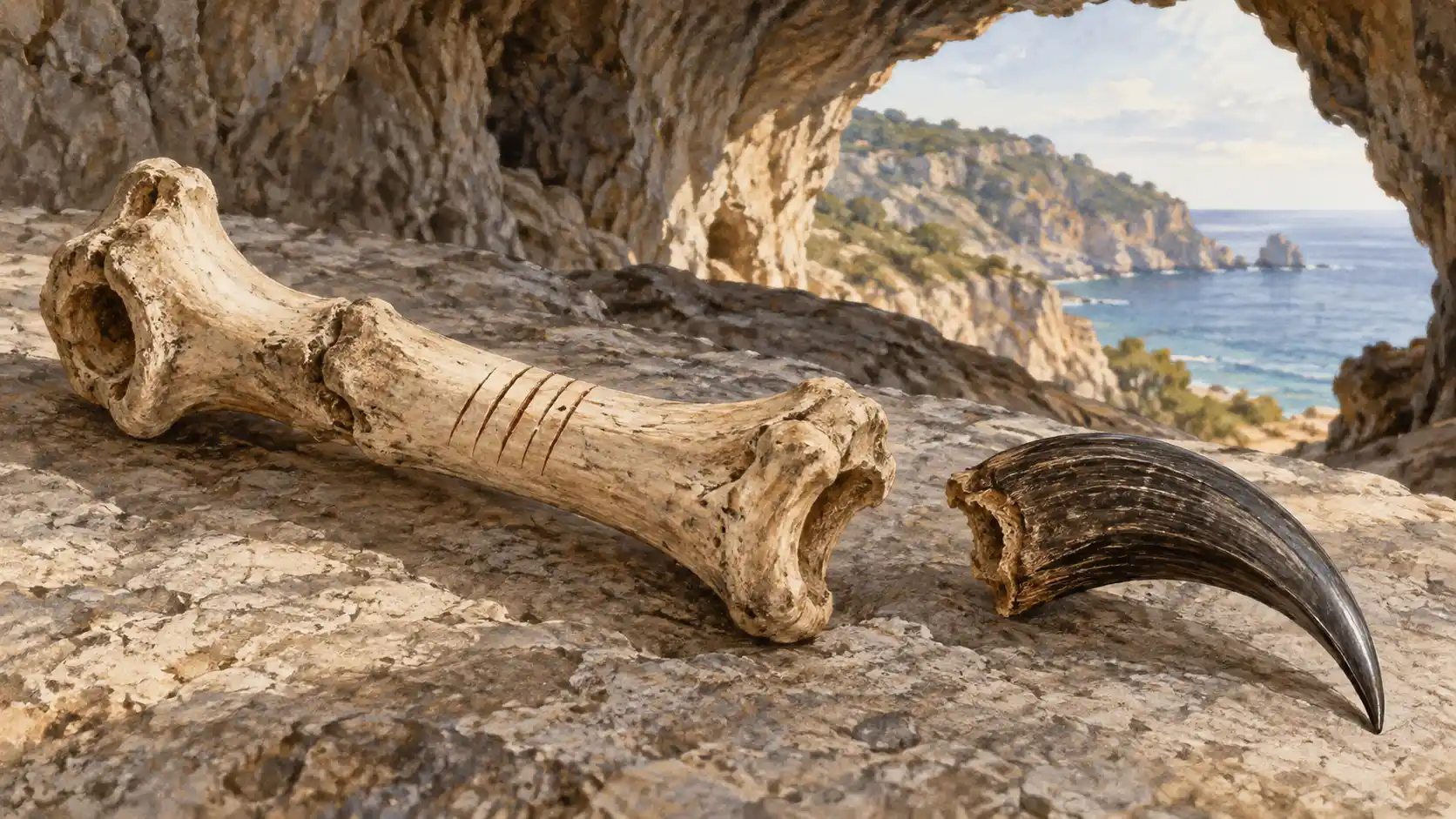
The Cova Foradada eagle bone is a single phalanx from a large bird’s toe, marked by twelve cuts. Eleven run diagonally in near-parallel lines; a shallower twelfth crosses them at another angle. Researchers argue that the marks were made while someone freed the curved talon from its bony base.
The talon itself is missing. So what did someone do with it after taking the trouble to remove it?
What the cuts show
Cova Foradada is a cave near Calafell on Spain’s Mediterranean coast. The bone came from layer IV1, among stone tools associated with the Châtelperronian. Radiocarbon work on the cave sequence places the occupation around 39,000 years ago, although the site’s modelled dates provide minimum ages for the occupations. The eagle bone itself was not directly dated.
The study focuses on one phalanx—the bone at the base of a toe—from the left foot of a large eagle. Its shape points most closely to an imperial eagle or a close ancestor, though the researchers could not settle the species more precisely.
The twelve incisions cover about two-thirds of the bone. Eleven are deep, oblique and almost parallel; the shallower twelfth runs at a different angle. Researchers made a three-dimensional model of the surface, then compared the grooves’ shape and position with marks left during animal processing. They concluded that a sharp stone edge had freed the talon.
Raptor bones are uncommon at Cova Foradada. The team found no sign that this phalanx was cut for food. They argued that the talon had been taken for symbolic use and described it as the first evidence of Neanderthal-associated eagle-talon use in Iberia. Because the claw was not recovered, its use remains an interpretation rather than a finished object archaeologists can examine.
The talon is missing
Someone might have worn the claw on a cord or attached it to clothing. It could also have been kept or used in a way that left no trace on the bone. The researchers found neither the keratin claw nor a cord or finished ornament, so a pendant remains one possible use, not an object from the cave.
Krapina, in present-day Croatia, offers a comparison. Researchers there studied eight mostly complete white-tailed eagle talons, about 130,000 years old, with cut marks, polished areas and wear that they interpreted as a jewelry assemblage. It is a much older find from another species, but it shows that Neanderthals selected and worked eagle talons at more than one place and time.
A find from a Neanderthal-associated layer
The Cova Foradada bone lay in a Châtelperronian archaeological layer, a tool tradition generally associated with late Neanderthals. No human remains were found with the phalanx. The team links it to Neanderthals through the associated tools and its place in the cave sequence. Châtelperronian finds come from a contested stretch of the record, around the time Neanderthals and modern humans met in Europe.
At Üçağızlı Cave, researchers have examined signs of cultural continuity between Neanderthals and modern humans. Our report on the Üçağızlı cave sequence follows that separate debate; the Cova Foradada case rests on one cut-marked eagle bone.
Someone carefully cut the talon free from the toe bone. Whether it was worn, kept or used another way remains unknown; the cave preserved the cut marks, not the claw.
Sources
- Rodríguez-Hidalgo et al., “The Châtelperronian Neanderthals of Cova Foradada (Calafell, Spain) used imperial eagle phalanges for symbolic purposes,” Science Advances (2019), doi:10.1126/sciadv.aax1984.
- Morales et al., “The Middle-to-Upper Paleolithic transition occupations from Cova Foradada (Calafell, NE Iberia),” PLOS ONE (2019), doi:10.1371/journal.pone.0215832.
- Radovčić et al., “Evidence for Neandertal Jewelry: Modified White-Tailed Eagle Claws at Krapina,” PLOS ONE (2015), doi:10.1371/journal.pone.0119802.