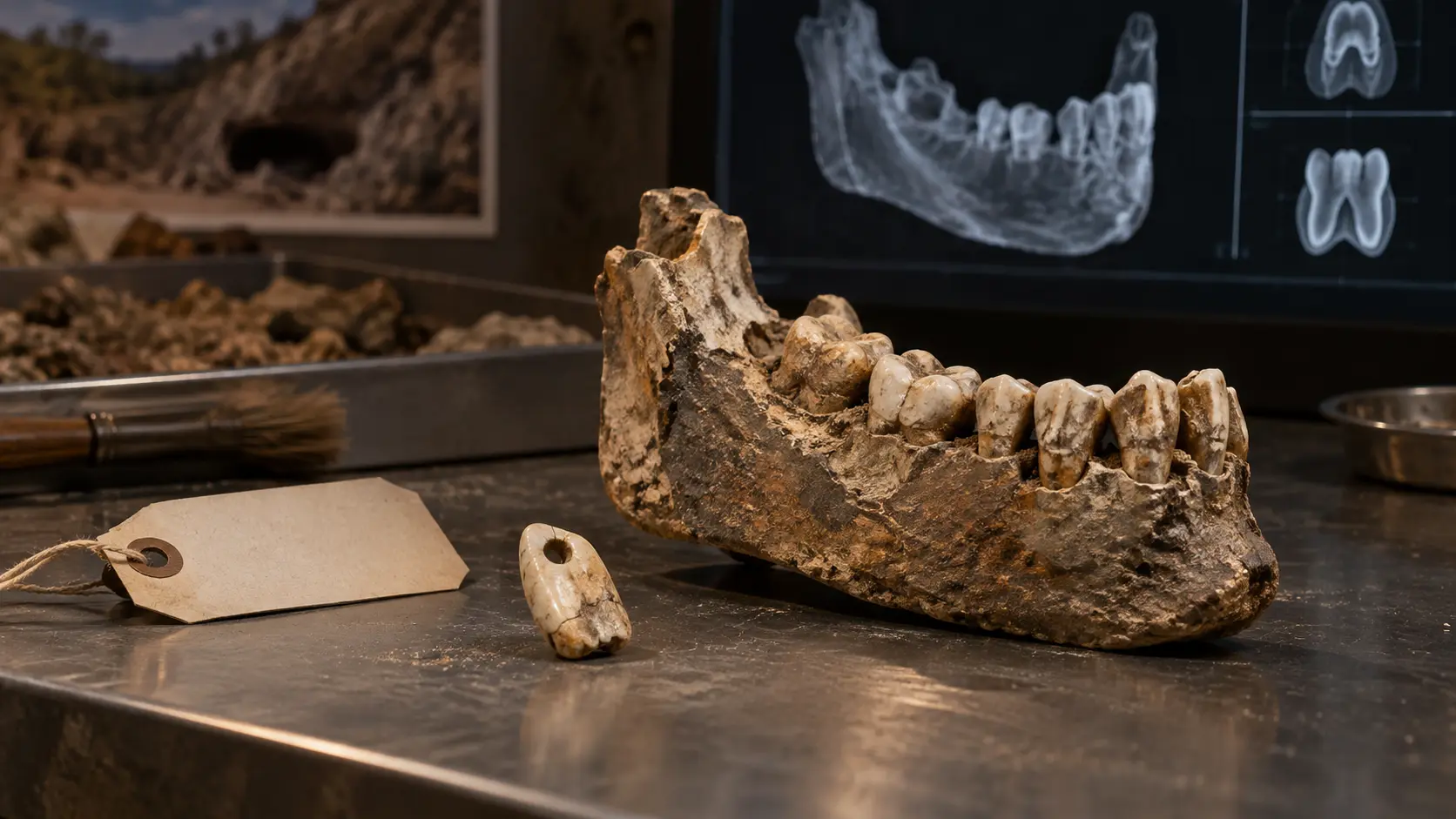
Les Rois teeth and a 30,000-year-old mandible once seemed to tell a grim Neanderthal story. But what if the first part of that story was wrong?
A new study has returned to the teeth and mandible known as Les Rois 2, found in the Les Rois Cave in southwestern France. After comparing the specimen with large samples of Neanderthal and Homo sapiens teeth using micro-CT scans and three-dimensional measurements, the researchers conclude that its anatomy is more consistent with Late Pleistocene Homo sapiens. The finding does not erase the cut marks or the evidence for unusual treatment of human remains. It changes the identity of the person at the centre of the story.
The paper, published in the American Journal of Biological Anthropology, does not claim that the specimen looks like an average modern human. Instead, it places Les Rois 2 near the edge of the variation seen in later Holocene populations while finding that its dental anatomy fits early Upper Paleolithic Homo sapiens. The distinction matters. A rare feature is not automatically a Neanderthal feature, and an unfamiliar face from 30,000 years ago should not be forced into a modern category.
How the Neanderthal interpretation began
Les Rois is an Aurignacian site, associated with some of the earliest Upper Paleolithic communities in western Europe. Earlier research examined a juvenile mandible with cut marks and dental traits that seemed difficult to assign. One interpretation was that Neanderthals might still have been present in the region when Aurignacian groups were making tools and ornaments. Another possibility was that the specimen belonged to Homo sapiens whose anatomy retained features that are uncommon in recent populations.
Because the cut marks were consistent with the processing of a body, the case became linked to a dramatic reconstruction: modern humans had killed and butchered a Neanderthal child, then kept the child’s teeth as a personal ornament. That reconstruction was never a simple fact read directly from one bone. It depended on several steps—identifying the individual, interpreting the marks, and connecting the teeth with a funerary or symbolic practice.
The new research addresses the first step. It does not turn an ambiguous find into a solved crime scene. It asks a narrower question: what population does the dental anatomy most closely fit?
What the new scans examined
The researchers used micro-computed tomography to look inside the teeth as well as study their outer surfaces. That allowed them to compare enamel thickness, the shape of the enamel–dentine junction, and three-dimensional features that are difficult to assess from a photograph or a damaged crown.
The comparison included Neanderthals, Pleistocene Homo sapiens and Holocene Homo sapiens. The team also examined nonmetric traits—small anatomical features whose presence or absence can help distinguish populations—and used geometric morphometrics to compare the shape of the internal dental surfaces.
The result was consistent across several lines of analysis. Les Rois 2 lacks a derived dental trait considered characteristic of Neanderthals. Its enamel and internal tooth shapes align more closely with Late Pleistocene Homo sapiens. At the same time, the specimen retains plesiomorphic, or ancestral-looking, features that are rare among recent humans.
That combination is exactly why the original interpretation was difficult. The specimen is not a neat representative of any textbook box. It is a member of an early Homo sapiens population with a broader range of dental variation than the samples most familiar to researchers today.
Does this disprove the necklace story?
Not by itself. The new paper primarily reassesses taxonomy—the question of whether Les Rois 2 was Neanderthal or Homo sapiens. It does not make every other observation at the cave disappear.
The Les Rois material still raises questions about cut marks, the treatment of bodies and the perforation or use of human teeth as ornaments. But those questions must be separated. If the mandible belongs to Homo sapiens, the evidence no longer supports a simple story in which modern humans butchered a Neanderthal child and wore the child’s teeth. It may instead point to complex mortuary or symbolic practices within an Aurignacian community.
Even that interpretation needs care. A tooth can be made into an ornament without telling us exactly who wore it, why it was kept or how it was obtained. Cut marks can show that a body was modified, but they do not automatically identify the motive. Archaeologists reconstruct behaviour by combining anatomy, context, tool marks, dating and the arrangement of associated objects.
A wider lesson about the first Europeans
The result also changes how we picture the people who lived in Europe during the Aurignacian. They were not a uniform population arriving with one fixed biological appearance. The fossil record is small, and the individuals that survive are often unusual. A rare trait can therefore seem more diagnostic than it really is.
The Les Rois study is a reminder that the boundary between “modern” and “archaic” is not a line drawn across every tooth. Early Homo sapiens could carry features that disappeared or became uncommon later. Populations changed, mixed and moved through landscapes that were already home to other human groups.
That does not make the past less mysterious. It makes the questions more precise. Were the cut marks part of a funerary rite, a practical act, or something else? Were teeth deliberately perforated and worn as ornaments? Did different communities treat the dead in different ways? The identity of Les Rois 2 is now more securely placed, but the human story around the cave remains open.
The old headline was powerful because it seemed to offer a single shocking answer. The new evidence offers something more interesting: a reminder that one unusual jaw can preserve not just a biological history, but a warning about how quickly a complicated life can be turned into a simple tale.
Sources and further reading
- Isle de Beauchaine et al., “The Dentition of the Aurignacian Mandible Les Rois 2, France: New Data and Taxonomic Reassessment,” American Journal of Biological Anthropology (2026)
- PubMed record with abstract and full-text link
- Ramirez-Rozzi et al., “Cutmarked human remains bearing Neandertal features and modern human remains associated with the Aurignacian at Les Rois,” Journal of Archaeological Science (2009)
- Archaeology Magazine report on the reanalysis