The Spanish Armada reached the eastern English Channel in 1588 without being destroyed. Its greatest problem was still ahead: it needed to bring together ships arriving from Spain and an invasion army waiting in Flanders.
A fleet could threaten England from the sea. To complete Philip II’s invasion plan, it had to help get troops across the water. At Calais, the distance between those two tasks became painfully clear.
The campaign is often remembered through burning ships and Atlantic storms. Its maps and shipping records reveal a sequence of failures, rather than a single moment when every Spanish vessel was swept away.
The army was part of the plan
The Duke of Medina Sidonia commanded the Armada. The Duke of Parma commanded the army in the Netherlands. Their forces had to connect while English and Dutch opponents were trying to prevent precisely that.
Colin Martin and Geoffrey Parker’s Armada: The Spanish Enterprise and England’s Deliverance in 1588 describes the correspondence between the commanders. Coastal sandbanks and the absence of a suitable deep-water port made a close inshore meeting difficult. Information travelling by small vessel also took time.
This was a practical obstacle with strategic consequences. A large ship could reach the general rendezvous area without being able to enter every stretch of shallow water. Meanwhile, soldiers waiting ashore were not an invasion force in England until transport and protection had actually been arranged.
Calais gave the English an opportunity
Royal Museums Greenwich’s campaign guide follows the Armada’s progress through a series of Channel engagements to its anchorage off Calais. Earlier fighting had caused damage, but the fleet continued east.
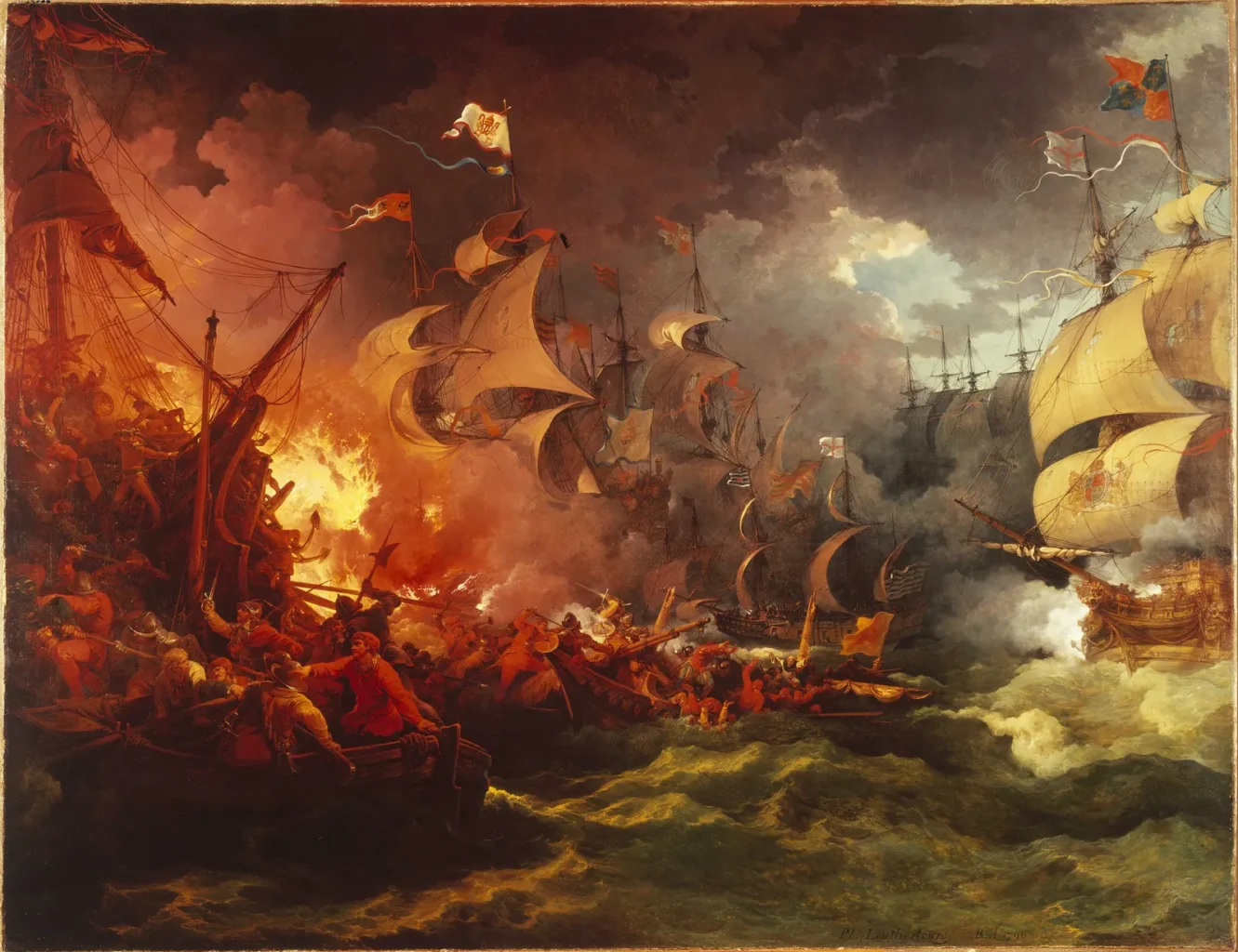
During the night of 7–8 August, using Gregorian dates, the English sent eight fireships toward the anchored vessels. Ships cut their cables to escape and the Spanish formation dispersed. The following battle off Gravelines caused more serious damage.
The English struck while Medina Sidonia was still trying to connect with Parma. Driving the ships from their anchorage disrupted the meeting on which the invasion depended.
Once the fleet moved away and conditions pushed it toward the North Sea, reaching home became the immediate problem. A fleet could still contain surviving warships while having lost the ability to carry out its assigned operation.
The campaign drawn on eleven charts
Robert Adams prepared eleven charts of the campaign, engraved and published by Augustine Ryther in 1590. The sequence follows the Channel actions and then the retreat around Scotland and Ireland. Royal Museums Greenwich holds a coloured copy.
The charts give the reader something a paragraph of battle names cannot: the relationship between coasts, fleet movements and the journey home. They were also produced after the campaign and dedicated to the English commander, Lord Howard. They should be read as a constructed account, rather than live tracking of every vessel.
A NASA presentation pairs historical charts with Landsat views of the same coast. The comparison makes the geography easier to grasp. The satellite views show the scale of the waters the commanders had to cross, while the historical charts set out the movements attributed to their fleets.
The ships did not all share one fate
Martin and Parker’s freely available ship-by-ship appendices record vessels, crews and outcomes. The Portuguese-built San Martín, Medina Sidonia’s flagship, returned to Santander. Other ships were captured after Channel fighting, while others were wrecked on the Irish coast during the retreat.
A ship captured after battle and one wrecked weeks later on the Irish coast tell different parts of the story. The appendices allow those losses to be followed individually, instead of folding every vessel into one scene of destruction. Where remains survive underwater, archaeology can add another record: the cargo and objects still together at the moment a vessel sank, as much earlier Mediterranean wrecks demonstrate.
England still had to prepare for a landing
English Heritage’s history of Tilbury records the army assembled near the fort as the invasion was expected. The sea campaign mattered because an army might otherwise have come ashore. English preparations extended beyond the ships doing the fighting.
The Armada’s failure prevented that invasion. The war continued until 1604, so the outcome of 1588 should not be made to stand for the immediate disappearance of Spanish power.
Philip’s commanders needed their two forces to meet at the right place and time, then carry soldiers across contested water. The fleet reached the Channel. The army remained on the other side of it.