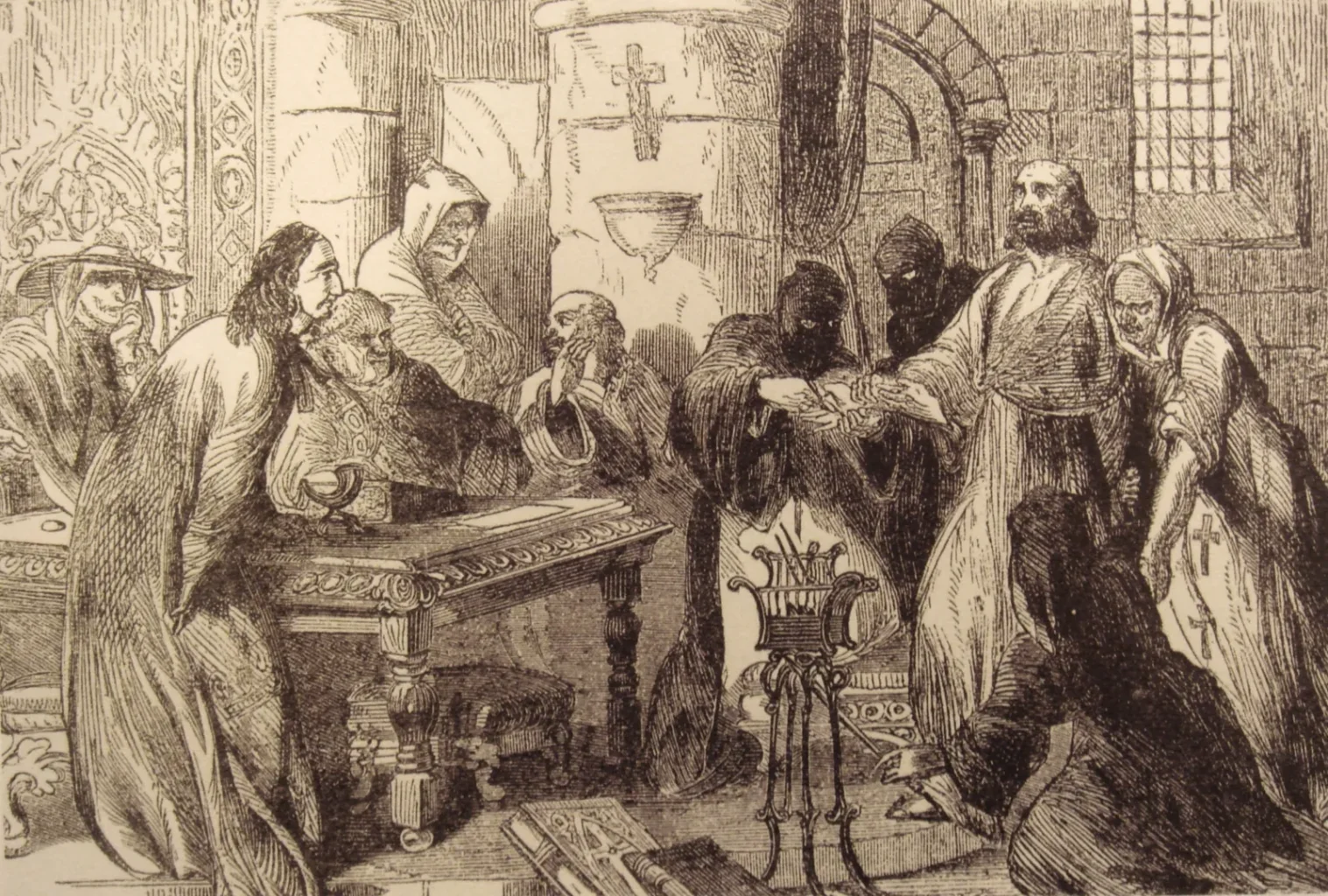
The fire was ready, and Jacques de Molay asked to join his hands in prayer. In a medieval chronicle, the last master of the Knights Templar faces his execution with a warning: those responsible for condemning him unjustly will suffer, and God will avenge his death.
The scene has become one of the most enduring stories attached to the Templars. In familiar retellings, de Molay summons powerful enemies to answer before God within a precise deadline. The drama is so memorable that it is easy to assume we possess a verbatim transcript.
An early verse chronicle preserves a different warning. It takes us closer to the execution, before the familiar names and deadline became part of the story.
A voice preserved in a verse chronicle
The account appears in the Chronique métrique associated with Geoffroi de Paris. The scholarly bibliography Arlima describes a work covering events from 1300 to 1316 and composed during the early fourteenth century. The text survives in a manuscript held by the Bibliothèque nationale de France.
An 1827 edition edited by J. A. Buchon prints the execution account on pages 219–221. In it, the narrator presents the scene as something he saw. That makes it a valuable near-contemporary account, although its verse form and reported speech still need to be considered.
The chronicle describes de Molay defending his order and rejecting the justice of his condemnation. As he is tied for the fire, he asks to pray and says that God knows he is being put to death wrongfully.
The warning in the early text
The passage then attributes a warning to de Molay: misfortune will soon fall on those who condemn the Templars unjustly, and God will avenge their deaths. He asks to have his face turned towards the Virgin Mary. The narrator describes his composure and the reaction of those watching.
The scene is stark. A condemned man appeals from earthly judgement to divine justice, maintaining his allegiance at the moment when it costs him his life.
The passage does not lay out the familiar, carefully named summons with a precise one-year deadline. Its warning is broader. The difference matters because it lets us distinguish what this early source attributes to de Molay from the more elaborately staged version that many readers know.
A chronicle is also a composed account. Even a narrator claiming to witness an event selects details, arranges them and writes speech from memory or report. The presence of direct speech in a medieval text does not make it a modern recording.
Why the story carried so far
A warning at an execution has a natural dramatic shape. Power appears to rest entirely with the people who ordered the death. The condemned man’s words reverse that relationship by invoking a judgement beyond their control.
The traditions surrounding the Templars’ lost treasure show how many stories grew around the order’s downfall. The Templars’ suppression gave the scene a wider setting. This was a wealthy and influential religious military order whose downfall invited questions about politics, belief and justice. De Molay’s death could stand for the fate of the entire order.
Later accounts could bring subsequent events into the story and read them through his warning. That is one of the ways a curse narrative gathers force: events occurring afterwards become part of the meaning assigned to the last words.
To investigate such a narrative, the useful questions are chronological. Which wording appears in the earliest account? Which names or deadlines occur in later versions? What information did each author have? Comparing the dated texts could show when the warning acquired its more familiar wording.
The human scene behind the legend
The early chronicle leaves us with more than a disputed quotation. It describes prayer, physical restraint, a defence of the order and the behaviour of a man facing execution. Those details are part of the Templars’ history even where the exact wording cannot be recovered.
De Molay’s warning appeals to a judgement beyond the men who sentenced him. Whatever later authors added, the early chronicle already describes a condemned man defending his order and asking to pray as he faced the fire.