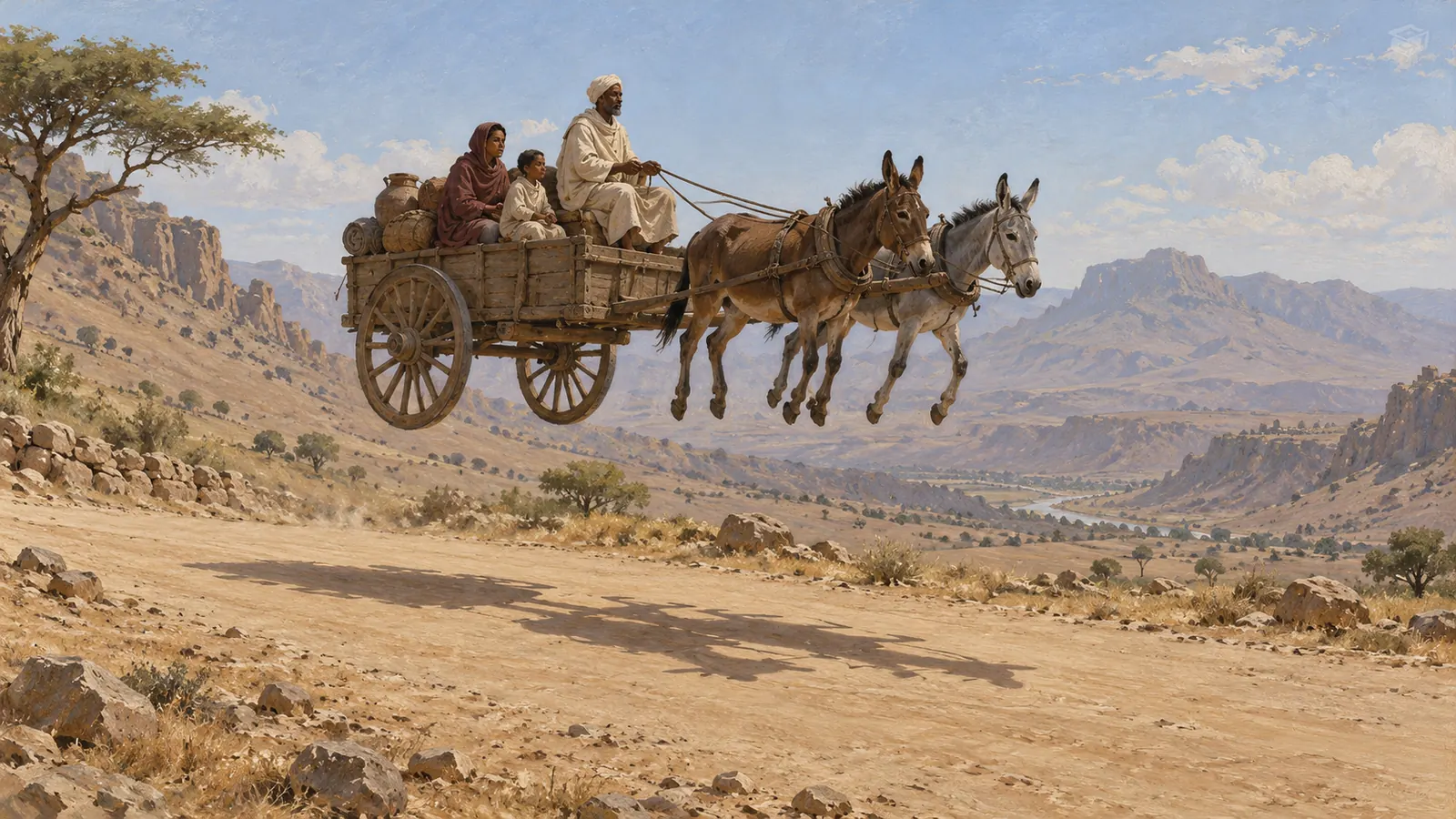
The wagons are loaded. Horses, mules and camels are ready for the road. Then the entire company rises above the ground.
In the Kebra Nagast, the Ethiopian account of Solomon, the Queen of Sheba and their son, a journey becomes something extraordinary. The travellers move with the ease of birds, carrying the Ark of the Covenant towards Ethiopia. A road that should take thirteen days passes beneath them in one.
It is an astonishing scene to find in a medieval religious work. And it raises a better question than the familiar search for a flying carpet: what exactly does the book describe, and how does that flight fit into its much larger story?
Solomon’s gift includes a vessel for the air
There are two passages worth reading together. Near the end of chapter 30, Solomon prepares gifts for the departing queen. Among the valuables and transport equipment, E. A. Wallis Budge’s English translation lists a vessel for the sea and another for travelling through the “air (or winds).” Solomon has made them through wisdom granted by God.
The description is brief. There is no drawing, account of its shape or explanation of how it moves. But airborne travel is plainly part of the scene, and the bracketed alternative in the translation is worth keeping in view. Readers working through an English edition are encountering a translator’s choices as well as the Ethiopian narrative.
Calling this object a flying carpet supplies a material and a shape the passage itself leaves open. A vessel, a wagon and a carpet create different pictures. Following the actual wording lets the stranger details of the story emerge without replacing them with a more familiar legend.
A caravan that floats above the road
Chapters 52 and 53 give us far more to imagine. Solomon’s son, called David in this part of Budge’s translation and also known as Menelik, leaves Jerusalem with his company. The archangel Michael goes before them, opening their route and shielding them from the sun.
The wagons no longer need anyone to haul them. People, pack animals and baggage are raised above the earth. The account compares their movement with a ship driven by wind and an eagle gliding overhead. Their arrival after a single day leaves them neither exhausted nor hungry.
Notice how inclusive the flight is. This is a travelling household with animals and luggage, rather than one exceptional passenger aboard a special craft. The author makes the whole burden of a difficult journey disappear.
The same chapters connect that movement with the Ark, called Zion in the narrative. Its presence gives the journey its religious purpose. The extraordinary speed takes the sacred object beyond Solomon’s reach and carries the story towards Ethiopia.
The flight carries a kingdom’s origin story
The Kebra Nagast, usually translated as The Glory of the Kings, follows Makeda, the Queen of Sheba, her meeting with Solomon and the fortunes of their son. Its account joins royal ancestry to the movement of the Ark.
Scholar Wendy Laura Belcher places the Ethiopian text’s redaction in the fourteenth century, while recognising that parts of its traditions circulated earlier. In her study of the queen’s role, she explains how the narrative places an African woman and her descendants at the centre of a sacred history of kingship.
That gives the airborne journey an importance a detached list of ancient flying machines misses. Who travels, what they carry and where they arrive are all essential. Remove Ethiopia and the Ark, and much of the episode’s meaning goes with them.
Solomon’s reputation for extraordinary wisdom also travelled through quite different books. Curiosmos’s account of the medieval Ars Notoria follows another tradition in which his name became associated with knowledge granted from beyond ordinary human learning.
Reading the remarkable details closely
Could the Ethiopian account preserve something older about how people imagined flight? Comparing its vessels and wagons with descriptions in earlier texts could help trace that history. The language and the age of each version would be essential: a resemblance between two English translations might disappear when the original words are examined.
A surviving manuscript is also a particular object. The British Library dates its Kebra Nagast volume Or 818 to 1700–1750. That is the date of that copy, centuries after the medieval redaction discussed by Belcher. Keeping the story, its composition and an individual manuscript separate helps us follow how an extraordinary account survived.
The most memorable image remains the caravan: even the loaded animals lifted clear of the ground. The writer imagined a journey in which distance, fatigue and the weight of possessions could all be overcome.