A strip of red linen, soaked in a fragrant preparation, was laid over the face of the dead. Four days later, the treatment could be repeated. The instructions survive in a papyrus whose other subjects include plants, skin diseases and remedies.
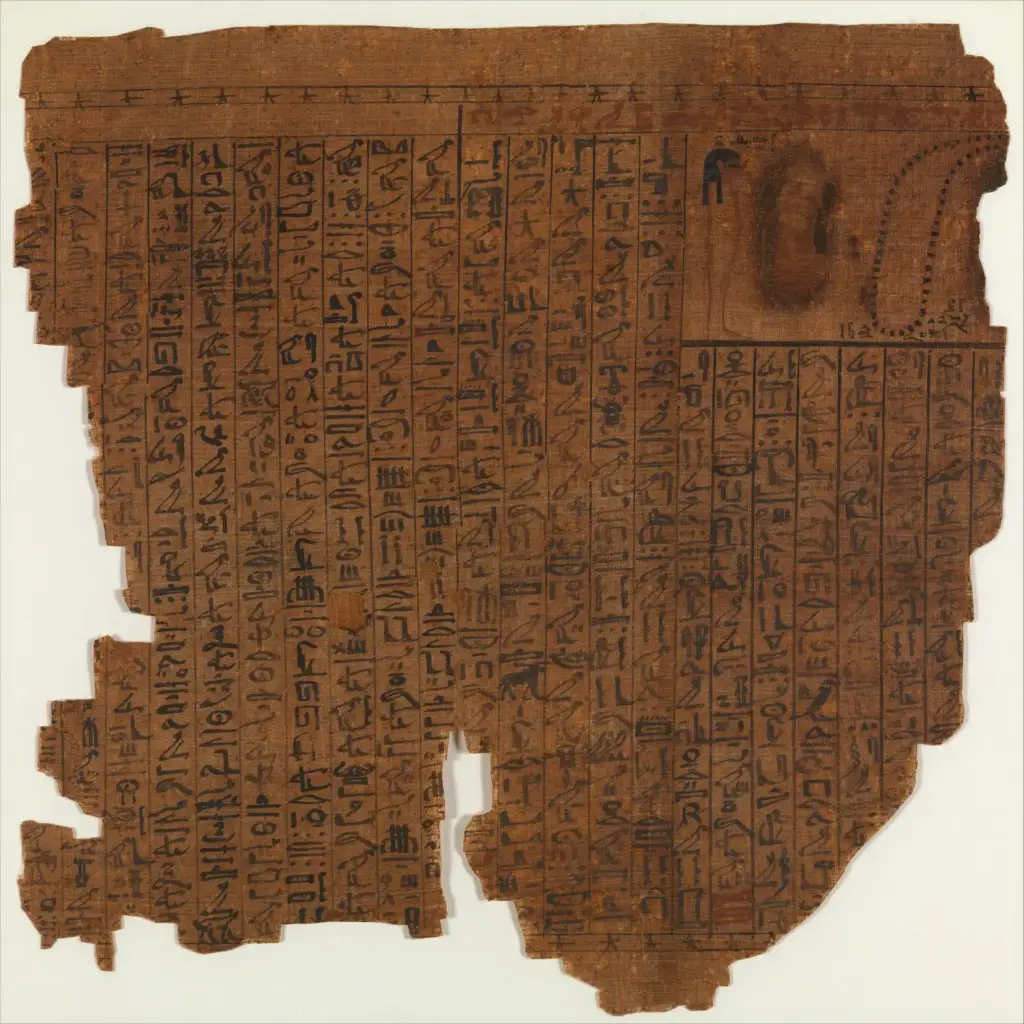
Known as the Louvre-Carlsberg papyrus, the manuscript preserves a rare ancient Egyptian guide to embalming. Its surviving sections are now held in Paris and Copenhagen. Together they offer a glimpse of a craft usually encountered through the bodies it preserved, rather than through the words of the people who practised it.
Egyptologist Sofie Schiødt’s research also reveals a manuscript with a modern history of its own: it was cut into pieces, passed through private collections and separated before its parts were studied together. At least one section is still missing.
A face wrapped in red linen
Ancient Egyptian embalmers prepared bodies for a life beyond death, a journey reflected in the funeral ceremonies that accompanied burial. Mummies, tomb scenes and later accounts have given researchers ways to study that work, but written instructions for the embalmers are exceptionally rare.
In a University of Copenhagen account of her research, Schiødt describes a preparation made largely from aromatic plant substances and binders. The mixture was cooked into a liquid and applied to a piece of red linen, which was then placed over the deceased person’s face.
The cloth formed a scented covering. Schiødt notes that researchers have also examined mummies from the period whose faces were covered with cloth and a resin-like material. Those finds do not identify a particular person treated according to this papyrus, but they give the written instructions a material counterpart.
The text does not tell a beginner everything. Schiødt suggests that it served more like an aide-mémoire for specialists who already knew the craft. Some familiar stages, including drying with natron, are omitted from the surviving instructions.
Why four days kept returning
The papyrus is especially valuable for the rhythm it suggests. Several instructions refer to intervals of four days. In a 2024 study of Egyptian hieratic texts, Schiødt explains how those intervals help reconstruct a 70-day process: the mummy was finished on day 68, followed by resurrection rites and burial.
The university’s 2021 account describes a broader reconstruction with a drying period and a wrapping period, each lasting 35 days. It also describes processions marking the work. That reconstruction draws on more than a single set of instructions; the surviving embalming passage itself occupies only three columns of the papyrus.
The manuscript offers unusually detailed clues, though it is not a complete day-by-day diary of every embalmer in Egypt.
Other surviving texts approach the work from another direction. The much later Ritual of Embalming, preserved in manuscripts including Papyrus Boulaq 3, describes stages of wrapping alongside words to be spoken during the rites. Comparing such texts shows how practical treatments and religious ceremonies could belong to the same undertaking, even when surviving sources emphasize different parts of it.
One manuscript, two collections
The names in Louvre-Carlsberg come from the collections that hold its surviving pieces. The Louvre acquired its portion in 2006. A separate portion entered Copenhagen’s Papyrus Carlsberg Collection in 2015 after it had belonged to a private collector.
According to Schiødt’s study, a preliminary translation of the Louvre material published by Thierry Bardinet in 2018 helped confirm that the Copenhagen fragments belonged to the same manuscript. Much of the Louvre portion preserves upper sections of the sheet; the Copenhagen material includes parts from the bottom.
The surviving manuscript measures a little over six metres. Schiødt estimates that it was originally at least seven metres long, because at least one section appears to be missing. Its ancient findspot is unknown. Its condition could be consistent with a tomb, she writes, but does not establish where it was found.
The papyrus contains more than the embalming passage. Other sections discuss remedies, a plant and its seeds, and swellings of the skin. Healing and preparation for burial occupied different parts of the same long document.
How old is the papyrus?
The dates attached to the manuscript are not identical. The University of Copenhagen’s 2021 release placed it around 1450 BC. The Louvre’s catalogue, updated in 2025, assigns its portion to the later Ramesside period, roughly 1295–1069 BC, on stylistic grounds.
Both place it in ancient Egypt’s New Kingdom, but the difference spans centuries. It is a reason to treat a precise year as an attribution rather than a date written on the surviving scroll.
Egyptian ideas about the journey after death were recorded in other forms too. A fragile coffin belonging to a woman named Ankh preserved an early version of the Book of Two Ways, a composition concerned with the world beyond death. The Louvre-Carlsberg passage brings us closer to the practical work done before a body entered its tomb.
For all that has been lost, the surviving lines still bring a small detail into focus: a face, a piece of red linen and a treatment repeated over days. Behind them lies an Egyptian workshop whose practitioners knew far more than the brief written guide needed to say.
Sources
- Sofie Schiødt, “New Kingdom Hieratic Texts in Danish Collections”, 2024, pp. 89–98, especially the Louvre-Carlsberg case study.
- University of Copenhagen, account of Sofie Schiødt’s mummification research, 2021.
- Michelle Chapman, The Embalming Ritual of Late Period through Ptolemaic Egypt, University of Birmingham doctoral thesis, 2017, section 3.2.1.
- Musée du Louvre, catalogue entry for Papyrus médical E 32847, last updated 2025.