What are some of the most puzzling ancient standing stone monuments on Earth? Let us take a look.
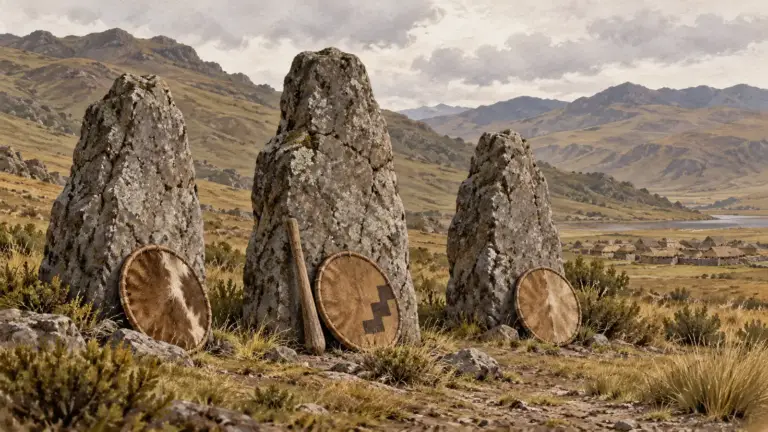
The word Menhir originates from Brittonic languages and signifies “Men” Stone and “Hir” long. Essentially, Menhirs are long stones. Archaeologically speaking, we see Menhirs as large human-made upright standing stones.
These ancient monuments can be found as either monoliths –singular standing stones– or as part of a group of similar stones. Standing stones come in all shapes and sizes and can differ considerably. Their existence has been well documented across Europe, Africa, and Asia. However, they are most numerous in Western Europe. If we look at Ireland, Great Britain, Brittany, and France, we will find over 50,000 examples of ancient standing stones.
Most Puzzling Ancient Standing Stone Monuments

Standing stones belong to many different sites and periods. An object found near a stone needs a secure archaeological context before it can be used to date the stone’s erection.
A blanket attribution to “the Beaker People” misses the different histories of these monuments. English Heritage’s Stonehenge timeline places the first enclosure around 3000 BC and the large sarsen settings around 2500 BC, while Beaker graves appear in its account around 2400 BC. Later communities used and altered landscapes that already contained monuments.
The survival of a monument also reflects later use of its landscape. English Heritage records that Avebury’s stones were buried or destroyed in the Middle Ages, with further removals during later building and agricultural work.
The destruction of Menhirs is a huge loss in history since many of the ancient sites were engraved with different kinds of megalithic art. Menhirs would often become anthropomorphic stelae, although images of objects such as stone axes, plows, shepherd crooks, and yokes were seen as common symbols engraved by the ancients onto the different standing stones.
The chronology has to be established site by site. Historic Environment Scotland dates the Calanais standing stones to between 2900 and 2600 BC. That Neolithic date should not be confused with the later use of the site.
Callanish Stones
The Callanish Stones, or Tursachan Chalanais in Scottish Gaelic, is an intricate arrangement of standing stones positioned in a cruciform pattern with a main, central stone circle. Thought to have been erected in the Neolithic, the Callanish Stones were most likely the focus of ritual and religious activity in the region during the Bronze Age. Located near the village of Callanish, other ancient sites are located close to the Callanish stones. Nearby, we can find other stone circles, arcs, stones specifically arranged, and singular standing stones Menhirs. Some of them are even visible from the Callanish Site.

Impressive examples
The most impressive examples, dubbed Callanish II and Callanish III, are located about a kilometer southeast of the main site, consisting of stone circles. Given the sheer existence of other standing stones in the area, it has been suggested that the region surrounding the Callanish stones was central to many prehistoric rituals and religious activities that span more than 1,500 years.
Unlike other standing stones discovered across Europe, the Callanish stones consist of thirteen stones arranged in a circle and a monolith standing near the center. The central stone measures 4.8 meters high, 1.5 meters wide, and 0.3 meters thick. Its largest sides seem to be perfectly oriented to the North and South. Its weight is estimated to be around 7 tons. The Callanish stones have an average height of three meters, and the outer stone ring covers an area of 124 square meters.
The Callanish stones feature a chambered tomb between the stone circle’s central and eastern monolith. The tomb is 6.4 meters long and was built later than the stone circle. How were these massive stones moved? Carved? Why? And by whom?
Göbekli Tepe
Göbekli Tepe belongs to a much earlier setting than the British stone circles. UNESCO’s account of the site dates its monumental buildings to about 9600–8200 BCE and identifies their builders as hunter-gatherer communities.

Its round-oval and rectangular buildings include T-shaped limestone pillars, some reaching 5.5 metres. Carved animals and human attributes on the pillars provide evidence of the communities’ beliefs and artistic traditions. UNESCO also notes remains interpreted as domestic buildings.
The site is therefore more than an isolated collection of unexplained stones. The relationship between communal buildings, ritual and everyday life is part of its archaeological significance.
Standing Stones of Avebury
One of the best-known prehistoric sites in England is Avebury, home to the largest megalithic stone circle in the world. This is one of the most puzzling ancient standing stone monuments in Europe.
English Heritage dates the building and alteration of the Avebury complex to roughly 2850–2200 BC. The monument includes a large henge and stone circles within it.
Like many other ancient sites, researchers have not managed to understand the exact purpose of the site. However, it is estimated that Avebury was a place where the ancients would perform either religious or ritualistic ceremonies.
The site is part of a much larger landscape of older monuments. The site itself is shrouded in mystery. The area where the monument was erected has yielded little archaeological information, and archeologists argue that evidence of human activity before the 4th millennium BC is limited.

Understanding the timeline
Avebury developed through a sequence of projects. English Heritage notes that the exact order of the banks, ditches and circles is not fully understood. Excavation and geophysical work suggest earlier timber features, while two stone avenues later linked the henge with other ceremonial sites.
The wider landscape suggests gatherings, processions and ritual activity. Such interpretations come from the arrangement of monuments and archaeological evidence, rather than from a surviving explanation written by their builders.
Join the discussion and participate in awesome giveaways in our mobile Telegram group. Join Curiosmos on Telegram Today. t.me/Curiosmos