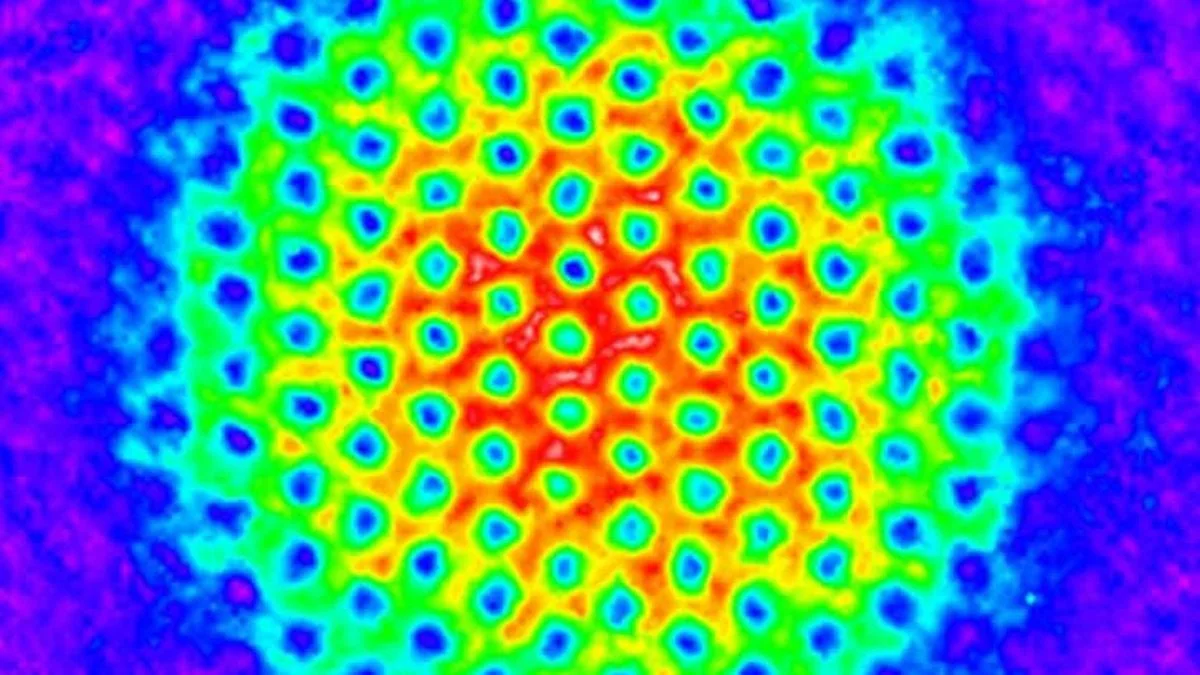
Physicists have observed the tiny, random fluctuations expected in a quantum field by building a version of the field in the laboratory. The experiment did not photograph literal empty space. Instead, a cloud of ultracold atoms was arranged so its measurable behaviour matched the mathematics of a relativistic quantum field.
The work, led by Yansheng Zhang and colleagues at the University of Cambridge, uses a two-dimensional Bose–Einstein condensate made from potassium-39 atoms. At temperatures just above absolute zero, the atoms behave collectively, allowing the researchers to track changes across the cloud rather than following each atom separately.
The team used two internal states of the atoms as the two components of the system and coupled them with radio waves. The relative phase between those components acted as the field the physicists wanted to study. In the regime used for the experiment, the setup emulated a massive sine–Gordon field, a model that appears in several areas of theoretical physics.
What “empty-space fluctuations” means
Quantum theory says that a field cannot be perfectly still, even in its lowest-energy state. The uncertainty principle leaves a residual pattern of fluctuations. In a literal vacuum, those fluctuations are associated with effects such as spontaneous emission, the Casimir force and the quantum fields used in models of Hawking radiation.
Most experiments measure one of those consequences rather than seeing the underlying fluctuations directly. Zhang’s team created a system in which the field itself could be reconstructed from images of the atoms. That makes the result an analogue experiment: the camera sees the laboratory field, while the field’s equations provide the connection to vacuum behaviour.
The researchers first prepared the condensate close to its ground state. They then changed the coupling between the two atomic components. That sudden change amplified the small variations already present, turning them into oscillations large enough to measure. A field with no initial quantum uncertainty would not respond in the same way.
The team also measured the system without first amplifying the fluctuations. Their strength changed with frequency in the pattern expected for vacuum fluctuations rather than ordinary thermal noise. That comparison is important because temperature and experimental imperfections can also produce small variations in an ultracold cloud.
A controllable stand-in for difficult physics
The experiment is useful because some interacting quantum-field calculations are extremely difficult to solve, especially when the system is far from equilibrium. A tunable atomic condensate gives physicists a way to prepare a state, change one part of the system and watch the result develop in real time.
The authors suggest that the same platform could be used to investigate phenomena such as particle production, the formation of topological defects and false-vacuum decay. These are laboratory simulations, not miniature versions of a cosmic event. Their value is that they let researchers test the behaviour of equations in a controlled physical system.
The distinction matters for the headline claim. The experiment did not point a telescope at space and capture vacuum fluctuations between the stars. It imaged fluctuations in a bosonic quantum field made from atoms, then tested whether the measured spatial and frequency patterns agreed with the predictions for a vacuum state.
The result is currently available as an arXiv preprint and has not yet undergone peer review. Independent checks will be needed to assess the analysis and the limits of the analogy. Even so, the method gives researchers a new way to examine quantum-field behaviour that is normally accessible only through indirect measurements or difficult calculations.
That broader problem appears throughout physics. Scientists often learn about something they cannot see by measuring the effects it leaves behind. Curiosmos has explored a related example in how gamma rays might reveal fossil neutrinos from the early universe. Here, the advance is that a laboratory system makes the hidden fluctuations themselves easier to follow.