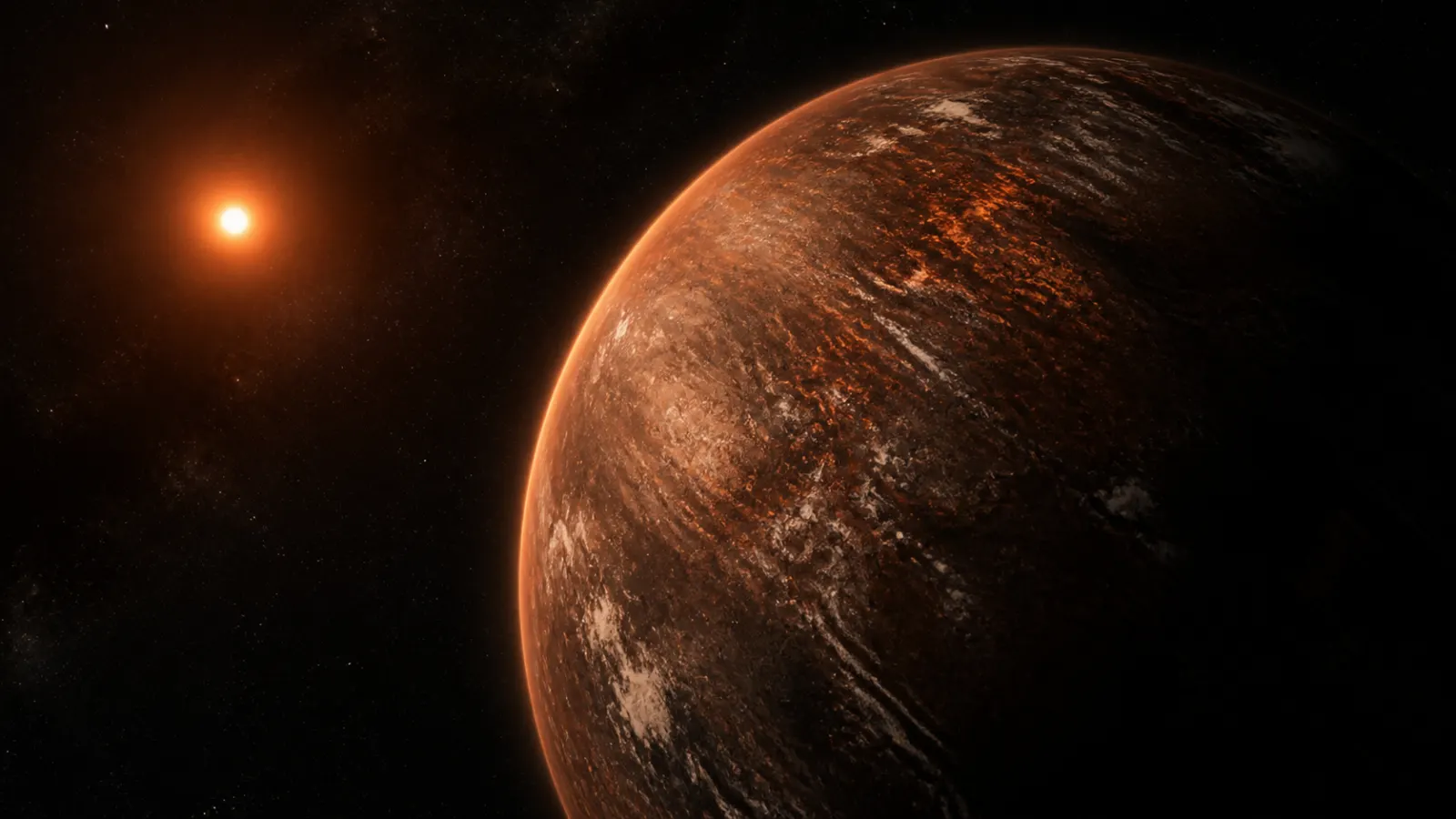
Astronomers have confirmed an unusually heavy planet around a young star. GJ 523b is about 23.5 times as massive as Earth, yet its radius is only 2.55 times larger. That combination makes it one of the densest worlds known in its size range and gives researchers a rare chance to study a planet that seems to sit between the familiar categories of rocky planet and mini-Neptune.
The result comes from a preprint by a team led by Maxwell Kroft and Thomas Beatty at the University of Wisconsin–Madison. The paper is still under review, so its conclusions may be refined. Even so, the measurements are strong enough to establish GJ 523b as a real planet and to show why its existence is difficult for standard planet-formation models to explain.
How astronomers weighed a planet they cannot see
GJ 523b was first noticed by NASA’s TESS space telescope. TESS watches stars and looks for a small, repeating drop in their brightness. That dip happens when a planet passes in front of its star, blocking a little of the starlight. The length and depth of the dip tell astronomers about the planet’s size and how long it takes to complete an orbit.
The TESS data showed that GJ 523b circles its star once every 17.75 days. The planet is close enough to its star to cross the star’s face from our point of view, but astronomers still needed to measure its mass. For that, the team used the NEID spectrograph on the 3.5-metre WIYN telescope in Arizona.
A planet’s gravity tugs on its star. The star moves back and forth by a tiny amount, and that motion shifts the star’s lines in its spectrum. Measuring the shift is called the radial-velocity method. When the TESS transit and the NEID wobble are combined, the result gives both the planet’s radius and its mass. That is the information needed to estimate its density.
Density is simply how much material is packed into a given amount of space. Imagine two boxes the same size: the one filled with iron is heavier than the one filled with foam. GJ 523b is large, but it is carrying an enormous amount of mass for its width. The team calculates a bulk density of about 7.8 grams per cubic centimetre, with an uncertainty of roughly 1.8 grams per cubic centimetre.
Why the label “Mega-Earth” matters
“Mega-Earth” is an informal name, not an official planet class. Astronomers have used it for years to describe planets that are much more massive than Earth while still appearing mainly rocky. GJ 523b gives the term a particularly clear example: it is around 23 times Earth’s mass, but only a little over two and a half Earth radii across.
That size is important because planets in this range often look different from Earth. A world a few times wider than our planet can gather a deep layer of hydrogen and helium while it is forming. With enough gas, it becomes more like a small version of Neptune than a very large Earth.
GJ 523b does not appear to have a substantial hydrogen-helium envelope. The measurements point instead to a gas-poor planet rich in rock and water, although the exact mixture is still uncertain. A planet’s mass and radius cannot reveal every layer inside it. Several different combinations of rock, metal, water, steam and high-pressure ice can produce similar numbers.
This is why the team does not claim to have looked inside GJ 523b. No telescope has photographed its surface. The interior is inferred from the planet’s measured mass, size, temperature and the physical models used to test possible compositions.
A young world with a strange orbit
The planet is estimated to be about 169 million years old, with a large uncertainty. That is young compared with the 4.6-billion-year age of our Solar System. It also receives enough starlight to have a calculated zero-albedo equilibrium temperature of about 538 kelvin, or roughly 265 degrees Celsius. This is a modelled temperature, not a direct reading of the ground, and it assumes the planet reflects no light.
The orbit appears strongly misaligned with the spin of its star. The team estimates a minimum orbital obliquity of about 71 degrees, which means the planet’s path is steeply tilted compared with the star’s equator. A “polar” orbit in this context does not mean the planet has a north and south pole like Earth. It describes the angle of the planet’s path around its star.
The age and orbit make the planet even more useful for testing ideas about planetary history. GJ 523b formed recently enough that its early conditions may still be easier to compare with models, yet it has the mass at which a large gas envelope would normally be expected.
What could have happened to its atmosphere?
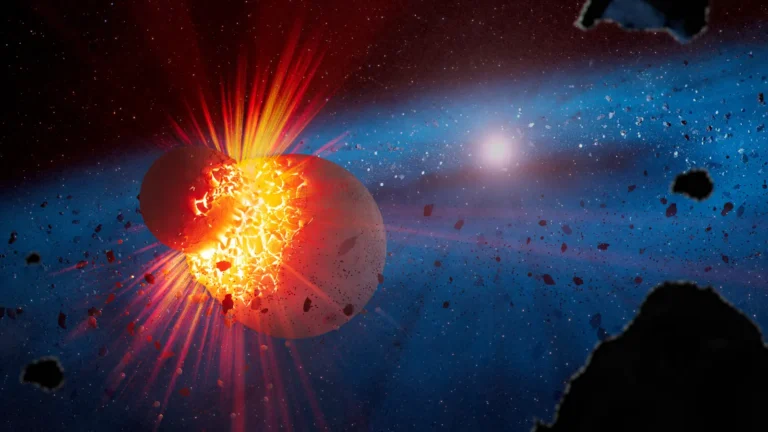
The paper examines several possible explanations. GJ 523b may have started with a thicker atmosphere and lost much of it because it orbits close to a young, active star. Strong radiation and heat can lift gas away over time. Another possibility is a violent collision between two large young planets. Such an impact could remove much of an atmosphere while leaving a dense body behind.
The researchers also consider less familiar formation pathways involving different kinds of solid material gathering in the early planet-forming disk. At present, the data do not choose one explanation. That is a useful result in itself: it tells astronomers which parts of their models need to be tested against a real world.
GJ 523b will become more informative as more measurements arrive. Additional radial-velocity observations could tighten the mass estimate and reveal whether another planet is tugging on the star. Better knowledge of the star’s age and rotation would improve the orbital picture. Future observations aimed at the planet’s atmosphere could also show whether it has a thin envelope, a steam-rich layer or almost no gas at all.
For now, GJ 523b is best understood as a young, dense outlier rather than a second Earth. Its value is that the basic numbers are unusually clear: a 23.5-Earth-mass planet, only 2.55 Earth radii wide, circling its star every 17.75 days. Finding more worlds with the same combination will show whether GJ 523b is a rare accident or the first well-measured member of a larger family.