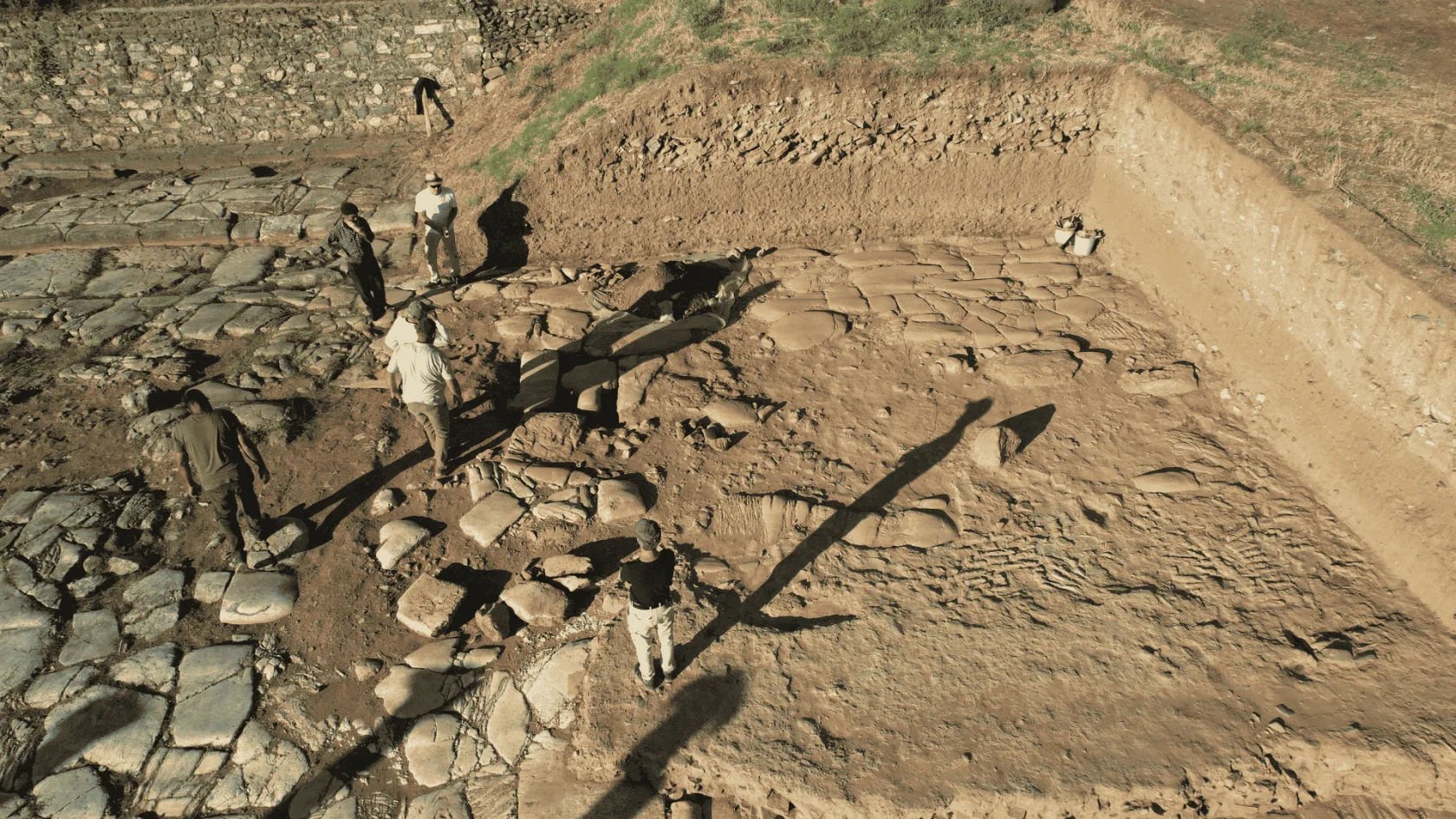
At Sardis in western Türkiye, archaeologists have recovered a statue that spent part of its life as building material. The figure was made nearly 2,500 years ago, broken in two and placed face-down in a Roman colonnaded avenue. Its reuse preserved a large part of the sculpture while also hiding the original setting its makers intended.
The statue is more than seven feet tall and combines features associated with the archaic Greek and Lydian worlds with the modelling of the early Classical period. Archaeologists do not yet know whom it represented or where it stood first. The excavation, sponsored by Türkiye’s Ministry of Culture and Tourism and the Harvard Art Museums, is now working through the sculpture’s style, paint traces and findspot.
A statue out of time
Sardis was the capital of Lydia before it became part of the Persian, Hellenistic and Roman worlds. Every political change left new buildings over older ones. A statue that once carried religious or civic meaning could later be treated as convenient stone, especially when a street or colonnade was being rebuilt.
The Roman avenue where the figure was found ran through a busy urban space. Builders laid the broken statue horizontally, face-down, beneath the paving. That decision sounds destructive, but it also protected the carved surface from weather and foot traffic. The stone survived in a condition that allows conservators to study details that would have disappeared if it had remained exposed.
Reused sculpture is a common feature of ancient cities, but each example carries a different history. The position of the fragments, the mortar around them and the date of the paving show when the older object was taken out of circulation. They can also reveal what later residents considered valuable, obsolete or simply useful.
Style offers clues, not a name
The statue’s broad features point toward a period when Lydian and Greek artistic traditions overlapped. The body was made in a style that looks older than the Roman street above it, while the treatment of the form suggests knowledge of early Classical sculpture. That mixture narrows the date but does not identify the figure with certainty.
One possibility is that the statue was connected with a sanctuary dedicated to Cybele, a major Anatolian goddess. The excavation has not recovered enough architectural evidence to make that identification secure. Archaeologists are treating it as a working idea while they compare the statue with fragments, inscriptions and buildings elsewhere in Sardis.
Traces of colour may provide another line of evidence. Many Greek and Anatolian statues were painted, even though modern museums often show them as bare stone. Conservators are examining the surface for surviving pigments and tool marks. Those details can indicate how the figure was presented and whether it belonged to a public, domestic or sacred space.
What the pavement preserved
The discovery also tells a story about Roman construction. The avenue was not an isolated monument; it was a working piece of the city, repaired and adapted as people moved through it. The choice to use a large statue as paving records a moment when Sardis was reorganising an older landscape.
Curiosmos has covered how archaeologists infer purpose from monumental architecture and how physical remains can rebuild the history of a complex site. At Sardis, the clue is a sculpture’s second life. The broken figure is evidence both for the art of an earlier period and for the practical choices of Roman builders centuries later.
The work is not finished
Conservation is still underway, and the statue’s reconstruction may change as the fragments are cleaned and joined. Its original location could remain unknown if later construction removed the surrounding buildings. Even so, the find gives archaeologists a rare chance to study a large early statue in a precisely dated context of reuse.
The discovery at Sardis is therefore about more than an intact-looking sculpture. It shows how cities absorb their own past. A work made for a lost setting survived because a later generation broke it apart and used it to build a road.
The statue’s original audience may have encountered it in a very different setting from the one in which archaeologists found it. A figure placed in a sanctuary would have been part of ritual movement, offerings and a carefully framed view. A figure displayed in a civic space would have carried a message about a family, a ruler or the identity of the city. Without its first location, the researchers have to recover that context from style, paint and the surrounding remains.
That uncertainty is part of the value of the find. The broken statue does not come with a label, but its physical history can still be reconstructed step by step. Each fragment, layer of paving and trace of colour narrows the range of stories that fit the evidence.