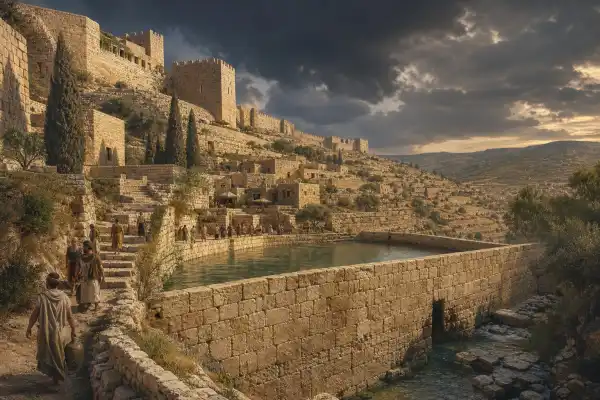
Jerusalem’s ancient water system was not only about finding a spring. It was about controlling what happened when the water came too quickly and when the rain failed to arrive at all.
A new study has dated a large dam near the Siloam Pool to roughly 805–795 BCE, during the period when the kingdom of Judah was ruled by Joash or Amaziah. The structure was built to manage water from the Gihon Spring and runoff from intense storms. Its builders were responding to two problems at once: shortages during dry periods and dangerous floods when rain finally came.
The result is a rare piece of infrastructure from the First Temple period, preserved well enough to show how a city adapted its landscape instead of simply waiting for the weather to cooperate.
A wall built beside the pool
The dam is about 12 metres high and more than 8 metres wide. The exposed section runs for at least 21 metres, while the rest continues beyond the area that has been excavated. It stood near the Siloam Pool, at the southern end of the City of David, where water from the Gihon Spring and storm runoff could collect.
At first glance, a wall of this size might seem like an obvious feature to date. It is not. Jerusalem has been rebuilt repeatedly, and large stones can be moved, reused or incorporated into later construction. The crucial evidence came from short-lived plant material trapped in the mortar and from a high-precision radiocarbon programme that allowed the researchers to narrow the building window to about a decade.
That precision is unusual for an ancient structure. Instead of assigning the dam to a broad century, the researchers could place it around the turn of the eighth century BCE, when Judah was a regional kingdom with a growing capital and complex water needs.
Why the climate matters
The dam’s design makes more sense when the climate is treated as part of the story. Jerusalem’s water supply was never simply wet or dry. A long spell of low rainfall could threaten the city’s reservoirs, while a short, violent storm could send water rushing through the valleys.
The study’s climate reconstruction points to a period of reduced rainfall combined with episodes of intense precipitation. Those conditions reward infrastructure that can store or redirect water. A wall by the pool could slow sudden flows, protect the settlement below and help retain water for later use.
This is not evidence that one specific drought caused the construction. Ancient builders rarely leave us that kind of explanation. It is evidence that Judah’s engineers were working in a climate where both extremes mattered, and that the system around the Gihon Spring was designed with those extremes in mind.
The kings behind the date
The dam’s date falls within the reigns of Joash and Amaziah, two kings of Judah whose rule is recorded in the Hebrew Bible. Archaeology cannot assign the building to one king simply because the dates overlap. The most defensible conclusion is that the structure belongs to the political and engineering world of eighth-century BCE Jerusalem.
That distinction matters. A royal project could be ordered by a king, a city administration or a local authority operating with royal support. The stonework tells us about organisation and labour, but it does not preserve the name of the official who approved the plan.
What it does show is that water management was a public concern. A dam of this scale required quarrying, transport, skilled masonry and a decision about how water should move through the city. It was part of the city’s infrastructure, not an isolated household improvement.
A reminder that ancient cities were engineered landscapes
Popular images of ancient Jerusalem often focus on temples, walls and royal buildings. The dam adds a less glamorous but more revealing category: the structures that kept a city functioning on ordinary days.
Water systems are also unusually good at connecting archaeology with daily life. A palace inscription can tell us what a ruler wanted remembered. A dam tells us about a practical problem faced by thousands of people. It raises questions about who cleaned the channels, who had access to stored water and how the city responded when the system was overwhelmed.
The discovery also helps explain why the Siloam Pool remained important across different periods. It was not simply a convenient basin. It was part of a carefully managed landscape shaped by springs, channels, retaining walls and flood routes.
What the dam does not prove
The study does not show that Jerusalem was facing a single catastrophic flood, nor does it prove that the dam was built for one event. It does not turn every feature near the pool into a royal monument. The evidence supports a more durable conclusion: by around 800 BCE, Judah’s capital had invested in serious water control, and that investment was compatible with a climate of irregular rainfall and powerful storms.
The exposed section is only part of the structure. Further excavation may reveal its full length, the relationship between the dam and the pool, and whether it was altered later. Sediments trapped behind or beside the wall could also preserve information about how often major floods occurred.
For now, the dam changes the way we picture ancient Jerusalem. The city was not merely built beside a spring. It was built around a changing water system, and its inhabitants modified that system with the same care they gave to walls and public buildings.
Sources
- City of David, “The Dam”
- Joint research by the Israel Antiquities Authority and the Weizmann Institute, published in PNAS.