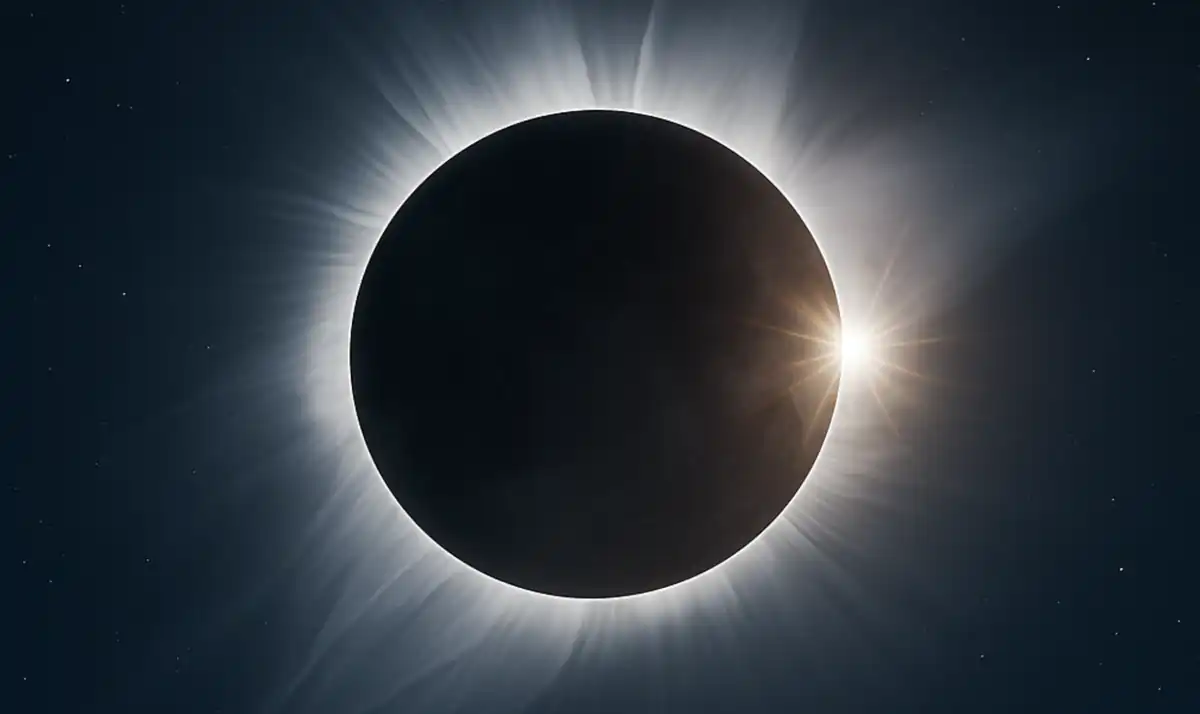
On Wednesday, August 12, the Moon’s shadow will sweep across a narrow stretch of the Northern Hemisphere. Greenland, Iceland, northern Russia, the Atlantic, Spain and a small corner of Portugal lie in the path of totality. Much of Europe, northwestern Africa, Canada and parts of the United States will see a partial eclipse.
It is an unusual route. In Iceland and Greenland, the Sun will be low in the afternoon sky; in Spain, totality arrives late in the evening, close to sunset. A great many people will be watching a partial eclipse, while a much smaller number will stand inside the Moon’s dark central shadow for less than two and a half minutes.
Where the eclipse will be total
Totality is a very precise thing. It is visible only along the narrow path where the Moon completely covers the bright face of the Sun. On August 12, that path runs from northern Russia across Greenland and Iceland, then across the North Atlantic to Spain. NASA’s official eclipse map and city tables are the sensible place to check a specific viewing location before making travel plans.
NASA lists totality in Reykjavík from 5:48 p.m. to 5:49 p.m. local time. In León, Spain, it is expected from 8:28 p.m. to 8:30 p.m. local time. Those short windows are why people who travel for eclipses arrive early: a hill, a harbor or a field can have a clear horizon while another nearby location does not.
Outside the path, the event can still be striking. NASA’s current projections put the maximum partial eclipse at 99% in Barcelona and Madrid, 94% in Dublin, 92% in Milan and 85% in Berlin. Those numbers describe how much of the Sun’s disk is covered; they do not turn a partial eclipse into totality. Even a thin remaining crescent is intensely bright.
Why 99% coverage is still not totality
People often talk about a 99% eclipse as though the final percentage were a minor detail. It is the opposite. The visible surface of the Sun is so bright that the last uncovered sliver still keeps the sky far brighter than it becomes during a total eclipse. The corona, the outer solar atmosphere that gives totality its ghostly appearance, is normally lost in that glare.
That difference shapes the atmosphere on the ground. Along the central track, colours flatten, temperatures can dip and bright planets or stars may appear. A few kilometres away, a partial observer may see a deeply bitten Sun through a filter without experiencing that abrupt shift. Both are worth seeing; they are simply different events.
Weather will decide how much of the sky is visible at any chosen place. A clear forecast is useful, but it is not a guarantee, especially near coasts and mountains. Travellers should keep a mobile plan within the same part of the path and avoid choosing a viewing site that offers no safe way to move if clouds settle in.
The safety rule is simple
During the partial stages, safe solar viewers are essential. Ordinary sunglasses are not enough. The same rule applies everywhere outside the path of totality, because the Sun is never completely covered there.
There is one brief exception: when the Sun is fully covered during totality, viewers in the path may look directly at the eclipse without solar filters. The moment sunlight reappears, the protection goes back on. Anyone using a camera, binoculars or a telescope needs a purpose-made solar filter fitted to the front of the optical instrument; eclipse glasses worn over the eyes do not protect a camera lens or binoculars.
NASA also recommends indirect methods such as a pinhole projector for the partial phases. It sounds almost old-fashioned, but a small hole in a card can project the crescent Sun onto a surface without requiring anyone to look at the Sun itself.
Why NASA is following the shadow
The dark interval has value far beyond the spectacle. When the Moon blocks the Sun’s bright surface, the faint outer atmosphere—the corona—becomes far easier to observe from the ground and from the air. For this eclipse, a NASA-funded team plans to follow the moving shadow in a WB-57 high-altitude research aircraft, extending the time available to study the corona.
That effort is joined by the Nationwide Eclipse Ballooning Project. Students from several U.S. universities are due to launch scientific balloons in Iceland and Spain before, during and after the eclipse, studying how the sudden loss of sunlight changes the atmosphere. The projects are a useful reminder that the shadow crossing the landscape is also a moving change in temperature, winds and ionization overhead.
NASA will stream coverage beginning at 1:15 p.m. Eastern on August 12, with views from along the path and interviews with scientists. The agency’s coverage announcement is worth bookmarking for broadcast details and the science plans.
What to plan for if you are watching
Start with the map rather than a headline. A location can be geographically close to totality and still be outside it. Check the local contact times, the height of the Sun, the horizon and the weather forecast for the morning of the eclipse. For Spain in particular, the late timing makes a western horizon and sunset conditions part of the experience.
Bring certified solar viewers for every stage before and after totality. Test the fit in advance, and keep a spare pair. If photographing, practise the sequence well before eclipse day. A total eclipse moves too quickly to learn camera settings during the minute when the corona is visible.
For everyone far from the path, the partial eclipse is still a real observing event. The changing crescent can be projected through a pinhole, seen through certified filters, or followed through NASA’s live coverage. What matters is treating the partial phase with the same care as the total one.
A narrow shadow with a wide audience
The most memorable eclipse photographs often show the dramatic black disk and its silver corona. On August 12, the human story will be broader: observers in Greenland and Iceland under the late-day Sun, crowds in Spain watching a total eclipse approach sunset, and millions more seeing the Moon take a bite from the Sun across Europe, Africa and North America.
That is also why this eclipse is worth following even from home. It will be a live laboratory for solar physics and atmospheric research, occurring over places where the changing light will be as much a part of the event as the dark itself.
Sources
NASA: Total Solar Eclipse on August 12, 2026
NASA: coverage and planned eclipse experiments