The desert can preserve a city in a way that a crowded capital cannot. In Egypt’s Dakhla Oasis, archaeologists have uncovered streets, homes, ovens, tools and written records from a Byzantine settlement that remained hidden beneath the sand for centuries.
The city dates to the fourth century, when Egypt was part of the eastern Roman world and Christianity was spreading through the province. Its buildings do not describe a single dramatic event. Together, they show how people cooked, traded, worshipped and managed ordinary life in an oasis far from the Nile Valley.
A city rather than an isolated ruin
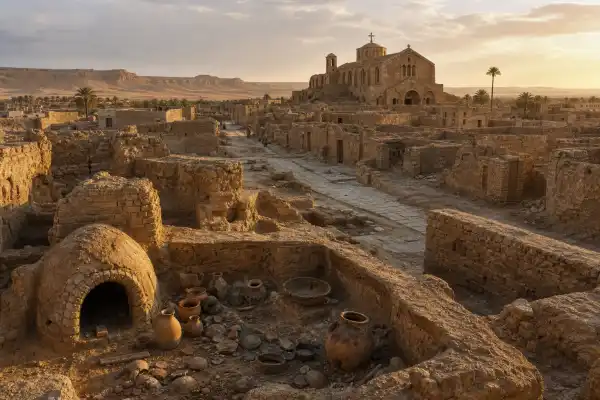
The excavation has revealed a planned residential area with streets and open spaces. A basilica, dated to the middle of the fourth century, anchors the settlement’s religious life. Two watchtowers point to a concern with visibility and control, while domestic buildings preserve the smaller details of daily work.
Archaeologists found bread ovens, kitchens and grinding equipment. These objects are easy to overlook beside monumental architecture, but they are among the best evidence for how a community functioned. Grain had to be processed, bread baked and meals prepared even when the city’s public buildings were in use.
One of the homes was associated with a deacon named Tisous. That connection gives the settlement a human scale. A title recorded in a house or inscription can show how religious institutions and households overlapped, without turning one individual into a symbol for the entire city.
The papers in the rubbish
Among the most valuable finds are around 200 ostraca. These are pieces of pottery or other broken material used for short written notes. They are not polished literary texts. They can record commercial exchanges, correspondence, accounts and practical instructions—the paperwork of people who needed to keep track of goods and obligations.
Such fragments are often more revealing than an official inscription. A public text tells us what an authority wanted displayed. An ostracon can preserve a name, a delivery, a debt or a brief message that was never meant to last. Read together, the fragments may show how the oasis was connected to larger administrative and commercial networks.
Coins made of bronze and gold add another layer. Their dates and circulation patterns can help establish when the settlement was active and how it participated in the monetary economy of Roman and Byzantine Egypt. The presence of valuable metal does not mean every resident was wealthy; it means the city handled transactions that reached beyond the household.
Life at the edge of the cultivated world
Dakhla Oasis has always been an argument with the landscape. Water and fertile soil made settlement possible, but the oasis was separated from the main river corridor by long stretches of desert. Roads, wells and stored food mattered as much as walls.
The new finds suggest a community that was neither cut off nor simply dependent on distant officials. The streets and public buildings required planning. The kitchens and grinding tools show local work. The written records may reveal how residents negotiated taxes, trade and religious obligations.
The basilica also belongs to a period of major change in the Roman world. Christianity was moving from a persecuted faith to an institution with buildings, offices and local leaders. A church in Dakhla does not mean that older practices disappeared overnight. It shows that Christian organisation had reached an oasis community with its own history and social structure.
The city may have been protected by its isolation
The settlement’s preservation is partly a consequence of where it was built. Sand can bury walls, seal rooms and protect fragile objects from rain and later construction. At the same time, desert preservation is uneven. Wind can erode exposed structures, and modern development or poorly controlled tourism can damage sites quickly once they are known.
That makes documentation essential. Each room, road surface and writing fragment needs a recorded location. The relationship between homes and public buildings can disappear if excavation removes objects without preserving their context.
The Dakhla city is therefore valuable beyond the individual finds. It offers a chance to study a Byzantine community as a connected neighbourhood rather than as a collection of attractive artefacts.
What the excavation can still tell us
Researchers will need to refine the chronology of the streets, basilica and watchtowers. Were all parts of the city occupied at once? Did the settlement expand during a period of prosperity and contract when water or trade routes changed? Do the ostraca point to a military presence, a church administration or a mixed economy?
Those questions will take time. The first reports already establish a strong story: a fourth-century city in Dakhla preserved enough of its domestic and written record to let archaeologists move beyond the image of the oasis as a remote outpost.
The most useful way to see the discovery is not as a buried mystery waiting for a single answer. It is a neighbourhood returning to the map, room by room. Its ovens, coins, watchtowers and scraps of writing show how people built a life in one of Egypt’s most demanding landscapes.