A terrace project in Rebild uncovered about 18.5 kilograms of Viking-Age silver. The objects show how wealth moved, was measured and was hidden in tenth-century Denmark.
A new terrace was supposed to change a garden. Instead, a few minutes of digging opened a small window onto the Viking Age.
In Rebild, northern Denmark, a homeowner found silver objects in the soil while preparing a private garden for paving. The discovery eventually revealed about 18.5 kilograms of silver—roughly 700 objects and fragments—making it the largest known Viking-Age silver hoard found in Denmark. The find was announced by Nordjyske Museer, the museum organisation responsible for the area.
What makes the discovery so interesting is not only the weight of the metal. The hoard preserves a record of how Viking-Age wealth actually worked. It was not simply a pile of coins waiting to be counted. It included bars, jewellery, cut silver, coins and a small hammer-shaped amulet—objects that could be worn, exchanged, divided or stored by weight.
What was hidden in the clay vessel?
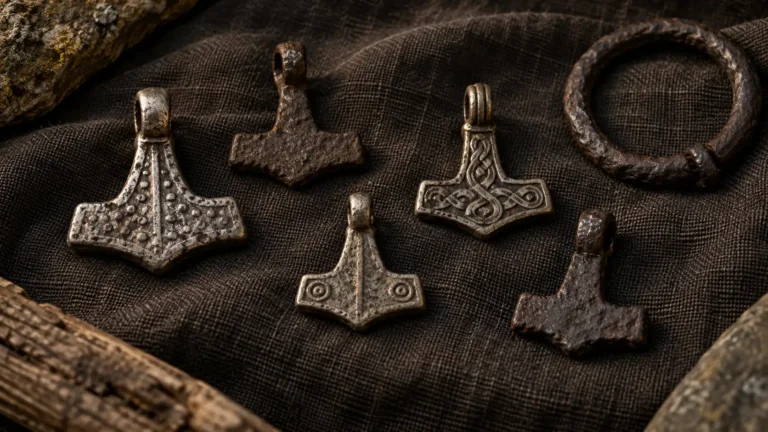
About 320 objects, weighing a combined 6.4 kilograms, remained inside an original clay vessel. Other pieces were scattered in the surrounding soil. The museum’s inventory includes silver bars, bracelets, fragments of jewellery, 47 whole coins and coin fragments, and a small object shaped like Thor’s hammer.
One silver bar carries an uncertain runic inscription that may read “hutu.” That could be a personal name, an owner’s mark or something else entirely. It is a tantalising clue, but it is not yet a solved message. The difference matters: the object is evidence of marking and ownership, while its exact meaning remains open.
The find also contains two Anglo-Saxon pennies minted during the reign of Edward the Elder, who ruled from 899 to 924. Those coins provide an important dating point. The hoard cannot have been buried before the coins entered circulation, placing its burial no earlier than the tenth century. The museum has not claimed that every piece was made at the same time, and the objects themselves still need detailed study.
Why was silver measured by weight?
Modern money encourages us to think of a coin as a fixed unit. Viking-Age silver was more flexible. Bars, jewellery and chopped pieces could function as wealth because their value depended heavily on the amount and quality of metal they contained.
The Rebild objects appear to cluster around recurring weight groups. That pattern suggests organisation rather than random accumulation. Someone may have arranged the silver for exchange, accounting or long-term storage. A bracelet could be worn, but it could also be cut. A bar could be kept intact, or divided when a payment required a smaller amount.
This is where the hoard moves beyond the familiar image of buried treasure. It may preserve part of a working economic system: silver sorted into useful amounts and kept ready for a future transaction. The original owner is unknown, and the museum has not yet established whether the cache belonged to a merchant, a local leader, a workshop or a household protecting its wealth.
A backyard find with connections far beyond Denmark
The coins point in several directions. Alongside the Anglo-Saxon pennies are Islamic dirhams and other pieces connected with long-distance exchange. The National Museum of Denmark explains that large quantities of silver reached Scandinavia through routes connected to the Russian territories and the Muslim world, while western European coins also moved into Denmark.
The Rebild hoard fits that wider picture without proving a single travel story. An Islamic coin does not show that the person who buried the hoard visited Central Asia. It does show that metal, coins and ideas could move through networks that connected northern Europe with regions to the east and west.
That distinction is part of what makes the find valuable. Archaeologists can follow the objects’ materials, inscriptions, minting and wear. They still have to be careful when moving from those clues to the identity or life of the person who hid them.
Why was the hoard buried?
The most obvious question may be the one archaeology cannot answer quickly: why hide it at all?
The hoard may have been concealed near a settlement, beside an old route or in a location chosen precisely because it was difficult to find. It may have belonged to someone who died, moved away or never returned. Because the modern garden sits in a built-up area, a large archaeological excavation of the surrounding landscape is not possible. That limits what researchers can say about the original context.
The absence of a final answer does not make the discovery less important. It gives researchers a clear boundary between what the objects show and what remains a question. The silver reveals storage, measurement and connections. It does not yet reveal the name of the owner or the reason for the burial.
What happens next?
The hoard is being submitted for assessment as danefæ, Denmark’s legal category for important finds that become state property. Conservation and examination will determine how many pieces can be identified, where the coins were minted and whether the runic mark can be read with greater confidence.
Nordjyske Museer hopes the material can eventually be displayed at the Viking Museum Fyrkat, alongside other finds from the region. Fyrkat itself was one of the ring fortresses associated with King Harald Bluetooth and the period when Denmark was becoming more tightly organised as a kingdom.
The Rebild hoard does not provide a complete picture of that transformation. It offers something more precise: a physical record of silver being treated as wealth, divided into practical amounts and connected to a world much larger than one Danish garden.
And that may be the most curious part of the discovery. A modern terrace exposed a buried cache, but the silver had already travelled across borders long before it entered the ground. The objects are quiet. Their route through the Viking world is not.