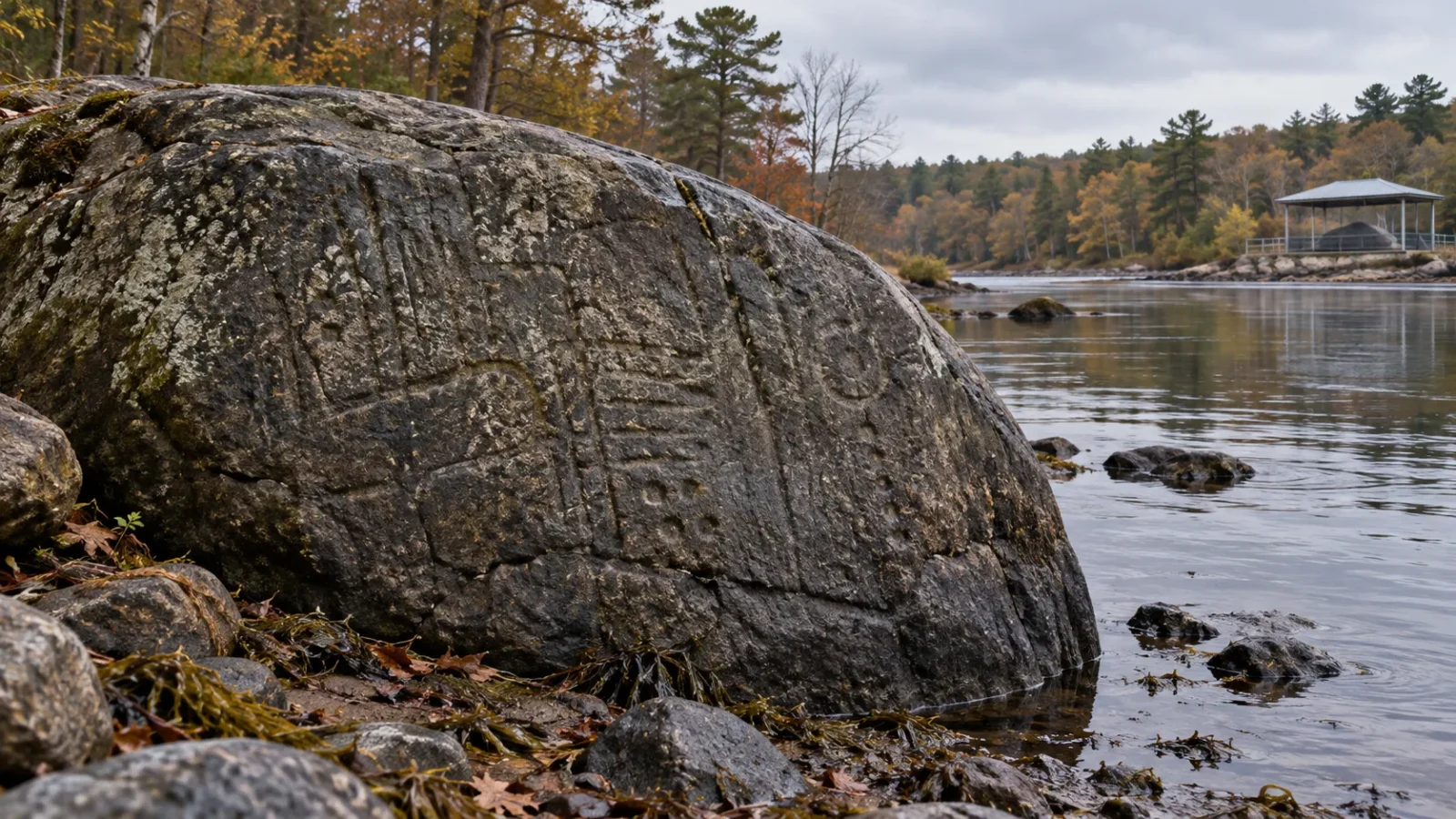
Beside the Taunton River, a forty-ton boulder carries a jumble of cut lines and shapes. Stand in front of it and the marks can look like a face, a letter or a map. That shifting resemblance is probably why people have been arguing over Dighton Rock for centuries. Were the carvings made by Indigenous people who knew this river, or did a visitor from across the Atlantic leave a message in the stone?
The theories have ranged from Phoenicians to Vikings and Portuguese explorers. The rock itself gives us a firmer place to start: it is a glacial boulder marked with petroglyphs in a landscape long used by Wampanoag people. The carvings have never yielded a readable Phoenician inscription. The more revealing story is how often observers tried to give an Indigenous place a European author.
A boulder carried by ice
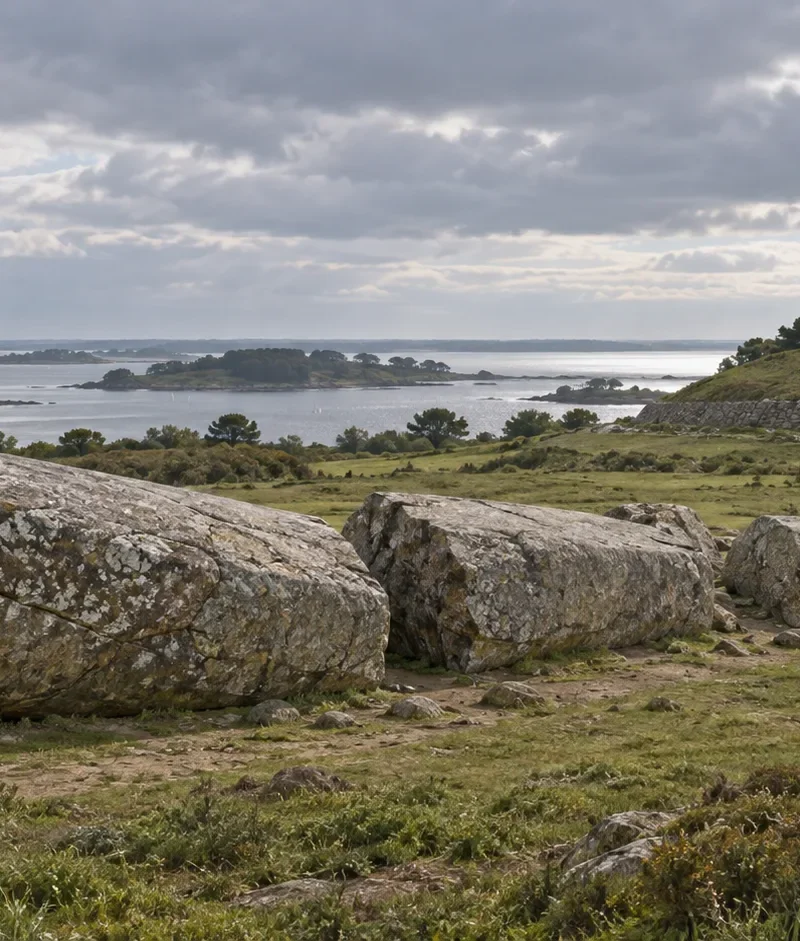
Dighton Rock is a glacial erratic, a block of stone carried and left behind by retreating ice sheets. It once stood in the Taunton River and now rests beneath a protective shelter at the state park. Massachusetts’ management plan notes that the river and surrounding landscape helped draw Wampanoag people to the area. The setting belongs in any account of the carvings; this is not a loose stone dropped into an empty wilderness.
Keep exploring
Continue with Curiosmos
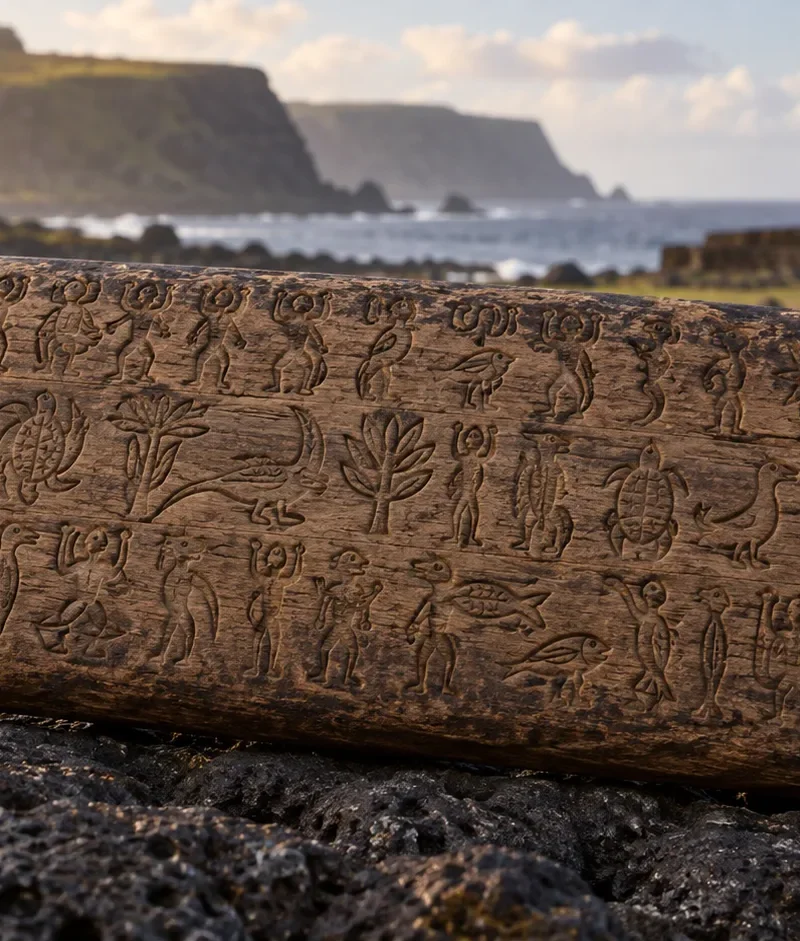
Archaeologists call the marks petroglyphs: designs cut or pecked into rock. The word describes how they were made, not what they say or when each line was added. Water, lichen, changing river levels and centuries of copying have all complicated the view of the surface. Some marks are clear; others are faint enough that a crack or stain can become part of a drawing.
When the stone became a European puzzle
Written European accounts of the rock date to the late seventeenth century. Once drawings of it began circulating, observers tried to match its marks to scripts and voyages they already knew. One person saw Indigenous figures; another thought a line resembled a letter. Later proposals named Phoenicians and the Portuguese explorer Miguel Corte-Real.
Those readings never settled into a translation that other researchers could test across the whole surface. A shape that resembles a familiar letter is a starting point, not a reading. To make a convincing case, the same signs would need to behave consistently, fit a credible date and match examples from the proposed writing system. Dighton Rock has not supplied that chain of evidence.
Douglas Hunter’s The Place of Stone follows the way these claims grew. The search for a European signature took attention away from a simpler possibility: Native people made the carvings, and their meanings were not written down for colonial visitors.
Reading the carvings in their own landscape
Petroglyphs are not necessarily sentences. Across North America, carved images can be tied to place, ceremony, animals, travel, memory or stories. Descendant communities may know things that a stone alone cannot tell an archaeologist. The National Park Service cautions against treating rock art as decoration with one obvious meaning.
The river matters here. A carved boulder could mark a place, carry a memory or take part in a tradition without spelling out a message in an alphabet. The Massachusetts park plan now includes Native American perspectives in its interpretation. That changes the question visitors bring to the shelter: instead of asking which European reached the river first, we can ask what the carvings meant to the people who knew the place.
Why the date is hard to pin down
Rock art rarely comes with a neat timestamp. Researchers can study tool marks, weathering and deposits that formed over a carving, but Dighton Rock has spent centuries exposed to water and ice. Early drawings help preserve views of lines that have faded since, though every drawing is also a person’s reading of the stone. A copied crack can look like a deliberate stroke; a faint mark can disappear from the page.
The evidence supports a long Indigenous history for the river landscape and records carvings that were already attracting attention centuries ago. It does not identify a Phoenician captain or date a transatlantic voyage. A more exact answer may depend on comparing the surface carefully with old drawings, archaeological context and knowledge held by Native communities.
Dighton Rock still invites a close look. Someone chose this boulder and left marks beside a river that mattered to generations of people. We may never recover every meaning, but the question is richer when it begins with the people who lived here: what did they see in this stone, and what stories did the river carry with it?
Sources and further reading
• Massachusetts Dighton Rock State Park resource plan
• Mass.gov park and museum record
• National Park Service guide to interpreting rock markings