Most asteroids that enter Earth’s atmosphere are discovered after the important part is already over. A small object can appear in survey images only hours before impact, leaving astronomers with a narrow window to determine whether it will burn up, break apart or leave meteorites on the ground.
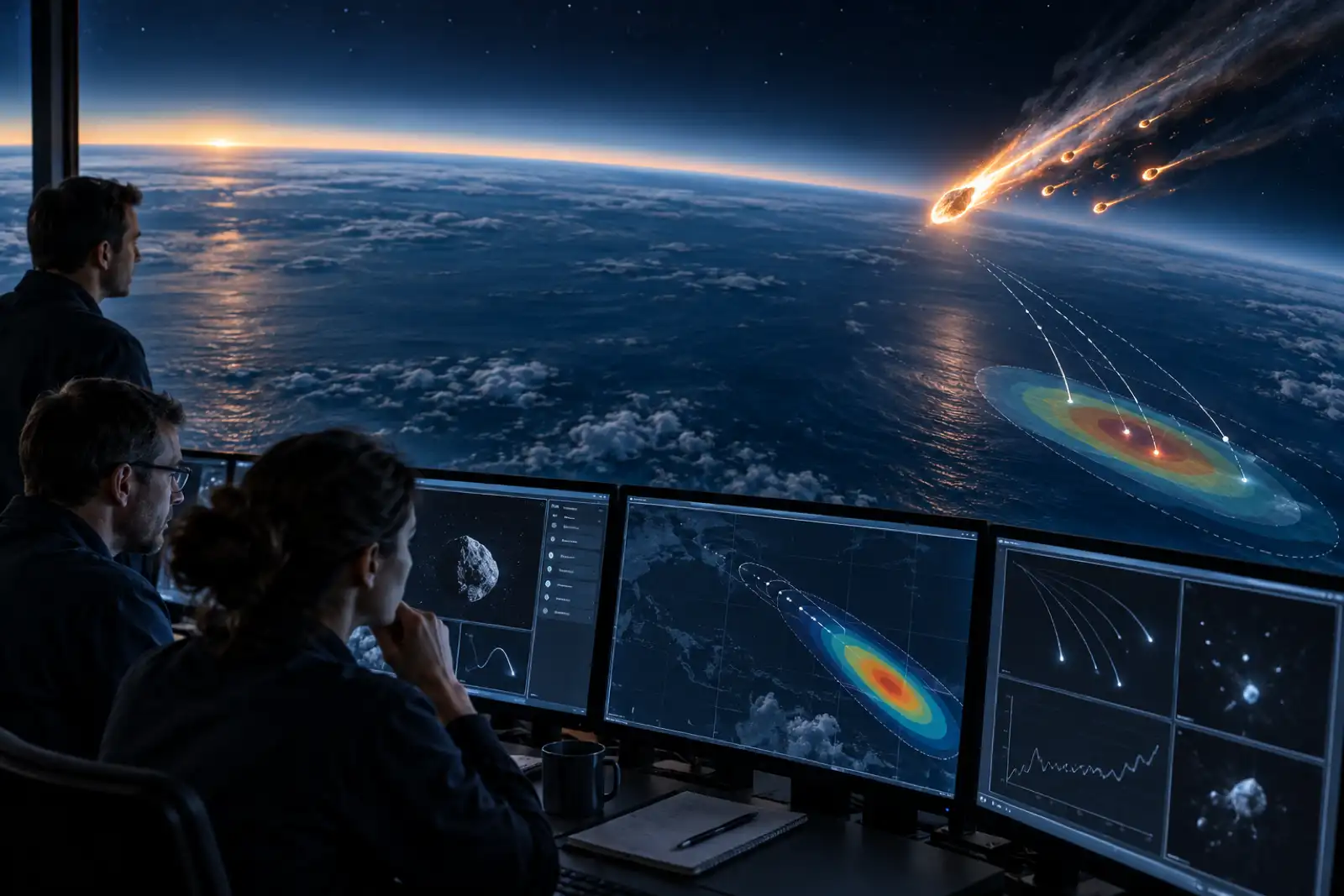
The European Space Agency has now added a new step to that rapid response. A model developed at ESA’s Near-Earth Object Coordination Centre can forecast a possible meteorite strewn field before an imminent impactor reaches the atmosphere. The result is a probability map: not a single guaranteed landing point, but a measured estimate of where fragments are most likely to fall.
The asteroid that arrived with five hours’ warning
ESA’s latest announcement points to 2026 RW1, a small asteroid detected by the Catalina Sky Survey on 6 September 2026. The object was spotted about five hours before impact and entered the atmosphere above the Indian Ocean. ESA’s Meerkat system listed an estimated diameter between 0.6 and 1.3 metres, based on its brightness and an assumed range of surface reflectivity.
That size is far below the scale associated with a global catastrophe. It is still scientifically useful, however, because such objects test the part of planetary defence that begins after an asteroid has already been found and before anyone knows where its material may end up.
From an orbit to a probability map
The new model begins with an asteroid’s entry state at an altitude of 100 kilometres, calculated from orbital observations. It then follows the object through the atmosphere, accounting for aerodynamic drag, ablation and a chain of possible breakups. A fragment can split again, slow at a different rate and enter a period of “dark flight” after it stops glowing.
The calculation uses a Monte Carlo approach. Instead of pretending that the asteroid’s size, strength, entry angle and winds are known perfectly, the system runs many physically plausible versions of the event. Each simulated fragment is tracked independently, with atmospheric conditions supplied by the Global Forecast System. The output is a set of probability boundaries showing where material could land.
This is why a forecast map should not be read as a precise bull’s-eye. The red or highest-probability region can be surrounded by wider zones that contain less likely outcomes. More observations can narrow the map, and the calculation can be repeated as the orbit becomes better defined.
Why fireball cameras are not always enough
Traditional meteorite searches often reconstruct a fall from images of the fireball. Networks of all-sky cameras can measure the luminous path and, with enough viewing angles, help researchers work out where fragments travelled after the breakup. Those observations are invaluable, but they are not available for every event. An ocean impact, a daylight entry or a fall over an area without cameras can leave large gaps.
ESA’s tool is designed for that gap. The agency says it can compute a strewn field without direct observations of the fireball and over regions not covered by all-sky camera networks. The workflow connects Meerkat’s rapid detections to the Aegis orbit and impact-corridor system, then sends a constrained prediction to NEO Coordination Centre teams within the short warning period.
Does the method work?
The researchers tested the framework against earlier imminent impactors, including asteroid 2023 CX1, which produced meteorites over northern France, and 2008 TC3. The open-access paper describing the method reports that nominal solutions reproduced observed fall locations within roughly 100–200 metres for the validated cases. That agreement is encouraging, but it is not a promise that every future prediction will be equally narrow.
Fragmentation is the largest source of uncertainty. The model must estimate how a particular object breaks, how much mass each piece retains and how the atmosphere pushes those pieces sideways. Wind forecasts also change with altitude and time. A useful prediction therefore needs both a central estimate and an honest description of the uncertainty around it.
What the map is for
The immediate benefit is practical. If an incoming object is large enough to create a meaningful ground hazard, a predicted impact corridor can support civil-protection decisions. If fragments are likely to survive, a pre-impact map can also guide meteorite searches before rain, soil chemistry and human activity alter the fresh material.
There is a deeper scientific payoff. A meteorite recovered soon after a fall can preserve the composition of a small Solar System body with less terrestrial contamination. When astronomers know its pre-impact orbit, they can connect that material to a specific dynamical history rather than treating it as an anonymous rock. Other Curiosmos reporting has examined how meteorite grains preserve magnetic clues about the infant Solar System.
The new system does not make small asteroids easy to find, and it cannot turn an uncertain orbit into certainty. What it changes is the final part of the response. Once a survey telescope catches a faint object on its last approach, researchers now have a way to ask a more useful question than “Where did it disappear?” They can ask where its fragments are most likely to be waiting.
Sources and further reading
- ESA NEO Coordination Centre, “Predicting the strewn field of imminent impactors” (10 September 2026): https://neo.ssa.esa.int/-/predicting-the-strewn-field-of-imminent-impactors
- ESA NEO Coordination Centre, “Imminent Impactors” (updated 6 September 2026): https://neo.ssa.esa.int/en/imminent-impactors
- A. Moscati and colleagues, “From orbit to ground: Pre-impact meteorite strewn field predictions for imminent impactors and meteorite recovery,” Icarus (2026): https://doi.org/10.1016/j.icarus.2026.117303