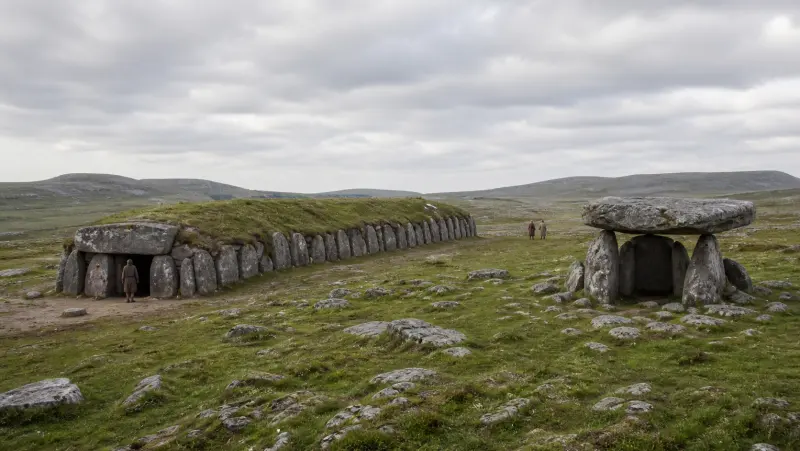
Two different kinds of Neolithic tomb have been identified beside one another near Maree in County Galway. One is a court tomb, a long stone-built monument with an open space inside. The other is a portal tomb, marked by a pair of upright stones and a large capstone. Their close relationship gives archaeologists an unusual opportunity to study how communities built and reused monuments nearly 6,000 years ago.
The court tomb was known from earlier research but had effectively disappeared from the modern record. The second monument had not been formally recorded before the recent work. The University of Galway describes the location as the only known Irish example where a court tomb and a portal tomb stand together.
A capstone weighing fourteen tonnes
The portal tomb’s capstone is almost four metres long, roughly a metre thick and estimated to weigh about 14 tonnes. Moving a stone of that size would have required planning, cooperation and a large labour force. The finished monument would have remained visible for generations, even after the people who built it had died.
The court tomb is about 30 metres long. Its design allowed people to approach an inner chamber through a forecourt, creating a sequence between the open landscape and the place where human remains were kept. Portal tombs have a different visual emphasis: their upright stones and capstone frame a chamber in a more compact form.
Objects left with the dead
Excavations and surveys have identified stone tools, pottery, cremated bone and an amethyst pendant. The pendant is especially interesting because the university says comparable amethyst pieces are not known from other Irish megalithic sites. That does not prove the wearer came from overseas, but it does raise questions about exchange networks and the movement of unusual materials.
Small finds have to be interpreted alongside the architecture. A tool may have been used in daily work before it was placed in a tomb. Pottery may have held food or drink during a ceremony. Cremated bone can represent one person or several individuals gathered over time. The meaning lies in the combination, not in any single object.
Monuments built by settled communities
The people who built these tombs were farmers, but farming did not make their lives simple or sedentary in the modern sense. They cleared woodland, moved animals, worked stone and maintained relationships across the landscape. A monument could serve as a burial place, a meeting point and a statement that a community belonged to a particular stretch of land.
The two tombs may not have been built at exactly the same time, and the current announcement does not establish how often either monument was reopened. That chronology will matter. If the structures were used by related communities over several generations, they may record continuity. If one replaced the other, the change could point to a shift in ritual practice or social organisation.
Why the discovery matters
Irish megalithic tombs are often discussed as isolated monuments. Finding two distinct forms together changes the scale of the question. Instead of asking what one tomb meant, archaeologists can compare how different designs organised movement, memory and access in the same landscape.
The Maree site also shows why careful field recording remains important. A monument can survive in a field for thousands of years and still vanish from the written record. Rediscovering it does not restore every lost detail, but it gives future research a fixed place to begin.
The wider landscape will be just as important as the stones. Researchers can look for traces of settlement, paths, quarrying and the places where people prepared food or tools. These details may explain why the monuments were placed together and how visitors approached them. A tomb was never only an object in a field; it was part of a route through a lived-in landscape.
The amethyst pendant raises a similar question about movement. It may have travelled through several exchanges before reaching Galway, or it may have been carried by a person who moved between communities. Until its geological source and archaeological context are fully analysed, the safest conclusion is that the pendant records a connection whose route is still unknown.