How do archaeologists date pottery? Usually, they do not look at a single shard and read a year from it. A ceramic fragment becomes useful when its shape, clay, decoration, manufacturing technique and archaeological position are compared with other dated evidence. Pottery is one of archaeology’s most common clues, but its date is built from context.
A vessel can outlive the person who made it. It can be traded, repaired, reused or carried into a later layer of soil. That is why a pot’s style is never the whole answer. Archaeologists ask where it was found, what was around it, and whether its manufacturing marks match a sequence already known from other sites.
Style creates a relative timeline
Pottery styles change. A rim may become thicker, a handle may move, a painted pattern may disappear, or a firing technique may spread from one workshop to another. When vessels with those features are found in layers that can be dated independently, researchers can build a relative sequence: one style is earlier, another later, and a third appears during an overlapping period.
This is called typology. It does not mean every pot of a certain shape was made on the same day. Styles can persist in conservative communities, appear in more than one region, or be copied after the original fashion has changed. Typology is strongest when it uses many examples and is tied to well-recorded excavation layers.
Clay and manufacture reveal movement
Pottery is also a geological object. Clay contains minerals and inclusions that can point toward its source. Petrographic analysis examines thin sections under a microscope, while chemical methods can compare the composition of a sherd with local clay deposits. The result may show that a vessel was made locally or travelled a long distance through trade.
Manufacturing marks provide another clue. Wheel-made and hand-built vessels leave different traces. The firing atmosphere can affect the colour and hardness of the clay. A pot made in a controlled kiln may belong to a different technological phase from one fired in an open bonfire. These details help archaeologists separate objects that look similar at first glance.
Stratigraphy keeps the object in place
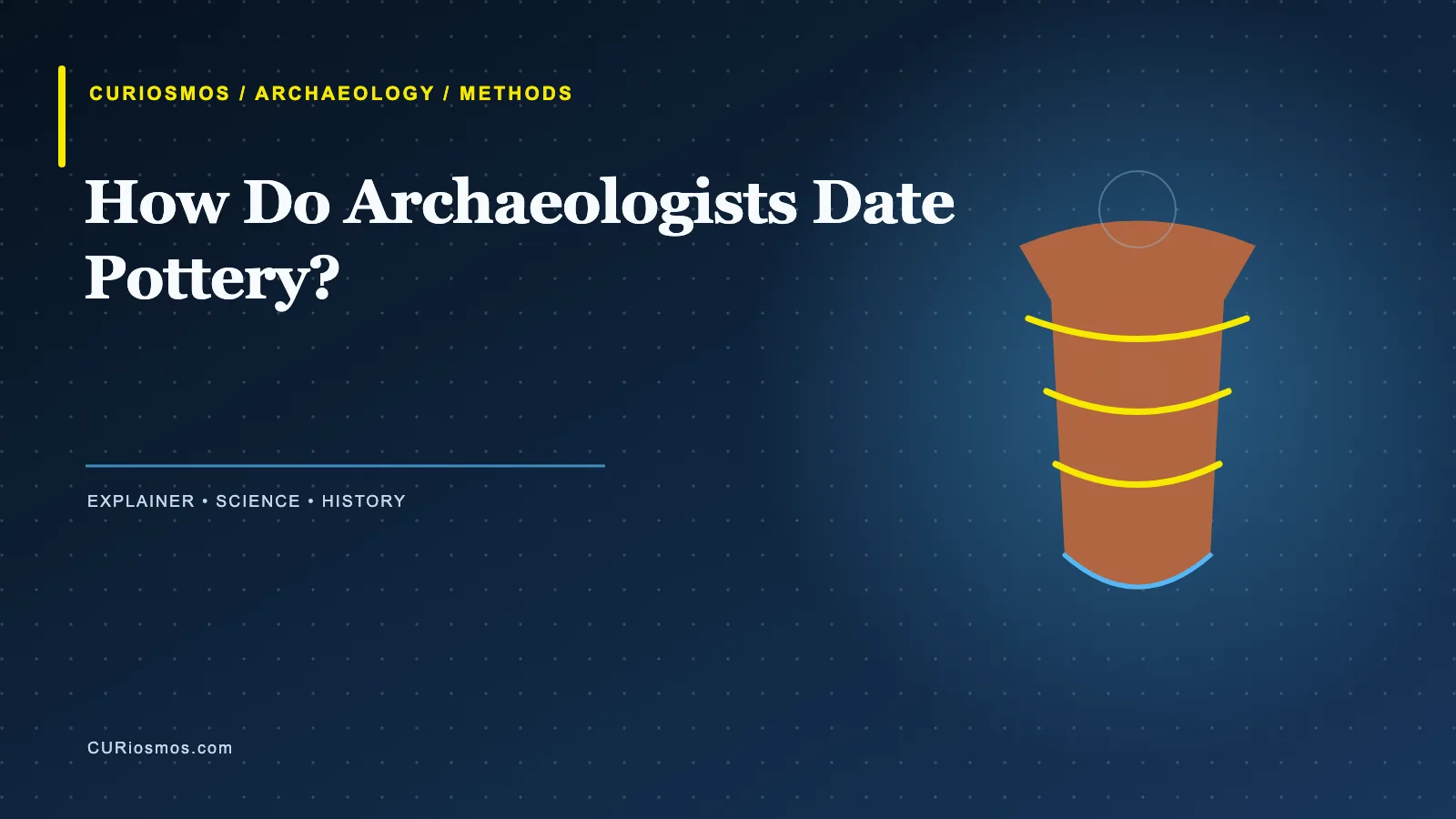
The layer around a sherd is often more important than its decoration. In a sealed deposit, material below is generally older than material above. The principle is simple, but real sites are messy. Burrowing animals, later digging, construction and erosion can mix layers. Excavators record the soil, features and relationships carefully so that pottery can be read as part of a sequence rather than as loose treasure.
Other objects in the same layer can provide a date. A coin, a piece of wood suitable for radiocarbon dating, or a building phase with a known historical event can help anchor the ceramic sequence. The more independent clues agree, the stronger the chronology becomes.
Can pottery be dated directly?
Some scientific methods can date the last time a ceramic object was heated. Thermoluminescence measures energy released from minerals that were reset during firing. It is useful in the right conditions, but it has uncertainties and must be applied to a carefully documented sample. It does not automatically identify when the clay was dug, when the vessel was shaped or how long it was used. Historic England explains how the method is applied to fired ceramics.
Radiocarbon dating usually measures organic material associated with a pot, not the fired clay. In some cases, researchers can get closer to a vessel’s period of use by extracting palmitic and stearic fatty acids absorbed into its walls. A 2020 Nature study purified palmitic and stearic fatty acids from pottery residues and radiocarbon-dated them, then checked the results against tree-ring dates and wider site chronologies. The method requires suitable residues to survive; a dark crust alone does not guarantee a usable sample. Read the direct-dating study.
There is another complication: residues from freshwater or marine foods can contain older “reservoir” carbon, making a date seem older than the vessel’s use. A multi-site study of prehistoric European pottery discusses this problem and, for selected chronologies, uses terrestrial bone and charcoal found with the vessels to avoid the effect. A date is useful only when archaeologists know what material was measured and how it relates to the pot. The study explains the dating limitation.
Pottery styles can also track contact between communities. A vessel shape may spread along a trade route, while the clay fabric shows that local potters copied an imported design. Comparing decoration, manufacturing technique and chemical composition helps researchers distinguish an object that travelled from one that was made nearby. In that way, pottery dating can illuminate both chronology and exchange.
Residue analysis can also answer a different question from dating: what kinds of materials a vessel was used to process. Lipid traces can identify broad food groups, but not every meal or each moment in a pot’s life. Read alongside the vessel’s form and excavation context, they add evidence about how a community used its pottery.
A pottery sherd is therefore less like a labelled timestamp than a sentence in a much larger archive. Its curve, fabric and firing carry information, but the ground around it supplies the grammar. Together they can reveal when a community cooked, traded, stored food and changed its habits.
That context becomes especially rich in places where settlements were rebuilt repeatedly. Our report on ancient cities built on top of earlier cities shows why a sherd’s exact layer can matter as much as its decoration.
Sources and further reading: National Park Service: Dating archaeological sites and artifacts; Historic England: Archaeological and Historic Pottery Production Sites; Casanova et al., direct radiocarbon dating of pottery; The Nature Human Behaviour study on pottery transmission and dating.