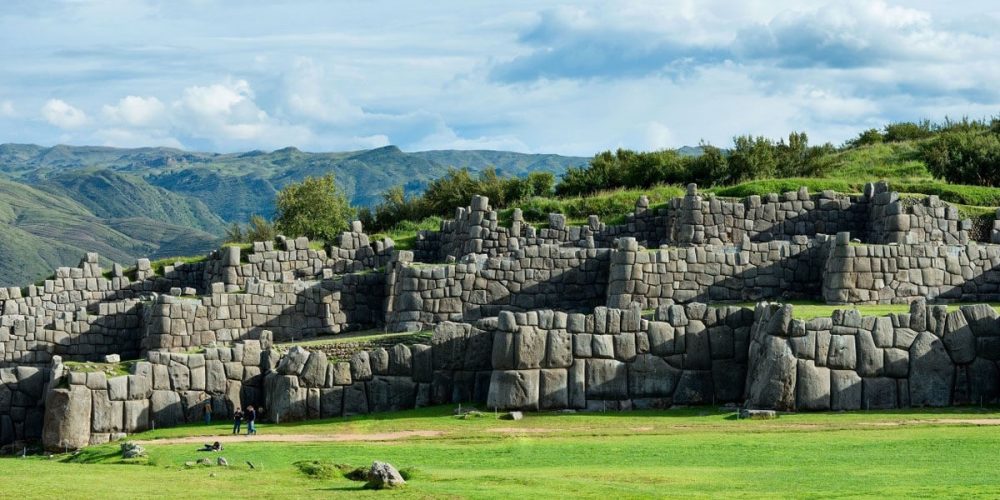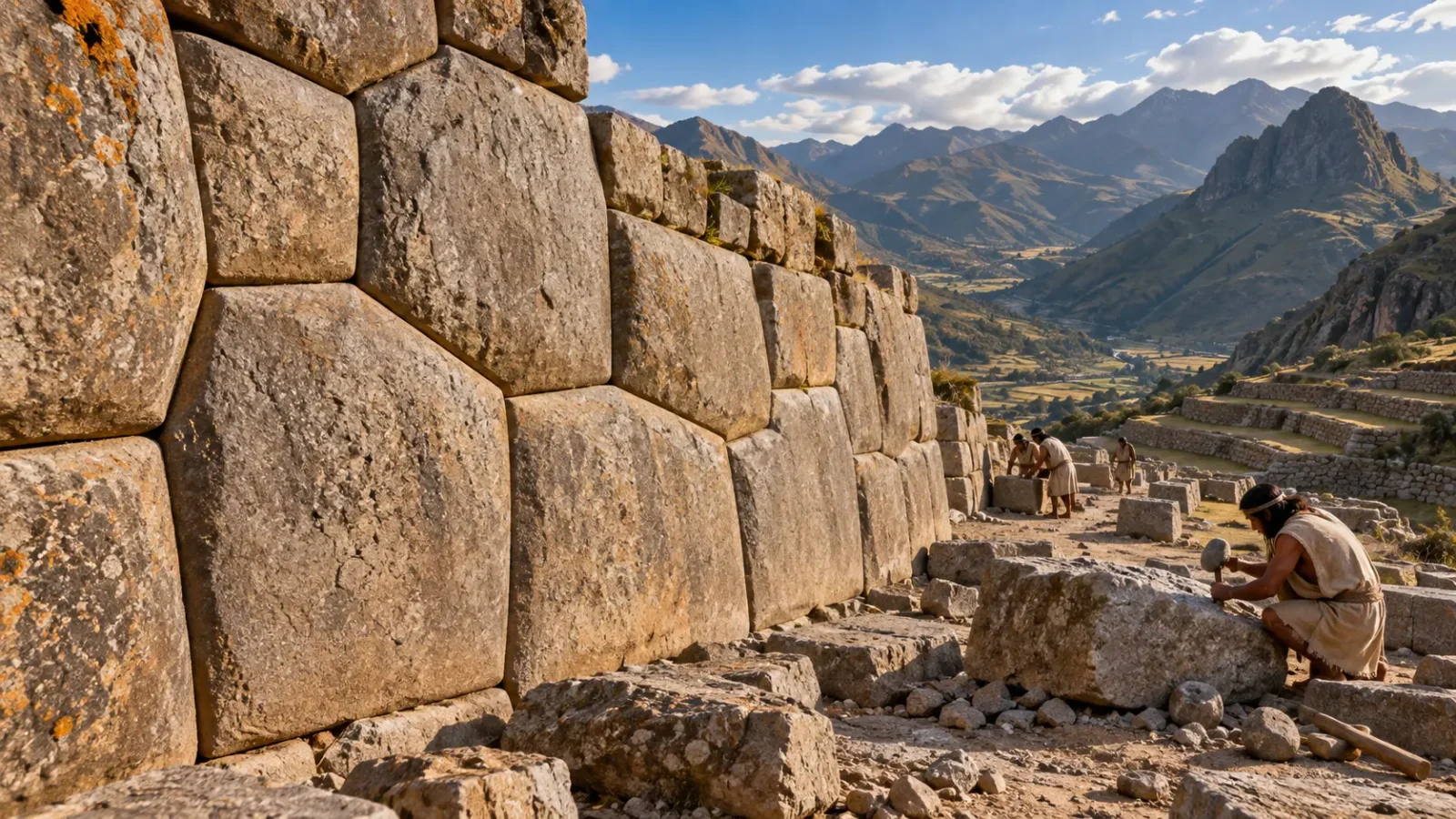
In Cusco, some Inca walls look as if their stones have settled into one another. Polygonal blocks meet at irregular joints, with no visible mortar. Nearby, more regular stones form a different kind of wall. Inca builders used several styles, choosing and shaping stone for the building and the place.
The craft is visible in the work left unfinished: quarry blocks, tool marks and surfaces worn smooth where stones meet. There was no single trick that produced every wall. Masons worked local rock, adjusted individual blocks and relied on organized crews to move the material across steep ground.
Different walls, different jobs
Some Inca buildings use rectangular blocks laid in even courses. Others, especially in the Cusco region, use large polygonal stones fitted against irregular neighbours. Important buildings could have carefully dressed faces, while the inner parts of a wall used smaller stones and fill.
Keep exploring
Continue with Curiosmos
Local geology mattered. Builders worked with andesite, granite, limestone and other stone available around a site. The rock determined how a block could be split, shaped and carried. A wall that looks uniform from the street may include stones with quite different histories behind its face.
Fitting the stones
To make a tight joint, a mason could set a block against its neighbours, find the spots that stood proud, chip them away and test the fit again. The faces that touched needed the most attention. Surfaces hidden inside the wall could remain rough.
Unfinished stones preserve stages of that process. A block might be roughly shaped near its quarry and worked further after it reached the building site. The final fit came from repeated adjustment, not from carving every face to the same finish in advance.
Building where the ground moves
Earthquakes are common in the Andes, and many Inca walls have features that suit a seismic region. Walls often lean slightly inward; doors and windows can narrow toward the top. Fitted blocks may shift a little during shaking without a crack running straight through a line of mortar.
That does not mean the buildings were earthquake-proof. Inca structures have been damaged and destroyed. Their survival depends on the wall’s shape, stone, foundations, later repairs and the force of each quake. The best evidence points to builders who understood their materials and landscape, not to one perfect formula.
Getting stone to the site
Large blocks had to travel over uneven ground. Inca rulers organized labour through systems such as mit’a, and work crews could be supplied through storehouses and roads. Ropes, levers and ramps are plausible tools for moving stone; the method would have depended on the block, route and slope. Archaeologists do not have one complete construction manual for every site.
At Cusco and Ollantaytambo, the walls belong to a broader landscape of quarries, terraces, roads and settlements. Moving the stone was only part of the project. Once it arrived, masons still had to place it, adjust its edges and make it sit securely in the wall.
Researchers combine quarry evidence, tool marks, wall patterns and later historical accounts to study the process. Experimental reconstructions can show that a proposed method is possible, but they cannot establish that every Inca crew used it. Each wall preserves its own sequence of choices.
That is what makes the masonry worth looking at closely. A fitted joint records where a mason removed stone and where a neighbour block had to meet it. Across an earthquake-prone landscape, the walls are a record of skilled work, repeated many times.
Curiosmos has also examined how archaeologists decide whether a site was a settlement or a ritual complex in this guide to reading ancient sites.