Radiocarbon dating is one of archaeology’s most useful tools, but it is often described as if a laboratory can place an exact year on any ancient object. The method is narrower and more interesting than that. It measures the remaining carbon-14 in material that was once alive, then uses calibration and archaeological context to estimate when that material stopped exchanging carbon with the environment.
Where carbon-14 comes from
Cosmic rays help produce radioactive carbon-14 in the upper atmosphere. Plants take in carbon dioxide, including a small amount of carbon-14, and animals receive it by eating plants or other animals. While an organism is alive, its carbon is continually replaced.
When a plant or animal dies, that exchange stops. The carbon-14 already inside the remains begins to decay. Scientists measure how much remains compared with stable forms of carbon and calculate a radiocarbon age. The result is normally expressed as years before present, with “present” fixed at 1950 in the conventional system.
What can be dated?
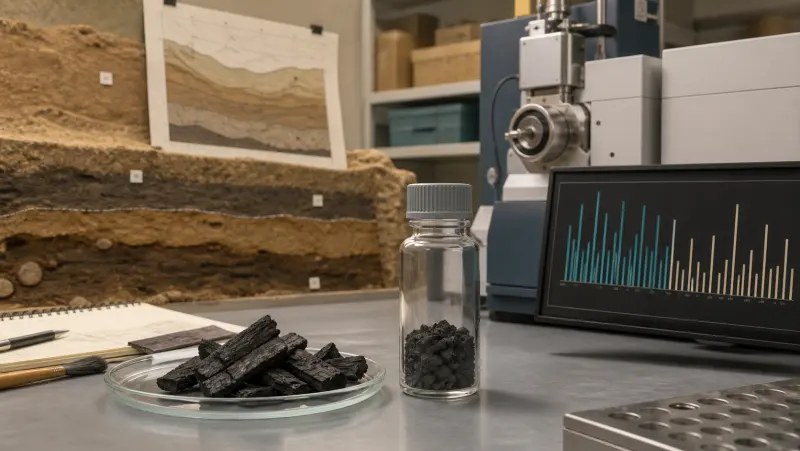
The sample must contain carbon from once-living material. Charcoal, seeds, wood, bone, shell and fibres can sometimes be dated. A stone tool cannot be dated directly with radiocarbon because the stone was never part of the biological carbon cycle. Researchers may instead date charcoal from the same layer, provided they can show that the charcoal belongs to the event they are trying to date.
That connection is crucial. A date measures the sample, not automatically the building, burial or artefact beside it. Old wood reused in a later structure can produce an age older than the construction. Contamination can make a sample appear younger or older. Good sampling and laboratory preparation are as important as the counting of isotopes.
Why the first result is not a calendar year
Radiocarbon dates are not straightforward calendar ages because the amount of carbon-14 in the atmosphere has changed over time. Solar activity, changes in the carbon cycle and other environmental effects leave uneven levels in the past. A sample with a particular carbon-14 ratio may therefore match more than one period on a calibration curve.
Researchers compare the laboratory measurement with independently dated material, especially tree rings. Oxford’s Research Laboratory for Archaeology explains that calibration converts the radiocarbon measurement into a calendar range. The answer may include several possible intervals, each with a different probability.
Why dates come with ranges
A laboratory report includes measurement uncertainty. Calibration adds the uncertainty of the curve itself. The final result is therefore usually written as a range, often with a stated confidence level, rather than as one exact year.
A date such as “3,000 radiocarbon years before present” is not the same as “1,050 BC.” It is a measurement on a radiocarbon scale. After calibration, it might correspond to a wider interval in calendar years. Two samples from one site may also produce overlapping ranges rather than identical dates.
How archaeologists use the result
Radiocarbon dating works best when combined with the rest of the evidence. Stratigraphy shows which layer lies above or below another. Pottery styles, coins, written records, tree rings and other dating methods can narrow the interpretation. Several samples from related contexts can be modelled together rather than treated as isolated numbers.
Historic England describes radiocarbon dating as part of a wider group of scientific methods that includes dendrochronology and luminescence dating. The choice depends on the material and the question. A wooden beam with preserved growth rings may be better suited to tree-ring dating, while a charcoal fragment may be a strong radiocarbon sample.
What radiocarbon dating cannot prove
A radiocarbon result cannot, by itself, prove that a civilisation began at a site, that a monument was built in a single phase or that a historical event happened exactly when a later writer said it did. It gives evidence about a sample’s age. The broader claim depends on whether the sample is secure, whether the context is intact and whether other evidence agrees.
That limitation is not a weakness of the method. It is the reason archaeologists report sample details, calibration curves and confidence ranges. A careful date is more useful than a dramatic number because it tells readers what was measured and how far the evidence can be taken.
Radiocarbon dating does not turn the past into a timetable. It gives archaeologists a measured thread, which becomes meaningful when it is tied to the layer, object and human activity from which the sample came.