
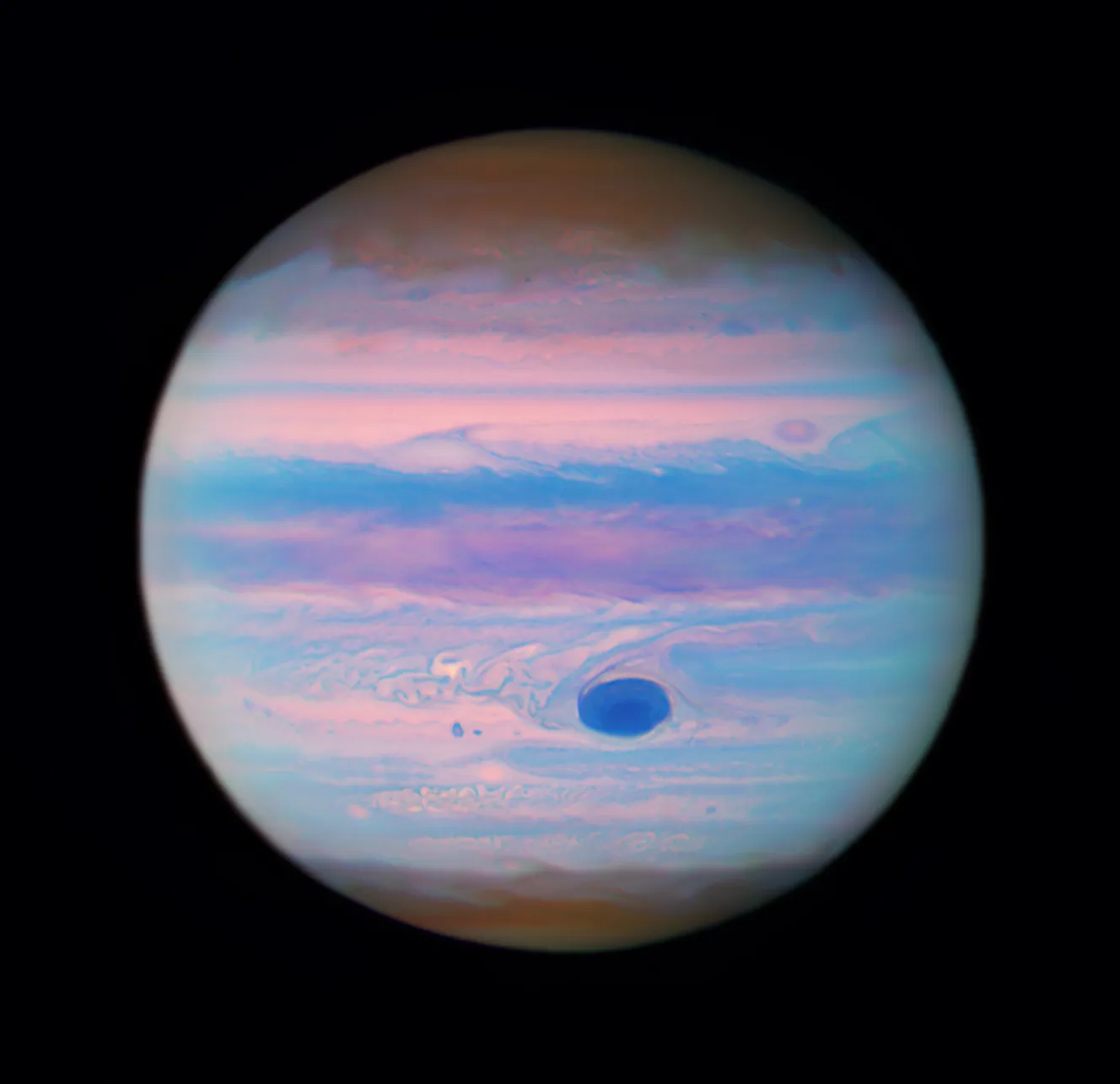
Jupiter is often called Earth’s “shield,” but published simulations suggest its absence could lower some threats while worsening others, depending on which population of objects is counted and on timescale.
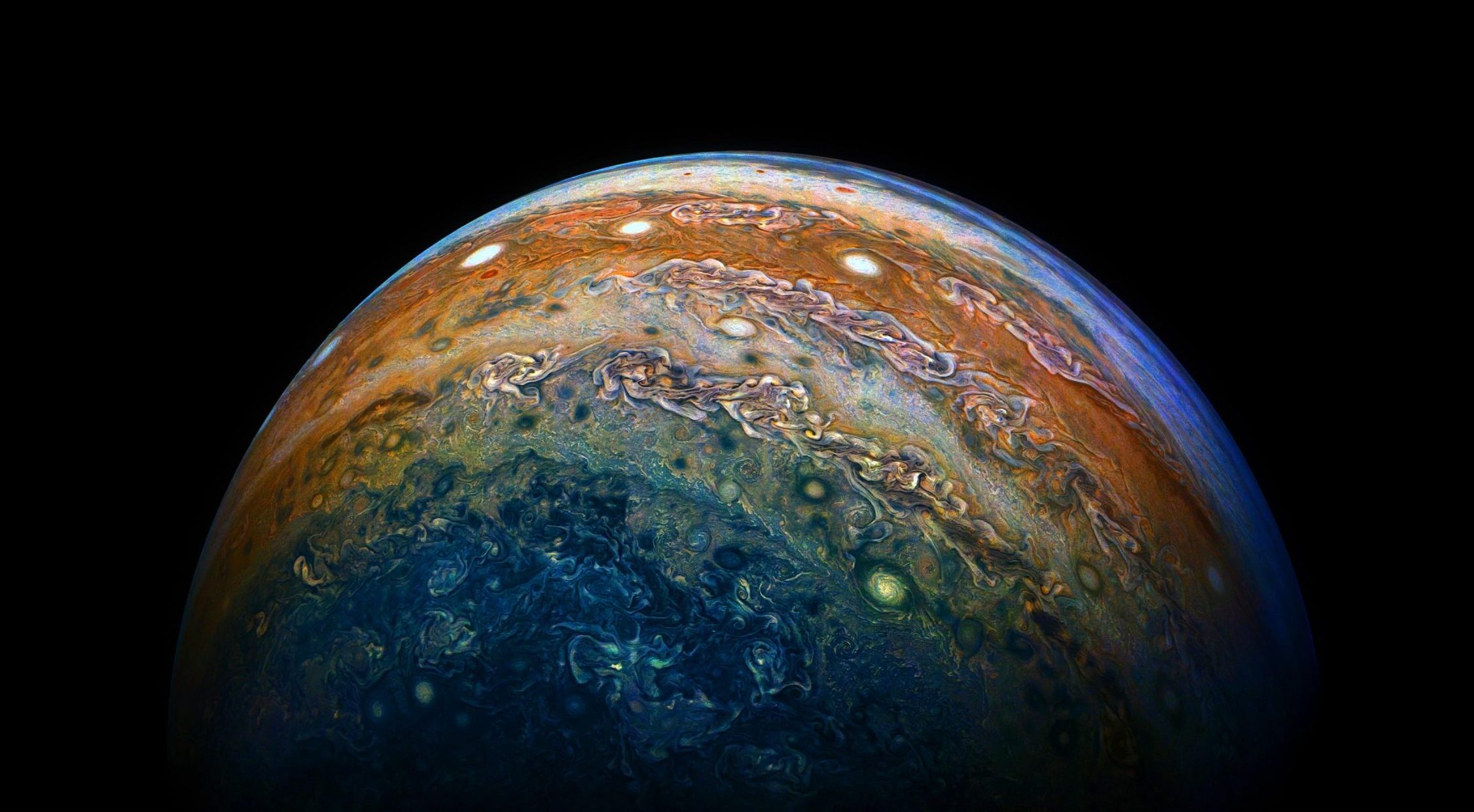
Jupiter dominates the Solar System’s architecture. At about 318 times Earth’s mass and orbiting far beyond Mars, it acts as a gravitational gatekeeper, tugging on asteroids and comets that might otherwise stay put or never reach the inner planets. Remove Jupiter from the picture and Earth’s impact environment would change in complicated ways. It would not reduce cleanly to “more hits” or “fewer hits.”
Researchers who have tried to answer the question in a rigorous way have tended to do it the same way: by running large dynamical simulations that compare impact rates with a Jupiter-like planet present versus absent, or with Jupiter’s mass dialed up and down. Those studies do not all focus on the same source of impactors, which helps explain why the popular “Jupiter as shield” line persists even as more nuanced results accumulate.
A useful place to start is with what “impact risk” means in practice. Most objects that threaten Earth are classified as near-Earth objects, typically asteroids, whose orbits bring them to within 1.3 astronomical units of the Sun. Where those objects come from matters as much as how many exist, because Jupiter influences each supply line differently.
The myth of a single shield
The shield idea is not invented out of thin air. Jupiter is massive enough to fling some incoming objects onto new trajectories, including paths that end with ejection from the Solar System. It is also massive enough to capture and break up comets, as happened with Comet Shoemaker-Levy 9, whose fragments struck Jupiter in July 1994.
That event became a kind of public exhibit in planetary defense. A giant planet can absorb punishment. But it can also redirect it.
Whether Jupiter is a net protector depends on which incoming objects dominate the long-term hazard to Earth, and on whether Jupiter mostly removes those objects or delivers them.
Asteroids: Jupiter can stir the pot
The largest reservoir of rocky debris near the inner Solar System is the main asteroid belt between Mars and Jupiter. Jupiter’s gravity sculpts that belt through resonances, orbital “rhythms” where repeated tugs add up over time. Those resonances help create the Kirkwood gaps, regions in the belt depleted of asteroids because their orbits become unstable.
Instability is a two-edged tool. An unstable asteroid can be removed from the belt, but it can also be injected into Earth-crossing space.
That tension shows up in simulation work. In the first paper of a series examining the “friend or foe” idea, astronomers Jonathan Horner and Barrie W. Jones reported that the story is “far less clear cut” than commonly assumed and that a giant planet can, under some conditions, enhance the impact rate of asteroids on Earth rather than suppress it, depending on Jupiter’s effective role in delivering objects from the belt into near-Earth space (International Journal of Astrobiology).
In plain terms, Jupiter helps maintain pathways that feed near-Earth asteroids. Without Jupiter, some of the most efficient delivery routes could weaken. But the belt’s long-term evolution would also change in ways that are hard to compress into a single outcome, because Jupiter also helps clear material and can destabilize orbits that would otherwise remain in safer configurations.
So if Jupiter disappeared, the asteroid component of Earth’s impact risk could plausibly drop in some regimes and rise in others, depending on how the rest of the Solar System rearranged over long timescales.
Long-period comets: Jupiter looks more like a guardrail
Long-period comets are a different kind of hazard. They originate in the distant Oort cloud, far beyond the planets, and arrive on steep, high-speed paths. Because they come from so far out, Jupiter’s gravitational reach matters.
In their study of Oort cloud comets, Horner and Jones found that adding a Jupiter-like planet significantly alters Earth’s impact rate from that population. In their simulations, the impact rate decreased as the giant planet’s mass increased, and “the greatest bombardment flux” occurred when no giant planet was present (International Journal of Astrobiology).
That result aligns more closely with the popular shield intuition, at least for long-period comets. A giant planet can act as a gravitational bouncer, ejecting some comets before they make repeated passes through the inner Solar System.
It is also a reminder that “impact risk” is not one number. For one source population, Jupiter can be broadly protective.
Short-period comets
Short-period comets, including so-called Jupiter-family comets, occupy a middle ground. Their orbits are shaped by repeated encounters with Jupiter and by transfers from the outer Solar System, including objects that wander inward and become planet-crossers.
A key point here is that Jupiter is not merely intercepting these comets. It is part of the machinery that captures them into shorter orbits in the first place.
That complicates the “what if Jupiter vanished” story. Without Jupiter, fewer comets might be steered into the specific families we track today. But Jupiter also helps eject many of these objects once their orbits become unstable, limiting the duration of their threat. In other words, Jupiter can both supply and remove. This broader framing, rather than a single slogan, is reflected in summaries of the research question in the planetary science community, including explanations that emphasize Jupiter’s mixed role across different object populations.
Timescale matters more than most retellings admit
The phrase “if Jupiter disappeared” hides a major technical issue. Jupiter’s influence is baked into the present-day distribution of debris. The asteroid belt’s structure, the populations of resonant objects, and the current inventory of short-period comets are products of billions of years of gravitational nudging and clearing.
If Jupiter vanished overnight, Earth would not instantly see a neatly predictable change in impacts. The system would respond in stages, with near-term effects driven by objects already on unstable paths, and long-term effects driven by how the asteroid belt and comet reservoirs slowly reorganized without Jupiter’s constant forcing.
Even the seemingly straightforward evidence, like Shoemaker-Levy 9, cuts two ways. It demonstrates that Jupiter can absorb impacts, but it also shows that Jupiter captures and holds objects in its vicinity, altering where and when they collide. In a Jupiter-less Solar System, that particular kind of capture-and-impact event would not happen at Jupiter. The question becomes what replaces it, and how often.
What the best-supported answer looks like
The strongest fact-grounded answer is not a yes or no. It is a split verdict.
-
For Oort cloud comets, published simulations indicate Jupiter reduces the number of Earth impacts, and removing Jupiter would raise that specific flux (International Journal of Astrobiology).
-
For asteroids, simulations show Jupiter’s presence can increase impacts in some regimes because it helps drive objects out of the asteroid belt and into Earth-crossing space, making the net effect less intuitive than the shield metaphor suggests (International Journal of Astrobiology).
So would Earth face more asteroid hits if Jupiter disappeared. The careful answer is that it depends on which impactors are counted, and that the best available published work argues against a simple “Jupiter protects us” claim for asteroids, even while supporting a protective role for at least some comet populations.
Jupiter remains what it has always been, in celestial terms: a brute-force architect. It shapes the traffic, and sometimes it is the traffic cop. Other times it is the on-ramp.