Meteorites and samples returned from asteroids contain organic molecules used by life. That raises a fascinating question: did space supply some of the ingredients from which life began on Earth? It does not establish that living organisms arrived here from another world.
In its January 2025 report on asteroid Bennu, NASA described amino acids and nucleobases in returned samples, while explicitly distinguishing those ingredients from evidence of life itself. Keeping that distinction in mind helps separate the findings below from the much broader panspermia hypothesis.
Life from space?
For as long as we’ve been asking where we come from, we’ve told ourselves the same story. That life began here, on our own little planet, circling the Sun. We’ve imagined lightning striking a pool of chemicals, triggering something strange and new. Cells formed, and over time, they became everything.
It’s a simple idea. Clean. Maybe even comforting. And maybe it’s true.
But not everyone is sure anymore. In research labs and observatories across the world, some scientists are starting to think the story might go back farther. And begin somewhere else entirely.
What if life, or the raw materials it’s built from, didn’t start here? What if it arrived from space, carried on a rock or frozen inside a comet?
If that’s the case, then we’re more than just creatures of Earth. We’re shaped by collisions, by wandering debris, by ancient dust that floated between stars long before Earth was ever born.
Maybe we’ve been searching the sky for signs of other life without realizing the most alien thing on this planet might be us.
The forgotten idea that never quite died
The notion isn’t new. It has surfaced and faded for over a century, from the musings of 19th-century Swedish chemist Svante Arrhenius to late-night science fiction. In those early versions, it was a fringe curiosity: spores riding solar winds, microbes hitching rides on comets. Nobody took it seriously.
The universe is older than Earth by billions of years, and the ingredients used by life have a history beyond our planet. Meteorites and returned asteroid samples give researchers something tangible to work with: material they can examine in a laboratory and compare with the chemistry of living things. How much of Earth’s early chemical inventory arrived this way?
This leads me to talk about panspermia. Not a theory about little green men from Mars, but a hypothesis that life, or its chemical seeds, can travel between worlds. Not by design. Not deliberately. Just as a function of physics, collisions, and time. Randomly. Across vast distances. Across an entire galaxy perhaps.
Cosmic Chemistry: Tracing Life’s Ingredients Across the Solar System
In the vast expanse of space, celestial bodies carry the secrets of our origins. Among them, meteorites and comets serve as time capsules, preserving the primordial ingredients that may have sown the seeds of life on Earth.
The Murchison Meteorite: A Treasure Trove of Organic Compounds
On September 28, 1969, the Murchison meteorite fell near Murchison, Victoria, Australia.
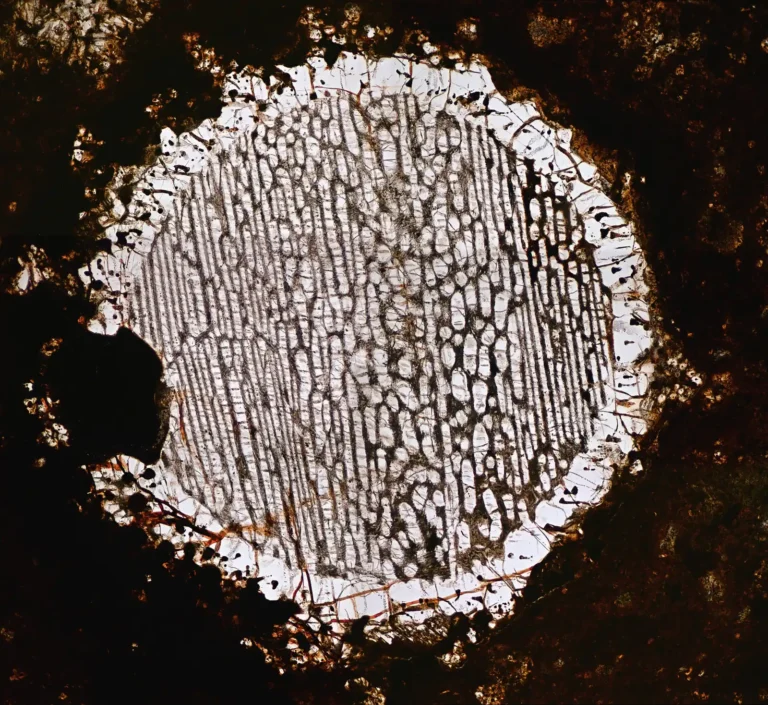
Classified as a carbonaceous chondrite, this meteorite has captivated scientists due to its rich organic content. Analyses have revealed over 70 amino acids within its matrix, including both common types like glycine and alanine, and rare ones such as isovaline and other non-proteinogenic amino acids — some of which are uncommon or entirely absent in Earth’s biosphere.
Notably, these amino acids exhibit a mix of left- and right-handed configurations, suggesting an abiotic origin.
Beyond amino acids, the Murchison meteorite contains a plethora of organic molecules: aliphatic and aromatic hydrocarbons, carboxylic acids, alcohols, and even nucleobases like uracil and xanthine. The presence of these compounds indicates that the meteorite harbors a complex suite of life’s precursors, formed in extraterrestrial environments.
Stardust Mission: Capturing Cometary Particles
NASA’s Stardust spacecraft, launched in 1999, embarked on a mission to collect samples from comet Wild 2. In 2004, it successfully captured particles from the comet’s coma using an aerogel collector and returned them to Earth in 2006. Among the findings was glycine, the simplest amino acid, marking the first time such a compound was identified in cometary material. Isotopic analysis confirmed its extraterrestrial origin, bolstering the idea that comets can harbor life’s building blocks.
Rosetta Mission: Unveiling Comet 67P’s Organic Inventory
The European Space Agency’s Rosetta mission reached comet 67P/Churyumov-Gerasimenko in 2014. Its instruments detected glycine, an amino acid used in proteins, and phosphorus, an element used in DNA and cell membranes. ESA reported the findings in May 2016. Finding both in the material surrounding a comet gives researchers another way to investigate how ingredients for life could have reached the young Earth.

Hayabusa2 and Ryugu: Sampling an Asteroid’s Secrets
Japan’s Hayabusa2 mission targeted asteroid Ryugu, collecting samples and returning them to Earth in 2020.
In a 2023 study, a team led by Yasuhiro Oba at Hokkaido University identified uracil, one of the components of RNA, and nicotinic acid, also known as vitamin B3, in Ryugu samples. The amounts were tiny: uracil measured 6–32 parts per billion. But the way the material reached the laboratory makes this discovery especially interesting. Hayabusa2 collected it directly from the asteroid and returned it in sealed capsules, helping researchers address the contamination questions that arise when meteorites lie exposed on Earth. The team’s account explains how hot-water extraction and mass spectrometry revealed the compounds.
Implications for the Origin of Life
The detection of amino acids, nucleobases and other organic compounds in meteorites, comets and returned asteroid samples shows that prebiotic chemistry is not unique to Earth. These findings are relevant to panspermia because they show that some ingredients can travel through space; they do not show that living organisms were transported or that life began elsewhere.
That distinction leaves a harder question. Could an organism survive the separate hazards of a journey between worlds? Experiments with dried microbes and tardigrades test pieces of that problem under controlled conditions; they do not recreate ejection, a long transit, atmospheric entry and successful growth on another planet.
Life’s brutal resilience
It’s one thing to find organic molecules drifting through space. It’s another to ask whether something truly alive could make the trip. Could life survive the violent birth of a solar system, the vacuum, the radiation, the cold? Surprisingly, some organisms from Earth suggest the answer might be yes.
One example comes from the Tanpopo experiment outside the International Space Station. Researchers exposed dried aggregates of Deinococcus bacteria for one, two or three years. As the publisher’s account of the 2020 study explains, some cells survived in aggregates thicker than half a millimeter after three years. Cells at the surface died, helping shield those underneath.
That protection matters. The experiment did not show that isolated microbes could travel indefinitely through space. Nor did it test the entire journey from ejection off one planet to landing and reproducing on another. The research tests one part of the panspermia hypothesis: survival during exposure, under particular conditions.
Then there is the tardigrade, a microscopic animal with a rounded body and eight stubby legs. How does something so small cope with conditions that would kill much larger creatures? In the 2007 TARDIS experiment, researchers sent dried adult tardigrades into low Earth orbit and exposed them to space for ten days. Some survived. The study tested animals in a desiccated state, an important detail when imagining how an organism might endure a journey between worlds.
Heat tells another part of the story. In a 2020 experiment on Ramazzottius varieornatus, researchers estimated that one hour at 82.7°C would kill half the dried animals. Extend the exposure to 24 hours, and that halfway point fell to 63.1°C. Active animals were much more vulnerable. Survival depends on the animal’s state and how long the exposure lasts; a blanket claim that tardigrades can be boiled misses what makes these experiments revealing.
The space results open an intriguing question: could a sheltered passenger endure a much longer trip inside a rock? As ESA explains, surviving atmospheric entry presents another challenge, making the depth of that shelter important too. Testing those stages brings the idea of life moving between worlds into the laboratory, one part of the journey at a time.
And then there are the extremophiles we’ve found closer to home. Bacteria thriving in hydrothermal vents two kilometers beneath the ocean, where the pressure would crush a submarine. Microbes living in acid pools and under Antarctic ice. Life forms that manage to survive in places where sunlight never reaches and temperatures swing from scorching to freezing.
These examples show why the question remains open. Extremophiles and space-exposure experiments reveal forms of resilience, but they are analogues, not evidence that a microbe has crossed from one planet to another. A rock could in principle provide shielding, yet the survival of a sheltered organism through every stage of transfer remains untested.
Earth was ready. Maybe too ready.
Life appears remarkably early in Earth’s story. Our planet is around 4.5 billion years old, and microbial communities were already leaving traces in rocks about 3.5 billion years ago. NASA researchers studying ancient stromatolites in Australia describe these layered structures as some of the oldest convincing evidence of life. Those rocks tell us life was present by then; the moment it first arose lies further back in a much patchier record. What happened between a planet becoming habitable and the first communities leaving traces we can recognize?
Early Earth was dynamic: impacts, ultraviolet radiation and volcanism all shaped its surface, while the atmosphere and oceans changed over time. That history does not by itself show that local chemistry could not produce life. It does explain why scientists compare several origin scenarios instead of treating one imagined setting as settled.
That is why some scientists ask whether life began here or arrived after forming elsewhere. Panspermia moves the location of the origin question; it does not answer how life first emerged.
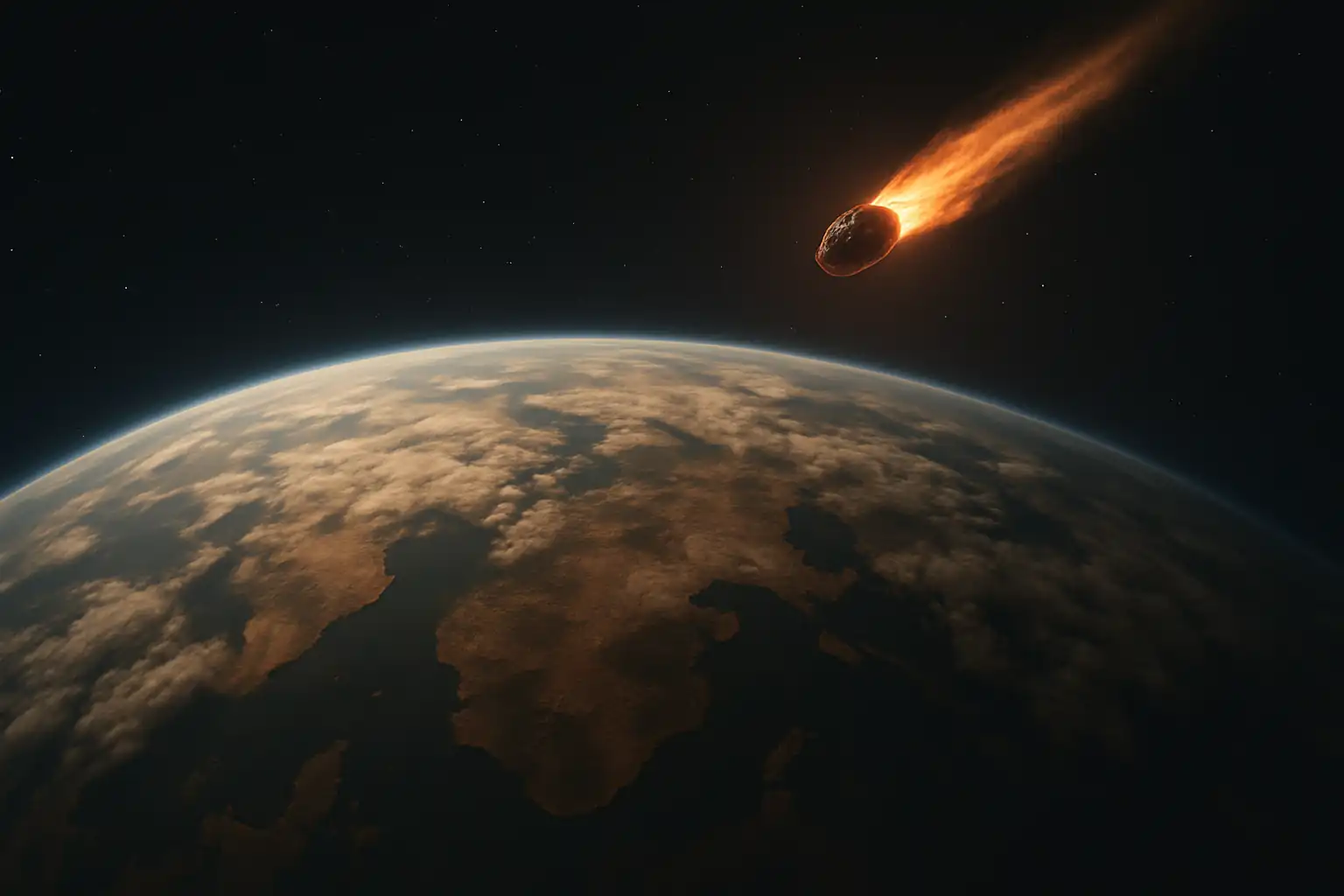
Imagine a meteorite carrying organic compounds—or, in the more demanding version of the hypothesis, a protected organism inside microscopic pores. If such a rock reached a young planet, it might deliver material worth studying. Whether any organism could survive the full journey and establish itself is still unknown.
That possibility changes the question without settling it: Earth could have received some ingredients from space, while the first living system may still have formed here. The evidence lets us explore both possibilities, not choose between them by imagination alone.
Critics and cosmic gaps
Not everyone buys into the idea that life came from space. Some scientists are skeptical, and honestly, it makes sense. Panspermia doesn’t tell us how life began. It just suggests Earth might not be where it started. The bigger question, how lifeless matter ever became something that could breathe, move, or think, is still hanging there, unanswered.
Others worry about contamination. A meteorite lands on Earth, sits out in the open, maybe gets touched or stored away for years before anyone tests it. So how do we know the organic molecules inside didn’t come from here? And even when we do find amino acids or sugars out there in space, they might have formed naturally, without any connection to life at all.
And there’s the bigger, quieter question. The one that never really leaves the room.
If life didn’t start here, and we haven’t found it anywhere else yet, what does that mean? Is there a design behind it? A direction? Some people see the patterns in physics and biology and feel like they’re looking at something planned. Others say it’s just chance, layered over billions of years.
I believe in science. I believe in testing things, asking questions, and following the evidence. But I also look up at the sky and wonder where all of this came from. The structure of the universe feels too precise to be random. That doesn’t mean I know who or what might be behind it. But I don’t think it’s all by accident.
A universe that breathes life?
Panspermia isn’t perhaps THE answer. It’s currently more of kind of like a lens. It doesn’t explain everything, but it changes how we look at the pieces. At the universe. At the possibilites.
If life can survive in deep space, if it can travel across light-years tucked inside ice or rock, then maybe life isn’t rare. Maybe it’s everywhere. Waiting for the right moment. Drifting across the dark until it finds the right kind of world.
And maybe that’s what happened here. Maybe the first living cell on Earth didn’t form in a pool of chemicals, but landed here after a journey we’ll never fully trace. A microscopic traveler, older than our planet, from a place we’ll never see.
That kind of idea doesn’t shrink us. It connects us. If life can spread, it means we might not be alone. It means every planet out there with liquid water and sunlight could be a home-in-waiting. It means life could be the rule, not the exception.
And if that’s true, if life moves from world to world, taking root wherever it can, then we aren’t just a product of this Earth. We’re part of something much older. A story that began long before us, still unfolding, still reaching. Ahh, what a beautiful thing the cosmos is!