For nearly two decades, astronomers have not been sure which galaxy produced the short gamma-ray burst GRB 061201. New observations from the James Webb Space Telescope point to a faint galaxy at a much greater distance than the nearby object originally linked to the burst.
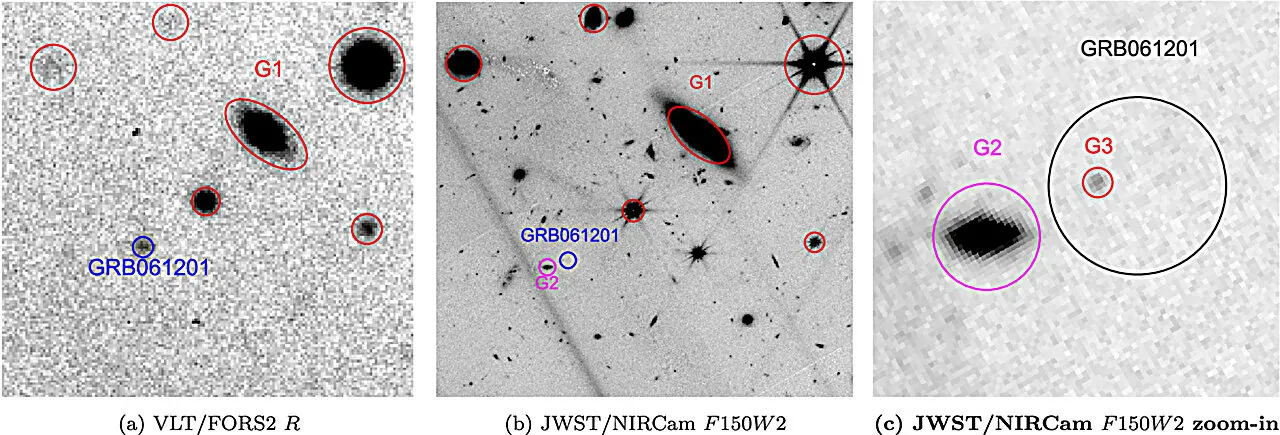
The candidate host lies about two arcseconds from the position of the burst’s optical afterglow. Photometric measurements place it near redshift 1.2, suggesting that the explosion occurred in a distant galaxy rather than in the foreground system at redshift 0.111 that had been proposed soon after the event.
The result comes from a 2026 study by Yuhan Mao and colleagues, published in The Astrophysical Journal. The team combined archival JWST/NIRCam and Hubble imaging; its paper describes the newly identified galaxy as a candidate host, not a final identification. NASA’s Swift record for GRB 061201 preserves the earlier redshift-0.111 host assignment, while the new JWST/HST study tests whether that interpretation still fits the evidence.
A burst without a convincing home
Gamma-ray bursts are brief flashes of high-energy radiation. Short bursts are commonly associated with the merger of compact objects such as neutron stars, but identifying their host galaxies is essential for testing that picture and measuring how often these mergers occur.
GRB 061201 was detected in 2006. Its afterglow appeared far from the centre of the nearby galaxy that was initially considered the host, leaving astronomers with an uncomfortable choice: accept an unusually large offset, or search for a much fainter galaxy that earlier telescopes could not see.
Webb’s sensitivity in the near-infrared makes that search possible. The new observations reveal a faint source, called G2, near the afterglow position, along with an even fainter nearby object labelled G3.
Why the distant interpretation fits
The team compared the two possible scenarios using several independent tests. If the burst came from the nearby galaxy, its inferred energy would make it an outlier from an established relation connecting the energy of short bursts with their peak emission. The higher-redshift interpretation fits the relation more naturally.
Deep infrared observations also fail to show a kilonova resembling the event AT2017gfo at the distance of the nearby galaxy. A kilonova is the fading glow expected from some neutron-star mergers, created when the collision throws neutron-rich material into space.
Finally, modelling of the afterglow favours the distant scenario. The authors report a difference in the Akaike information criterion of 16.35, a statistical result that strongly weighs against the lower-redshift model in their comparison.
Still a candidate, not a final identification
The evidence is persuasive but not absolute. The chance of finding a galaxy of the observed brightness near the afterglow position is not negligible, and the authors describe G2 as a candidate host rather than a confirmed one.
If G2 is the true host, the physical offset between the burst and the galaxy would be about 16.4 to 16.9 kiloparsecs. That is large, but substantially smaller than the roughly 42-kiloparsec offset implied by the older nearby-galaxy interpretation.
The candidate host also appears to have a stellar age of about two billion years, which is compatible with the broader population of short-burst host galaxies. A low-redshift origin would require a binary-neutron-star merger rate of roughly 1,400 events per cubic gigaparsec per year, in tension with gravitational-wave constraints.
What Webb changes
For years, GRB 061201 was treated as an example of a burst with no convincing host. Webb has not made the uncertainty disappear, but it has supplied a physically plausible alternative that explains several of the event’s unusual properties at once.
The case also shows why a burst’s afterglow is only part of the story. As with the indirect clues used to identify an unseen black hole, astronomers must combine position, distance, brightness, spectra and models rather than rely on one striking image.
Further observations of the candidate galaxy will determine whether it is physically associated with GRB 061201. Spectroscopy that confirms its distance and connection to the afterglow would be the decisive next test.