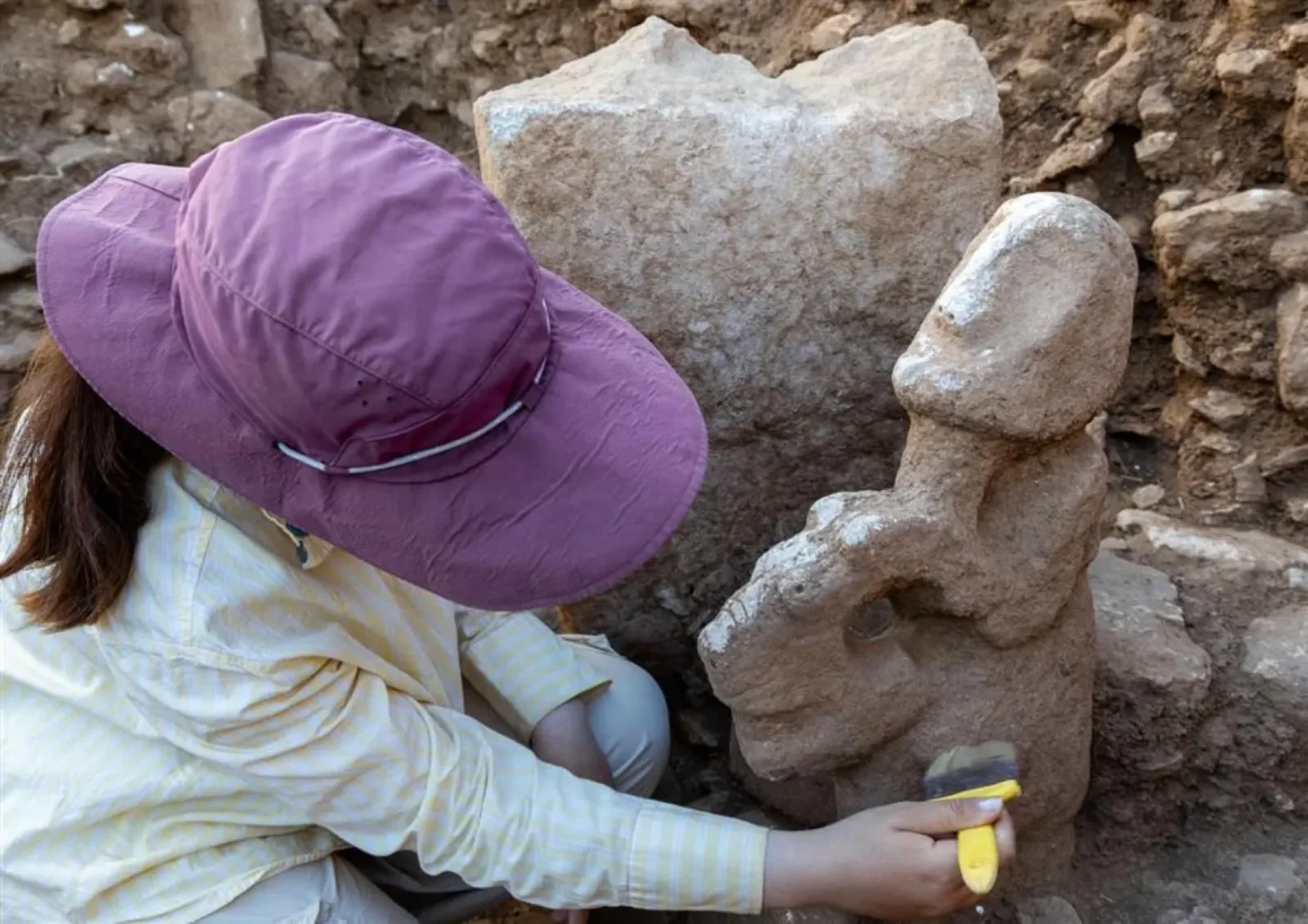
Karahantepe has produced a sculpture unlike anything previously reported from the site: a human figure seated on the back of a leopard. The composite work is about 70 centimetres high and was found during the 2026 excavations in southeastern Türkiye. In its announcement of August 25, 2026, the Ministry of Culture and Tourism dates the find to roughly 11,000 years ago, placing it among the earliest large-scale figurative works known from the region.
The find was not pulled from a later layer or displayed as a modern reconstruction. Excavators found it where it had been left, on a stone bench running along the wall of a circular structure about three metres across. The floor had been covered with flat stones. That setting matters because archaeologists can study the sculpture together with the room in which people placed it, rather than treating the object as an isolated work of art.
The figure combines two bodies in one composition. A person sits on the leopard’s back, while the animal forms the support beneath the human figure. The ministry describes the style as previously unknown at Karahantepe. The announcement does not identify the seated figure as a deity, ruler, or ancestor, and the evidence cannot yet tell us whether the sculpture represented a story, a ritual role, or a particular person. Those interpretations require comparison with the site’s other buildings, carvings, and deposits.
Karahantepe belongs to the same broad Neolithic world as nearby Göbekli Tepe, where communities built stone enclosures long before cities and writing. Curiosmos has examined how archaeologists distinguish domestic buildings from ritual spaces at Göbekli Tepe and why the related site of Karahan Tepe has changed the picture of early monumental architecture. The new sculpture adds another piece to that regional record: people were investing time in images that joined humans and animals in deliberate, carefully placed scenes.
The bench and the small room may prove as informative as the sculpture itself. A bench along a wall gives the object a fixed position and suggests that its placement was part of the building’s use. Archaeologists will need to document the surrounding sediments, tool marks, and any associated objects before deciding whether the space was repeatedly visited, deliberately closed, or used for a particular ceremony.
The discovery also complicates the old picture of early Holocene communities as groups concerned only with hunting, gathering, and immediate survival. People living in the region were organising labour, shaping stone, planning buildings, and creating visual statements that could be understood by others. That does not mean Karahantepe was a city or that its inhabitants had a state. It does show that social and symbolic life was already rich at a time when farming was still developing.
The sculpture is therefore valuable for two reasons. Its unusual human–leopard composition gives researchers a new image to compare with other Neolithic art, while its position inside a prepared structure preserves information about how the image was used. Further excavation and conservation work will decide how much more the find can tell us about the people who made it.
Comparisons with other sites will be crucial. Human and animal imagery occurs across the region, but the details differ from one enclosure to the next. Researchers can compare the treatment of faces, limbs, claws, and posture, then ask whether artists shared ideas or developed them independently. The new piece gives that comparison a rare three-dimensional subject with a documented archaeological context.