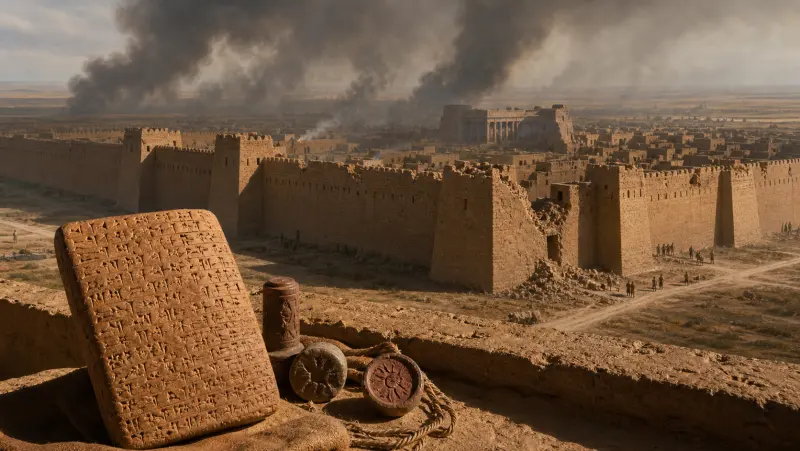
At Kurd Qaburstan in northern Mesopotamia, archaeologists are finding the kind of evidence that allows a destroyed city to be read from several directions at once. Cuneiform tablets, administrative sealings, a fortified wall and human remains are appearing together in layers associated with the ancient city of Qabra.
The project, led by researchers from the University of Central Florida and its partners, is examining a settlement that covered roughly 80 hectares. Magnetometer surveys have mapped large structures without removing the soil, while excavations have opened parts of a monumental wall with bastions and a palace area damaged by fire or collapse.
Twenty tablets in a palace destruction layer
More than 20 cuneiform tablets and over 100 administrative sealings were recovered from destruction layers. The tablets are still being studied, so it would be premature to treat every sign as a finished historical statement. Their presence is important because they connect the physical destruction of the building to the bureaucratic life that existed inside it.
Sealings served as a way to secure containers, doors or bundles of goods. In an administrative centre, they can reveal how officials controlled supplies and recorded movement. A tablet or sealing does not need to describe a battle to tell us that the city had an organised system capable of storing information and managing resources.
Seventeen people in the ruins
Excavators also documented the remains of 17 individuals in destruction layers. Some were not formally buried. That pattern may be consistent with a violent episode, a hurried abandonment or the later disturbance of bodies inside a collapsed building. The current evidence does not allow every death to be assigned to the same moment or cause.
Researchers are using isotopic and ancient-DNA analyses to investigate where people grew up, how they were related and whether the population moved during the crisis. Those results could add a human dimension to the texts, but they will not turn a complex destruction layer into a simple list of victims and attackers.
The siege of Qabra
The excavators connect the site with the siege of Qabra described in the historical record of Shamshi-Addu. That association gives the excavation a working historical framework. It is not the same as proving that every burned surface or damaged wall belongs to one named campaign.
Archaeologists compare the date of the destruction, the construction of the fortifications, the tablets and the wider political history. A siege may leave several traces: blocked entrances, repairs, ash, weapons, abandoned goods or sudden changes in the administrative record. The more independent traces agree, the stronger the connection becomes.
A city larger than its surviving texts
The magnetometer survey is revealing streets, large buildings and defensive lines that cannot be understood from the tablets alone. The city was more than a palace archive. It had workers, households, storage areas and movement through gates and roads. Remote sensing makes it possible to study that wider plan while protecting large parts of the buried settlement from unnecessary excavation.
That wider view matters because ancient Mesopotamian history is often told through kings and campaigns. Kurd Qaburstan offers a chance to connect those events to the physical city where people stored grain, stamped containers, raised walls and lived through the consequences of war.
The project is still in progress. Its most important results may come when the tablets, human remains and city plan are analysed together. For now, Kurd Qaburstan is giving researchers something rare: a siege that can be approached through both written administration and the damage left in the ground.