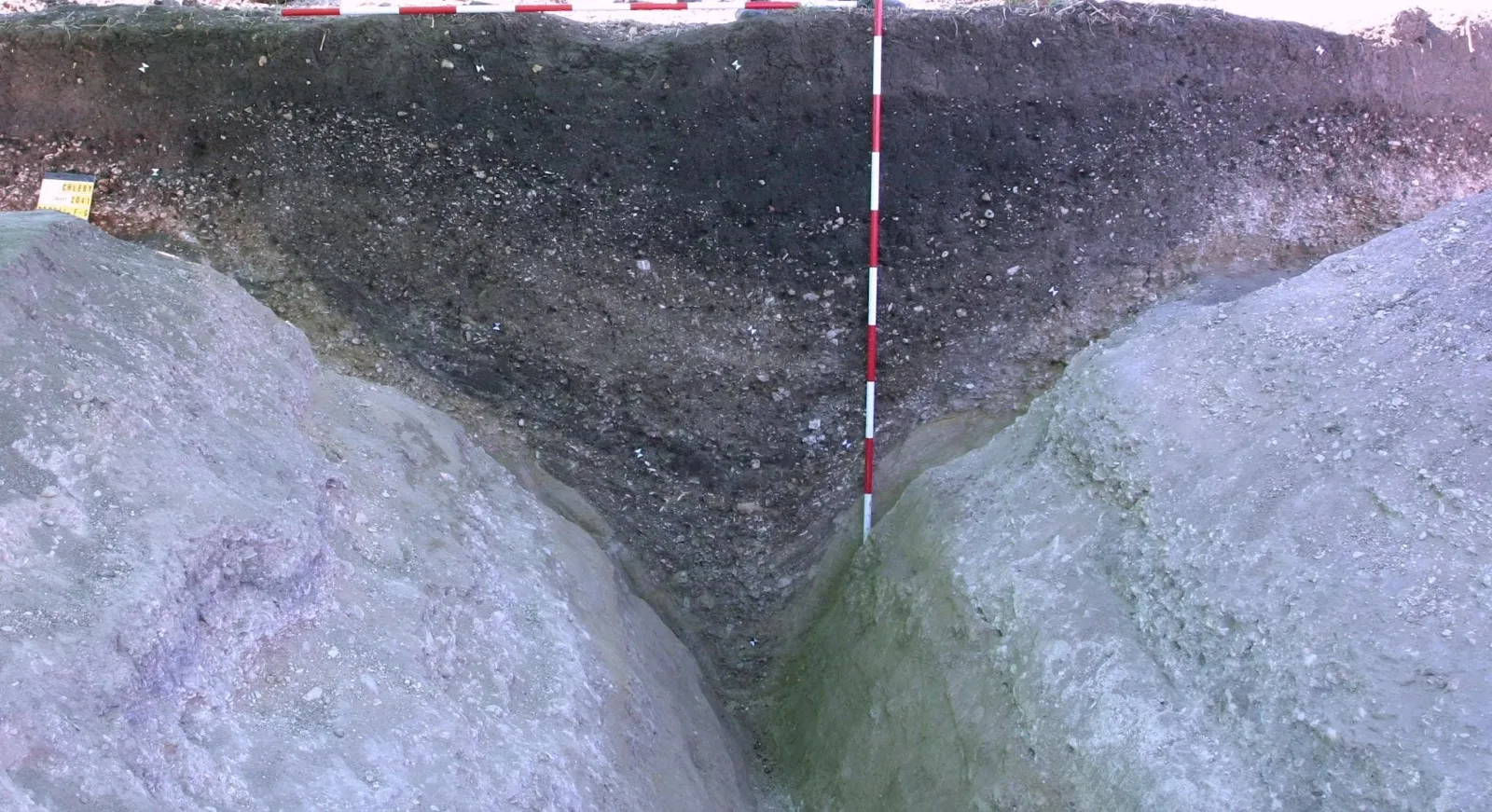
Archaeologists have developed a relatively inexpensive imaging system that can reveal differences hidden inside an excavation trench. Instead of lighting soil with ordinary white light, the prototype photographs it at sixteen wavelengths, from near-ultraviolet through visible and near-infrared light.
The idea is useful because an excavation cannot be rewound. Once a layer is removed, its exact position is gone. At many sites, neighbouring deposits look like the same brown or black soil even though they were created by different events. A camera that records how materials absorb and reflect different wavelengths can expose boundaries that the eye misses.
Seeing what ordinary photographs miss
Researchers from Aarhus University and Moesgaard Museum first tested the system at Sorte Muld on the Danish island of Bornholm. The Iron Age site contains more than a metre of dark cultural deposits built up through centuries of human activity. Thin, irregular layers make it difficult to tell where one episode of digging or filling ends and another begins.
The team repeatedly photographed the same soil profile while changing the LED wavelength. Statistical processing then combined the images and separated spectral differences. The results revealed changes in the fill and a possible old ground surface that were difficult to distinguish in normal colour photographs. The researchers stress that the interpretation still needs confirmation, but the system showed where a closer examination should begin.
Ultraviolet light also made small bone fragments fluoresce against the surrounding soil. That does not automatically identify the best sample for ancient DNA or protein analysis, but it could help field teams find material worth testing. The prototype is roughly twenty times cheaper than hyperspectral systems used for similar work.
From prototype to field tool
A second-generation version has since been tested at Fredbjerg in northern Jutland, where archaeologists are excavating a cemetery from the late Viking Age and early Christian period. Preservation is poor at the site, and some graves appear mainly as faint shadows. The multispectral images helped the team decide where to take samples for further analysis.
The newer system can collect its sequence in about thirty seconds, compared with up to five minutes for the first prototype. The researchers are working toward processing the results almost immediately in the field, and eventually on a phone or another portable device. Machine-learning software may assist with recognising material signatures, but the developers describe it as support for archaeological judgement rather than a replacement for it.
Source: Aarhus University report via Phys.org; David Stott et al., Journal of Archaeological Science, DOI 10.1016/j.jas.2026.106620.