A detector buried nearly a mile beneath South Dakota has recorded a particle interaction that researchers cannot yet explain with any known background process. The event was found by the LUX-ZEPLIN experiment, or LZ, in a new analysis of data taken with ten tonnes of ultra-pure liquid xenon.
It is the most intriguing dark-matter candidate LZ has reported, but it is not a confirmed detection. The collaboration describes the result as a possible hint, and the statistical significance is 2.6 sigma—well below the five-sigma level that particle physicists normally require before calling a result a discovery.
What happened inside the detector?
LZ is designed to catch the tiny flash and electrical signal produced when a particle strikes a xenon atom. The detector sits at the Sanford Underground Research Facility, where a kilometre of rock helps shield it from the constant shower of cosmic rays that reaches the surface.
The experiment also surrounds its central chamber with water and additional detectors. Those layers help identify neutrons, radioactive particles and other ordinary events that can imitate a dark-matter interaction.
For the new result, the collaboration examined 220 live days of data collected between March 2023 and April 2024. Earlier searches had concentrated on the simplest versions of the weakly interacting massive particles, or WIMPs, that many physicists have proposed as dark matter. This analysis opened a higher-energy region in which a wider range of WIMP interactions could appear.
Why one event matters—and why it is not enough
The signal contains the combination of light and charge expected from a particle depositing energy in the xenon. In the collaboration’s analysis, no known background model fit the event comfortably.
The result corresponds to a probability of about 0.5 per cent that known backgrounds alone could have produced the observation. That is unusual, but it does not cross the five-sigma standard used for a discovery claim. A single event can be a rare background, an unrecognised detector effect or a statistical fluctuation, even when the team has examined it carefully.
“We are not claiming to have seen dark matter,” Rick Gaitskell, the LZ spokesperson, said in the Berkeley Lab account of the result. The collaboration reported it because the event remains unusual after those background checks.
If it is a WIMP, it would be an unusual one
If the interaction was caused by a WIMP, the particle would probably have a mass of at least 200 gigaelectronvolts per the speed of light squared, or more than 200 times the mass of a proton. The event would also point to a type of interaction more complicated than the simplest WIMP models normally tested.
That possibility is one reason the result is interesting even before anyone knows what caused it. It does not simply repeat the usual dark-matter search at a higher sensitivity; it tests a part of the energy range where the experiment had not previously searched in the same way.
What dark matter is—and what this result does not show
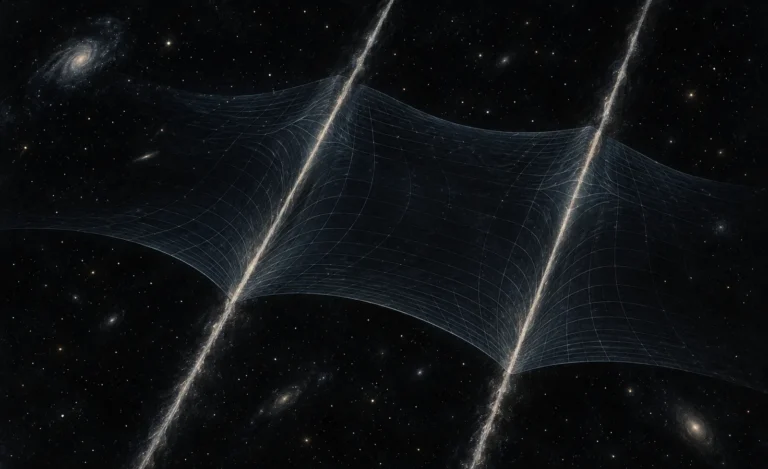
Dark matter is the name scientists give to whatever supplies the extra gravity needed to explain the way galaxies rotate, galaxy clusters hold together and cosmic structure grows. It does not emit, absorb or reflect light in a way ordinary telescopes can see, so its presence has been inferred from its effects on visible matter.
WIMPs are only one possible explanation. Other candidates include axions, hidden-sector particles and several forms of compact astronomical object. The LZ result does not choose between them, and it does not rule out the possibility that the event came from an unfamiliar background process.
This is why the next measurements matter more than the headline. LZ is continuing to collect data, and a genuine signal should become more convincing if similar events appear with the expected properties. If the event was a fluctuation or a background, its apparent significance should weaken as the larger dataset is analysed.
For now, the careful conclusion is narrow but important: LUX-ZEPLIN has found one interaction that deserves intense scrutiny. It is a test of how far underground experiments can push the search for the invisible matter shaping the universe, not proof that the missing particle has finally been caught.
Our earlier guide to what dark matter is and how scientists infer its presence provides the background; the LZ result is the next step in testing whether that gravitational mystery also has a detectable particle signature.