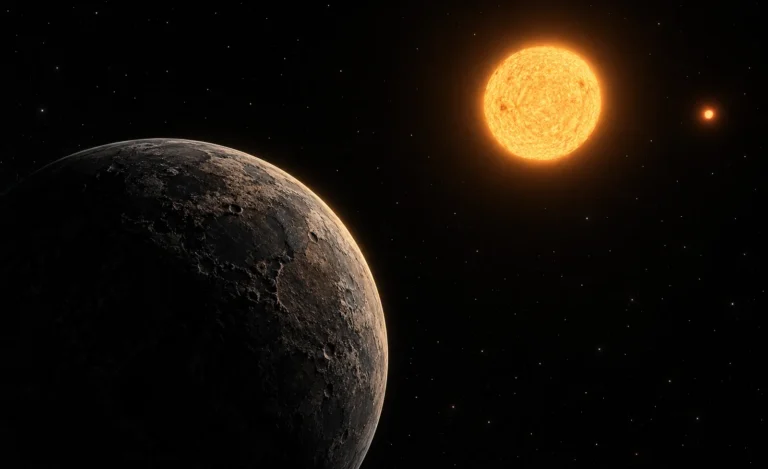
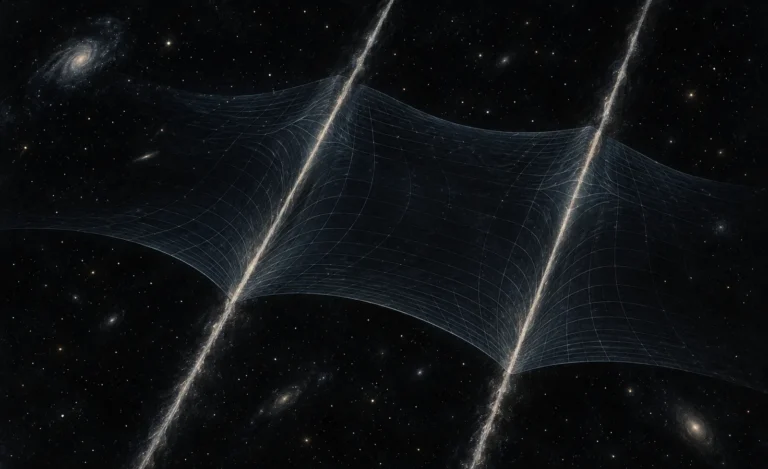
Could two stars that now move as a pair have begun life separately? A new study of the massive protostars in IRAS 07299−1651 points to just that possibility. Their orbit is unusually stretched, and the dusty disks around the two young stars tilt in different directions—clues that fit a close encounter while both were still forming.
That is a different picture from two stars growing side by side inside one shared disk. The distinction matters: astronomers think at least 90 percent of massive stars belong to binary or larger systems, yet they are still working out how those partnerships begin. Understanding massive binary star formation may help explain how the most luminous stars assemble and reshape their surroundings.
Eight years of motion reveal a three-dimensional puzzle
The stars are buried in the gas and dust from which they are growing, so a single image cannot show how they travel around each other. The research team instead compared observations made across nearly eight years. ALMA and the Very Large Array tracked subtle shifts in the pair’s position, while infrared images from the James Webb Space Telescope and the Very Large Telescope helped show the surrounding structure.
Those small changes add up. By combining the motion with measurements of gas around the stars and the direction of their jets, the team reconstructed the system in three dimensions: the orbit, the two circumstellar disks and the outflows all became parts of the same picture.
The result is striking. The preferred orbital solutions are highly eccentric, close to a parabolic path, rather than neat and nearly circular. The two disks are also strongly misaligned with the orbital plane and with each other. If both stars had formed within the same rotating disk, the researchers would expect a more coordinated arrangement.
Did the stars meet before they finished forming?
The team’s proposed explanation is called a core-merger scenario. In this picture, two separate, initially unbound pockets of gas each began forming a massive star. The young objects then passed close enough for gravity to bring them together, while their surrounding birth material was still present.
Once the team had reconstructed the orbit, it could ask when the pair came closest. Some representative solutions place that encounter roughly 60 years before the observations—a blink on the timescale of star formation. No telescope watched the meeting itself; that timing is inferred from the measured motion and the orbital models.
The pair is now about 200 astronomical units apart, roughly five times Pluto’s average distance from the Sun. It is not yet clear whether the two stars will remain bound for good. Their motion sits near the boundary between an orbit that holds the pair together and one that could eventually let them drift apart, and their shared gas can still influence what happens next.
One pair could test a bigger idea
A single system cannot tell astronomers how often massive binaries form this way. But it gives them a useful pattern to look for: a strongly stretched orbit paired with disks that point in different directions. Long-term observations of other young binaries could show whether close encounters between separate stellar embryos are rare curiosities or an important route to the companions massive stars so often have.
Curiosmos recently looked at a different kind of stellar partnership in a four-star system whose members reveal their arrangement through a rare sequence of eclipses. In IRAS 07299−1651, it is the pair’s motion and tilted disks that preserve clues to how the relationship may have begun.
The next step is to watch more young pairs for long enough to see whether this unusual geometry appears again. Each one may offer another glimpse of the moment a star’s solitary beginning turns into a shared future.
Sources and further reading
- Yao Wang et al., “An eccentric massive protobinary assembled via a core-merger parabolic encounter,” Nature Astronomy, published September 7, 2026.
- Atacama Large Millimeter/submillimeter Array, “ALMA Watches a Massive Binary Assemble in Real Time,” September 8, 2026.