Astronomers have directly measured an extremely faint radio signal from neutral hydrogen billions of light-years away. The detection, made with South Africa’s MeerKAT array, gives researchers a new way to trace how matter was arranged when the universe was younger.
Hydrogen is the most common element in the cosmos, but its radio signature is hard to see. Neutral hydrogen emits at a wavelength of 21 centimetres. As the universe expands, that signal is stretched, so its wavelength tells astronomers when the light began its journey.
Reading the hydrogen glow
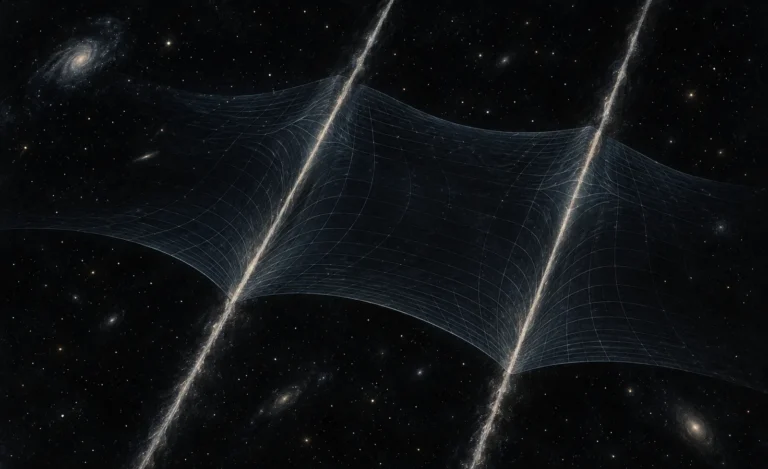
Instead of identifying every galaxy separately, the team used a technique called hydrogen intensity mapping. It measures the combined 21-centimetre glow from many unresolved galaxies at once. That makes it possible to survey huge volumes of space, provided the faint hydrogen signal can be separated from much brighter radio sources, interference from Earth and quirks in the telescope itself.
The researchers analysed about 96 hours of MeerKAT observations and detected hydrogen from two periods in cosmic history. The light travelled for roughly four to five billion years before reaching Earth. The measurements follow structure on scales of several million light-years, comparable to the distance between the Milky Way and Andromeda.
Earlier detections at these distances generally needed radio data to be combined with optical galaxy catalogues. This result came from the MeerKAT radio observations themselves. A direct measurement can be repeated over wider areas without first finding every individual galaxy in the same patch of sky.
Separating signal from noise
The signal is still difficult to extract. Bright radio galaxies dominate the raw images, while human-made transmissions and instrumental effects can imitate the hydrogen line. The team had to model and remove those foregrounds before testing whether the remaining pattern matched the expected 21-centimetre emission.
Future surveys should cover larger parts of the sky and observe for longer. Astronomers hope the method will help map the cosmic web, follow the growth of galaxies and measure how dark matter shaped structure over billions of years. MeerKAT’s detection is an early demonstration that the technique can work with real telescope data rather than only with combined surveys.
Source: Phys.org; Sourabh Paul et al., The Astrophysical Journal Letters, DOI 10.3847/2041-8213/ae808f.