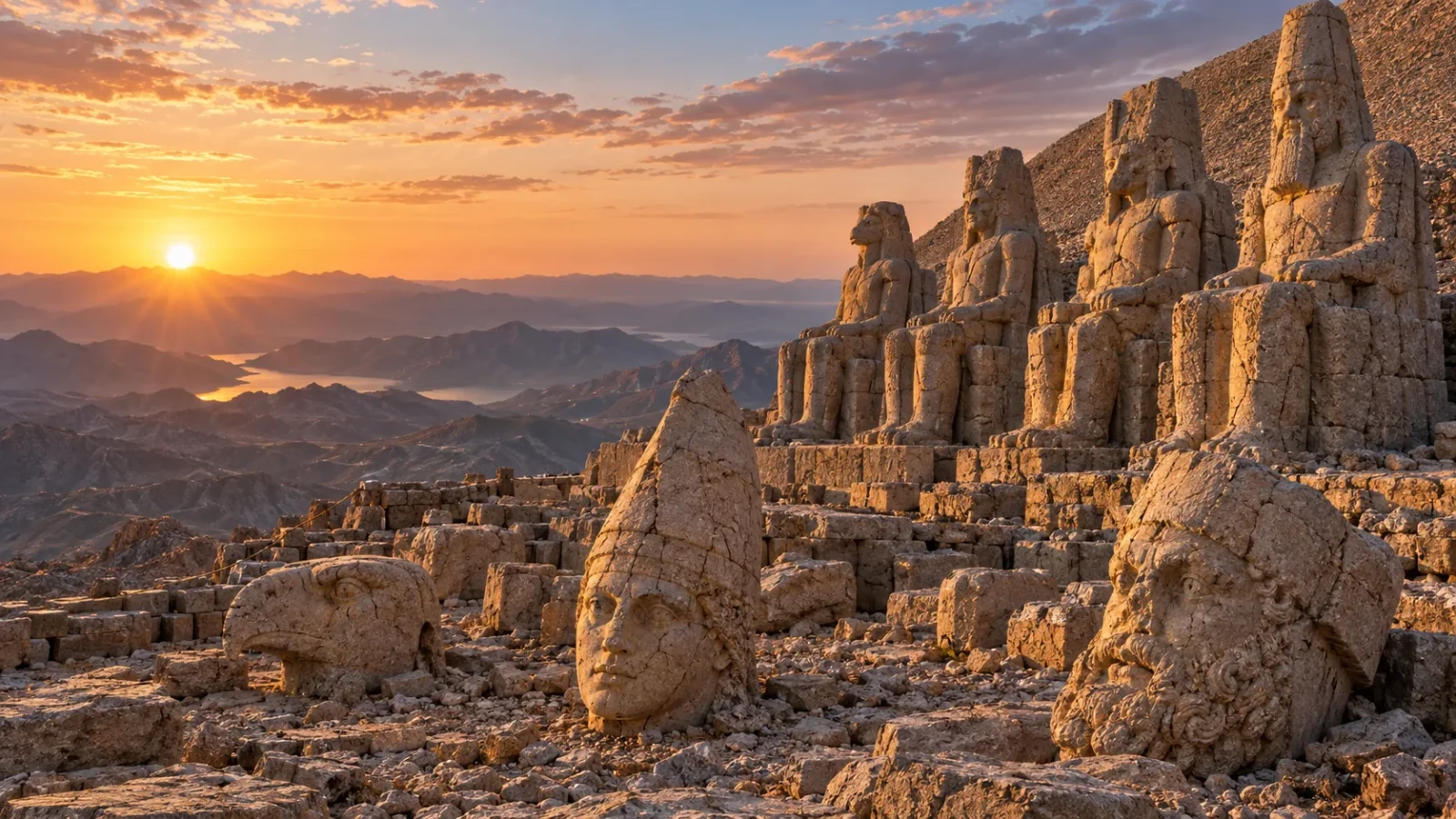
At sunrise on Mount Nemrut, the stone heads seem to be waiting for the rest of the world to wake up. They lie below their thrones, their expressions worn by wind and weather. Each once belonged to a seated statue several metres tall.
The sanctuary was built by Antiochus I, king of Commagene, in the first century BC. It was a tomb and a place of worship, but also a public statement. By placing himself beside a carefully chosen group of gods and ancestors, Antiochus made the mountain tell the story of his kingdom.
A royal sanctuary above Commagene
Commagene occupied a strategic position north of Syria and the Euphrates, between larger powers. Antiochus ruled from 69 to 34 BC. UNESCO calls the summit complex a hierothesion, a temple-tomb and cult centre dedicated to the king and his gods.
Keep exploring
Continue with Curiosmos
A stone-chip mound about 50 metres high rises between eastern and western terraces, with another terrace to the north. The tumulus dominates the summit, while the terraces stage the encounter between ruler, gods and visitors. It is not just a grave hidden under a mountain; it is a route through a royal idea.
Gods with two names
The seated figures once reached roughly eight to ten metres. They included Antiochus, the goddess Commagene, Zeus-Oromasdes, Apollo-Mithras-Helios-Hermes and Heracles-Artagnes. Lions and eagles stood among them.
The paired names show Antiochus bringing Greek and Iranian traditions together. Zeus was joined with the Iranian Ahuramazda; Heracles with Artagnes. The figures did not erase the differences between those cultures. They let a ruler present them side by side under his own authority.
That was useful politics for a small kingdom between empires. Antiochus’ inscriptions and reliefs gave visitors a way to see Commagene as a meeting place with its own royal identity. The gods shared the terrace; so, in the king’s telling, did the histories behind them.
The ancestry carved into the mountain
A long Greek inscription behind the western terrace explains the sanctuary and the rituals Antiochus wanted performed there. It praises the king and sets out his instructions. Like any royal inscription, it tells us what the ruler wanted people to remember; it is not a neutral account of his reign.
Reliefs show Antiochus greeting deities in a scene called dexiosis. Other stelae trace his father’s line toward Persian kings and his mother’s toward Macedonian rulers. Those genealogies helped place Commagene between two celebrated political worlds.
The ancestry may combine history with dynastic claims. That is part of its value: the monument shows how Antiochus justified his position and how he wanted the kingdom understood by its neighbours.
Why the heads lie below the statues
Earthquakes, frost, wind and human activity have all altered the summit. The heads separated from their bodies over time, leaving the arrangement that now appears in photographs. The fallen faces are dramatic, but they were not the original composition. The statues once sat upright on thrones, within a larger ceremonial landscape.
Nor have archaeologists confirmed a burial chamber containing Antiochus beneath the tumulus. Searches and geophysical work have not yet produced a verified burial. The mound’s stone fill makes the interior difficult to investigate, and the uncertainty has helped fuel stories of a hidden tomb. It does not tell us what the chamber contains.
The visible terraces matter whether or not the burial is found. They held the statues, reliefs and altars where ceremonies could take place. The mountain let Antiochus’ cult look out across the territory he claimed to unite.
Building high above the river valleys
The sanctuary stands at about 2,150 metres. UNESCO records blocks weighing as much as nine tonnes. Getting them onto the summit and into position required planning, skilled masons and a large workforce. The surviving construction tells us plenty about organization without needing an impossible explanation for how it was built.
Frost and exposure keep changing the site. Conservation teams have documented damage and worked to protect the sculptures. So the faces visitors see today carry several histories: the king’s original design, centuries of weathering and the modern work needed to keep the monument standing.
Mount Nemrut’s stone heads are not a puzzle about who built them. They are a rare surviving portrait of how one ruler wanted his gods, ancestors and kingdom to appear together. The question the summit leaves us with is political as much as religious: how do you persuade a borderland to see itself as one people?
Curiosmos has also looked at what ancient stone monuments can—and cannot—tell us. At Nemrut, the inscriptions make the builders’ ambition unusually clear, even while the rituals and the king’s final burial remain uncertain.
Sources
- UNESCO World Heritage Centre, “Nemrut Dağ.”
- Türkiye Ministry of Culture and Tourism, Nemrut.
- Turkish Culture Portal, Nemrut Dağı.
- Donald H. Sanders, ed., Nemrud Dagi: The Hierothesion of Antiochus I of Commagene.
- Bryn Mawr Classical Review, “Nemrud Dağı: Recent Archaeological Research and Conservation Activities.”