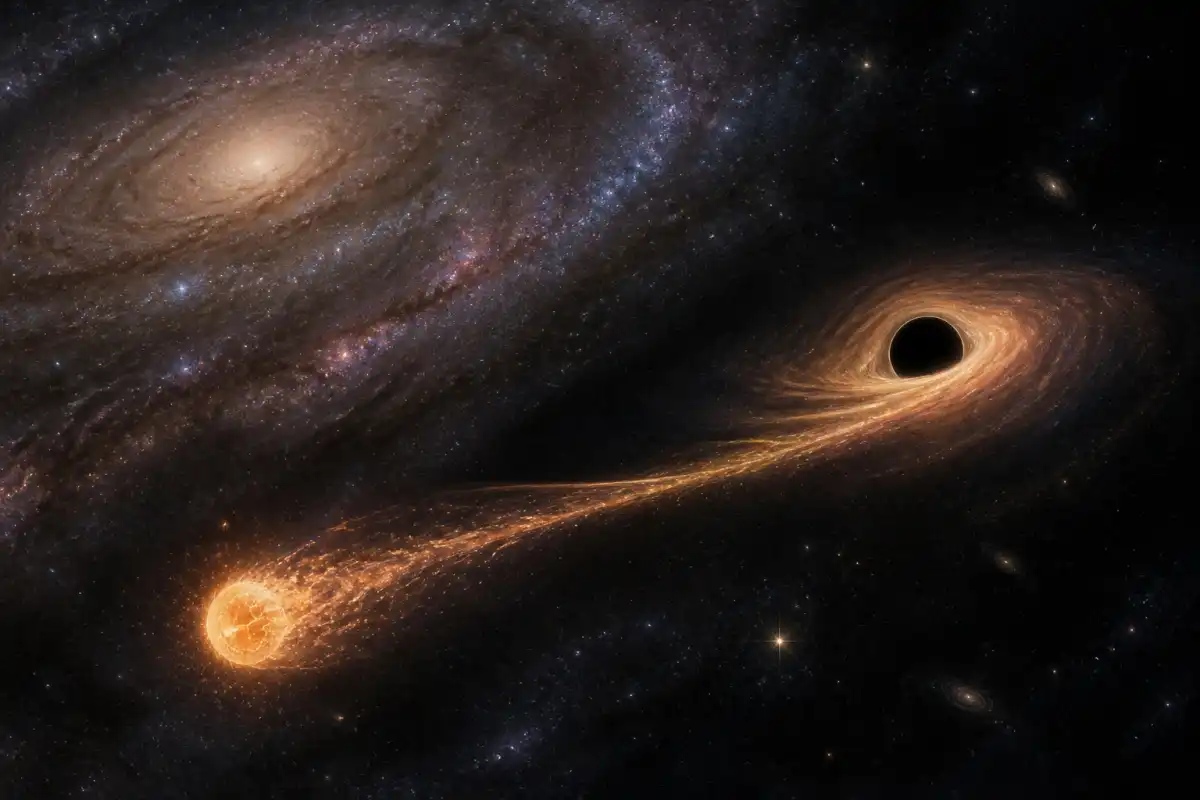
Black holes are difficult to find when they are quiet. The one in NASA’s latest Swift result gave itself away by destroying a star. The flare came from the outskirts of a galaxy about 750 million light-years away, more than 30,000 light-years from the galaxy’s center. That is an unusual address for a supermassive black hole.
The event is called a tidal disruption event. A star that passes too close to a black hole is pulled into a long stream by the difference in gravity between its near and far sides. Some of the debris whips around the black hole, heats up and shines across ultraviolet and other wavelengths. For a short time, the flare can outshine the galaxy that contains it.
How Swift identified the flare
The first warning came from the Zwicky Transient Facility, a survey that scans the sky for changing sources. In November 2025 it recorded an unusual brightening in the galaxy WISEA J014656.04-152214.7. A new automated search noticed that the flash resembled a star-shredding event even though it appeared far from the galaxy’s core.
Ground-based observations supplied a spectrum, the pattern of light that helps astronomers identify what is happening. NASA’s Neil Gehrels Swift Observatory then added ultraviolet and X-ray data. Swift’s ultraviolet telescope measured a temperature of roughly 54,000 degrees Fahrenheit, or about 30,000 degrees Celsius. Combining the observations helped the team rule out several other explanations for the flare.
For a few months, the blast radiated in ultraviolet light with the power of roughly 10 billion Suns. That number describes the event’s temporary brightness, not the mass of the black hole. The black hole itself is estimated to weigh about one million times as much as the Sun.
Why the location is surprising
Supermassive black holes are usually found at the centers of large galaxies. The previous off-center example in this search was about 2,600 light-years from its galaxy’s center. The new event lies more than ten times farther out.
One possibility is that the black hole began in the core of a smaller galaxy that merged with the larger one. As the smaller galaxy was absorbed, its central black hole could have been carried into the outskirts. Another possibility involves a more complicated merger involving three or more galaxies, with gravitational interactions pushing one black hole away from the center.
The observations do not yet distinguish between those histories. They do show that a tidal disruption event can act as a beacon for an otherwise invisible black hole. Astronomers had mainly searched near galactic cores because that is where the known supermassive black holes reside. Looking farther out changes the search strategy.
The word “wandering” can be misleading. The black hole is not roaming randomly through intergalactic space or hunting stars like a cosmic vacuum cleaner. It is still bound by the gravity of its host galaxy. Its unusual position is more likely the fossil record of a merger, a long gravitational tug-of-war that moved the black hole away from the centre where it was born.
A new way to build a census
Swift’s pointed observations are temporarily paused while the spacecraft awaits an orbit boost, but the mission may return to this search after operations resume. The Vera C. Rubin Observatory should find far more changing objects in wide surveys, and NASA’s Nancy Grace Roman Space Telescope will add sensitive space-based observations.
Each new tidal disruption event is brief, but the population of events can answer a longer question: how many supermassive black holes are wandering through galaxies after mergers? Finding them will help astronomers reconstruct how galaxies assemble and how their central black holes move during that process.
There is also a practical advantage to catching a star being torn apart. A quiet black hole can be almost impossible to separate from the dark background of a galaxy. A flare gives survey teams a clock, a position and a spectrum. Follow-up telescopes can then test the event across several wavelengths instead of relying on a single image.
That event belongs to the same family of observations discussed in Curiosmos’ guide to how black holes are inferred from light, motion, and surrounding matter.