What if the phrase “Neolithic cannibalism” hides several very different stories? A new study of three caves in southern Spain suggests that is exactly what happened in the Neolithic. Human bones from Malalmuerzo, Carigüela and Majolicas carry some similar traces of handling, but the chronology and the surrounding evidence point to different events, different pressures and perhaps different ideas about the dead.
The international team revisited nearly 1,000 bones and teeth recovered from the caves in Granada. Researchers examined the remains under a microscope for cut marks, fractures, signs of boiling and human tooth marks. They also estimated the ages of the people who died and used direct radiocarbon dating to place selected bones in time. That combination matters. A cut mark can show that a body was worked, but it cannot by itself explain whether the act was a meal, a ritual or the aftermath of violence.
Why do three caves tell three stories?
The study, published in the Journal of Archaeological Science, is built around a simple warning: there was no single Neolithic version of cannibalism. The caves contain similar-looking evidence, yet the episodes unfolded in different periods and under different social circumstances.
At Malalmuerzo, the bones of at least 36 people date to roughly 5300–4950 BC, in the Early Neolithic. More than half show evidence compatible with boiling, and two skulls bear blunt-force injuries. The age range is unusually broad, including children and adults. The researchers therefore propose that the cave may preserve one violent episode in which a whole group, or nearly all of it, was killed and then consumed. That is a powerful interpretation, but it remains an interpretation built from the pattern in the bones.
What happened at Carigüela?
Carigüela offers a much longer record. Its dated remains are spread across much of the Neolithic rather than concentrated in one event. Almost all of the studied bones carry butchery marks, while two skulls were modified into cup-like vessels. Those “skull cups” are among the most striking objects in the collection, yet their presence does not automatically reveal who made them or why.
Were the skulls trophies? Did they play a role in ceremonies involving ancestors? Were they used during a conflict and later kept as objects with a new meaning? The cave’s long chronology makes a single answer unlikely. The same place may have been revisited by communities whose relationships with the dead had changed over centuries.
That is why dating is so important in archaeology. A cave can look like one deposit when it is really a stack of separate moments. The methods archaeologists use to build those timelines are explained in our guide to how ancient remains are dated when the surrounding material is far older.
Why are the Majolicas bones red?
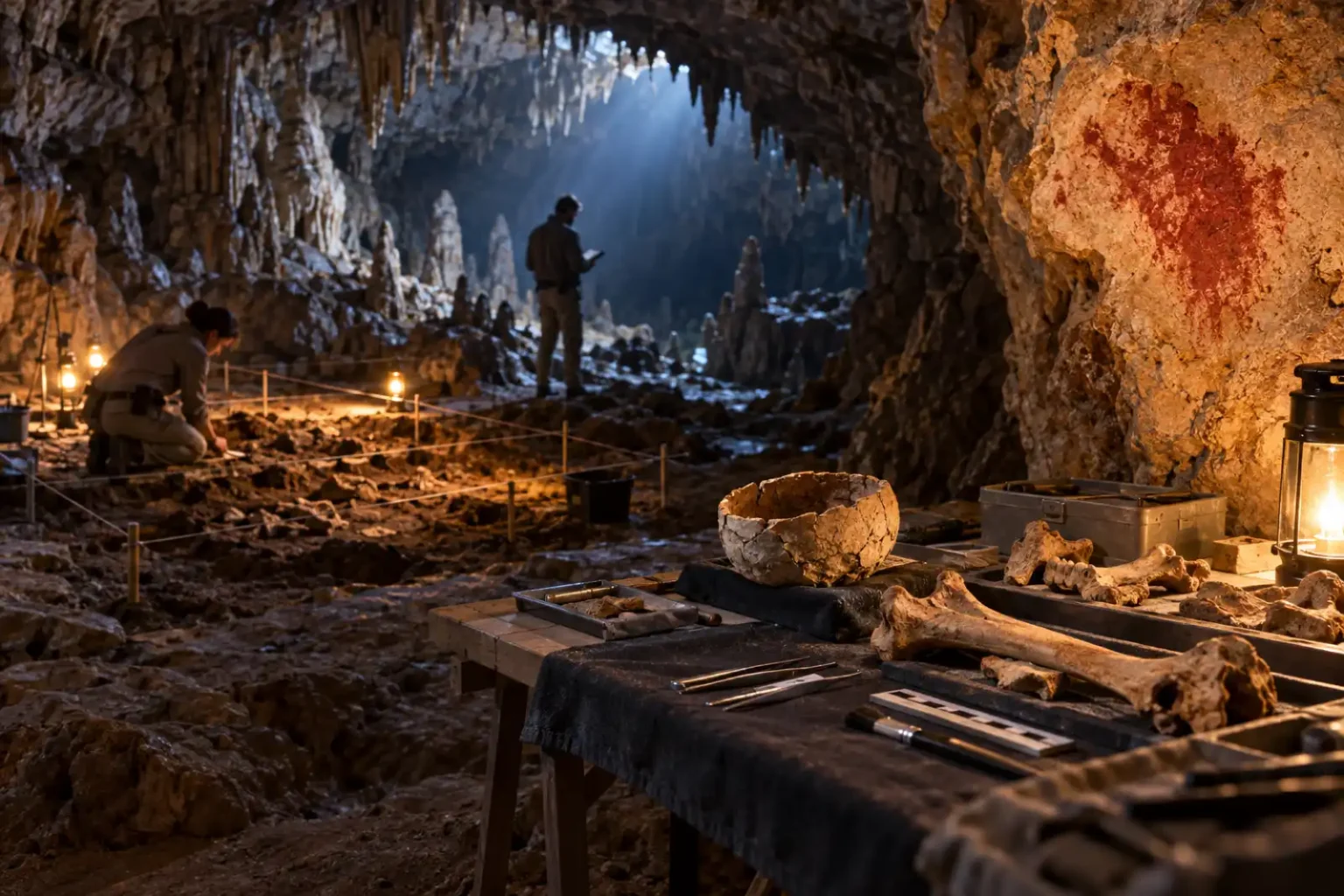
Majolicas appears to preserve the latest of the three episodes. Direct dates place its remains between about 3950 and 3760 BC, in the Late Neolithic. The bones were stained red, probably with cinnabar, a rare mineral with a strong symbolic and mortuary history.
Here the evidence does not resemble the proposed massacre at Malalmuerzo. The researchers suggest that the treatment of the bodies at Majolicas may have been connected with ritual or funerary practice. Cinnabar does not prove a particular ceremony, but it changes the question. Instead of asking only whether people were eaten, we also have to ask what the community was trying to do with the bodies and what the colour meant to those who handled them.
Can the bones prove cannibalism?
No single mark carries the whole argument. Cut marks can record dismemberment. Fractures can reveal blows or the breaking of fresh bone. Boiling and tooth marks may be compatible with consumption, but each trace has to be considered alongside the condition of the skeleton, the age of the remains and the cave’s stratigraphy.
The researchers used statistical analysis and machine-learning tools to help distinguish accidental breaks from damage caused by people. That does not make the interpretation automatic. It gives the team a more consistent way to compare hundreds of fragments and to test whether the pattern is too organised to be explained by animals, sediment or later disturbance.
The University of Granada’s account of the work describes the three caves as recurring episodes separated in time, with Malalmuerzo showing signs of collective violence, Carigüela preserving repeated practices and unusual skull treatment, and Majolicas pointing toward a ritual setting. The authors argue that similar marks can belong to very different social realities.
What was happening across Neolithic Europe?
The Granada caves fit a wider European pattern. The study places the strongest evidence for Neolithic anthropophagy into several windows: the end of the sixth millennium BC, the middle of the fifth millennium BC and the end of the third millennium, already approaching the Bronze Age. The timing is real, but its cause is not solved.
Perhaps periods of conflict made bodies vulnerable to acts that were normally forbidden. Perhaps communities used the dead to create bonds, warnings or ritual power. In some cases, the behaviour may have been practical and violent; in others, it may have been part of a ceremony whose meaning has disappeared.
That uncertainty is not a weakness in the discovery. It is what makes the evidence worth returning to. These caves were first recognised as important more than fifty years ago, and new dating and microscopic methods are now separating episodes that earlier researchers could only see as one broad pattern.
A thousand bones cannot give us a single neat explanation. They can, however, show that Neolithic communities were making choices about violence, food, ancestors and memory. The question left by the study is as unsettling as it is useful: how many other “mystery” deposits are really several human stories, layered together until time made them look like one?
Sources and further reading
- University of Granada: Three Granada caves reveal recurring Neolithic cannibalism in southern Iberia (8 September 2026)
- Archaeology Magazine: Neolithic Bones From Spain Show Evidence of Cannibalism (10 September 2026)
- Saladié et al., “Multiphase human cannibalism in Neolithic southern Iberia,” Journal of Archaeological Science 194 (2026), 106666