A small wooden head covered in gold foil has turned up in the Pazyryk burial mounds of Russia’s Altai Mountains, one of the most famous archaeological sites in Eurasia. It shows a predator, possibly a snow leopard or a bear, and it had gone unnoticed in earlier excavations of the tombs.
The find was announced at a press conference in Russia, reported by the state news agency TASS and summarized by Archaeology Wiki on 26 November.
At a glance
- What: a wooden figurine of a predator’s head, decorated with gold foil. The species is uncertain.
- Where: the Pazyryk burial mounds, Altai Republic, Russia. The new work revisits five mounds excavated earlier.
- Culture: the Pazyryk people, part of the wider Scythian world, who flourished in the Altai from the 6th to the 3rd century BC.
- Who: the State Hermitage Museum with the Institute of Archaeology and Ethnography in Novosibirsk and Gorno-Altaisk State University.
A new find in old tombs
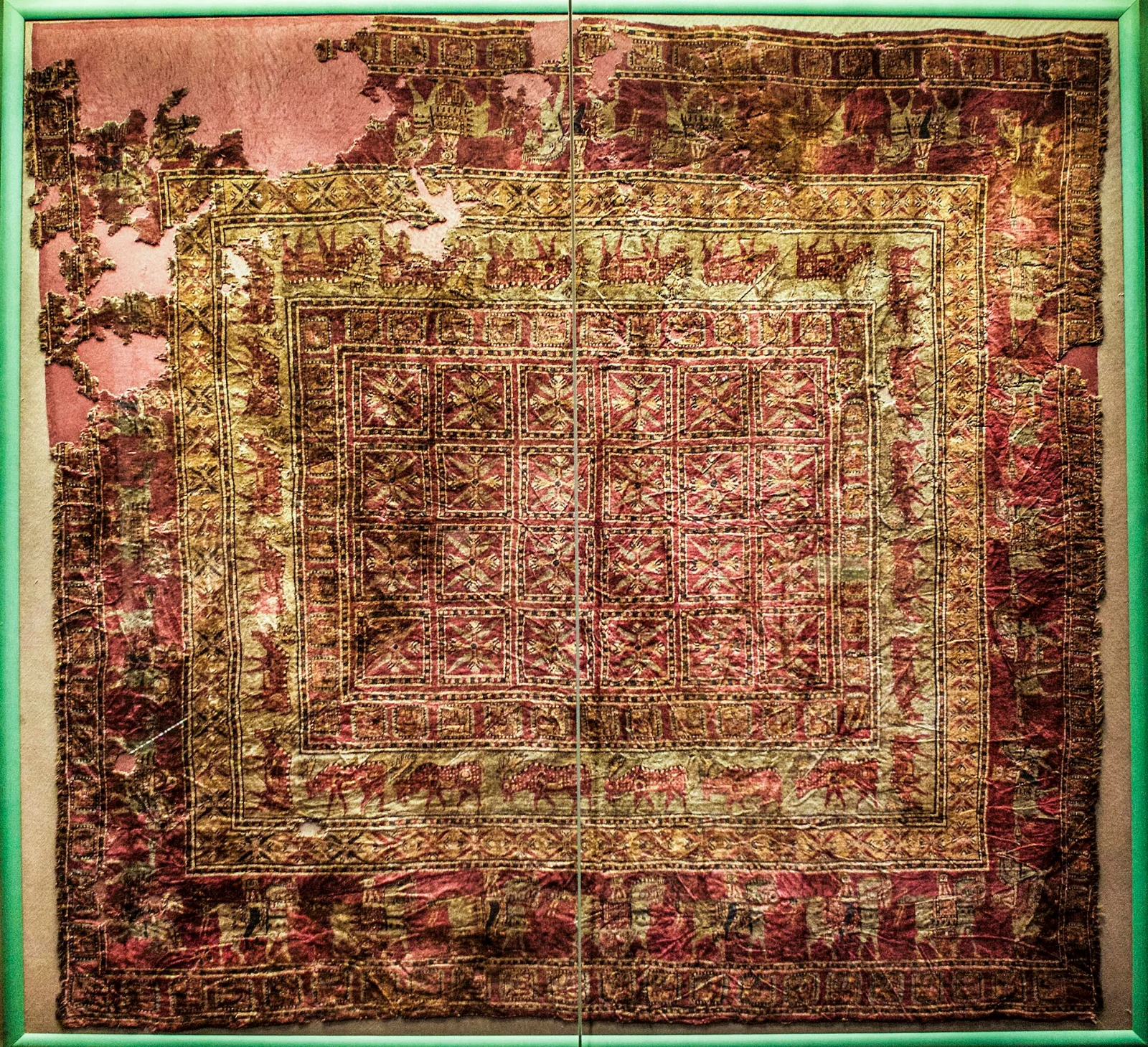
The Pazyryk kurgans were first dug in the 20th century, and their contents are some of the treasures of the Hermitage in St Petersburg. Because the burial chambers froze soon after they were sealed, they preserved what usually rots away: wood, felt, textiles, leather and even tattooed skin. The world’s oldest known pile carpet, shown above, came from one of these mounds.
The new project returns to five of the previously excavated mounds. Among the material, the team identified the gold-covered head, which had been missed before. Academician Vyacheslav Molodin, who announced the find, said its craftsmanship and subject are typical of Pazyryk art. The figurine has been conserved, and the surviving timber structures of the tombs are being treated so that the burial chambers can be reconstructed at the regional museum in Gorno-Altaisk.
Why a gilded animal head?
Animals were the heart of Pazyryk and Scythian art, often twisted, stylized and combined into fantastic creatures. Wooden carvings wrapped in thin gold foil were a typical way to make horse harness, headdresses and clothing glitter at little cost in metal. A predator’s head like this one would most likely have decorated a piece of equipment or clothing buried with its owner.
Our take
The find is small, but it shows something important: famous sites are not finished. Material excavated decades ago still holds objects nobody has properly looked at, and modern conservation can recover them. It also shows how much the Altai’s frozen tombs depend on care now, as climate change thaws permafrost across the region and threatens burials that have not yet been found.
The Pazyryk world reached far beyond the Altai. Read about cannabis smoke at a 2,500-year-old funeral in the Pamirs, and the Siberian mystery of Por-Bazhyn, the fortress on an island.