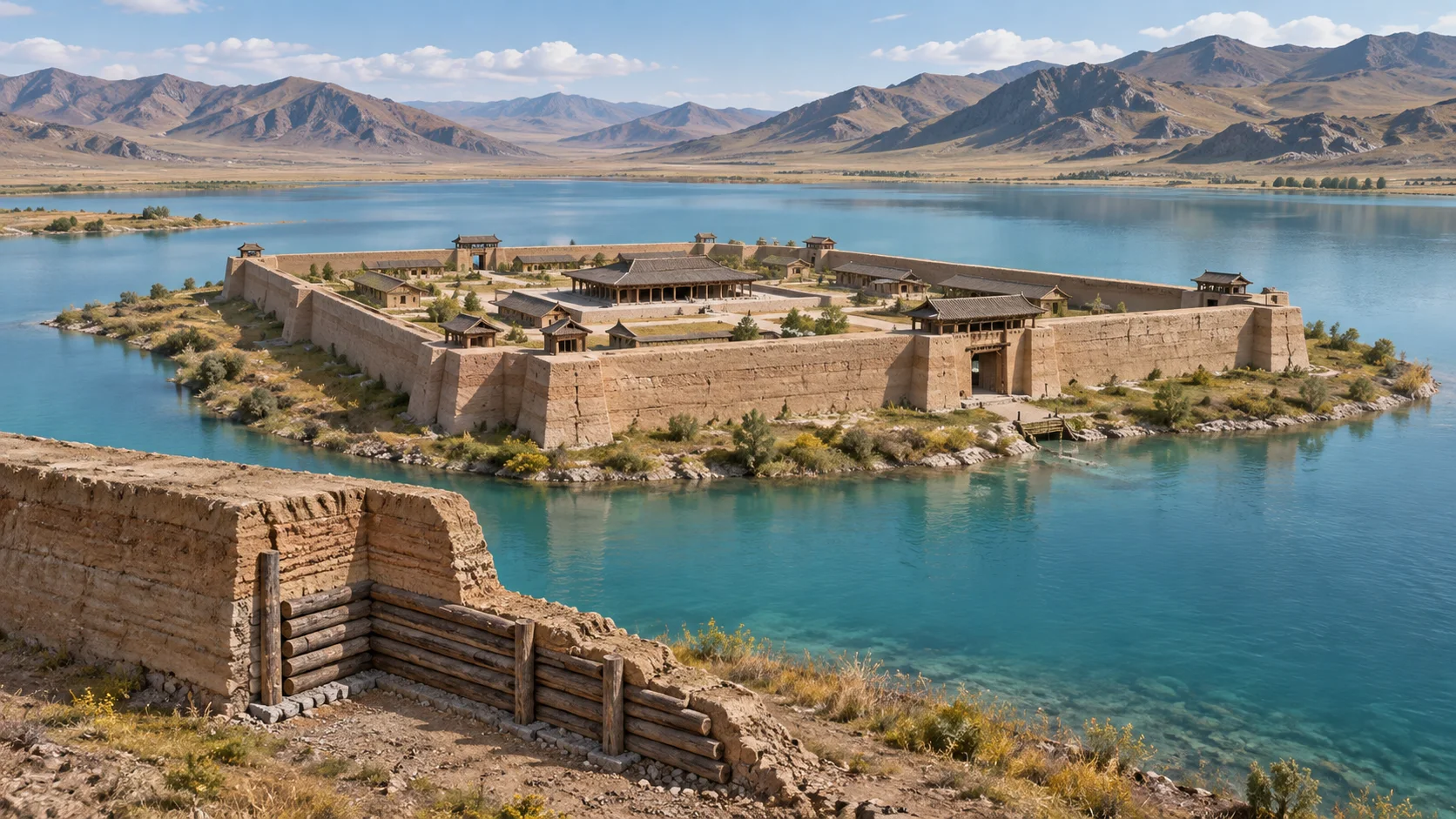
Por-Bazhyn stands on an island in Lake Tere-Khol, high in southern Siberia. From the shore, its long walls look like a fortress. Inside are courtyards, gates and the traces of about 30 buildings. The place appears to have been built, then used very little.
A few larch beams helped archaeologists pin down when construction began. A 2020 study in Proceedings of the National Academy of Sciences placed the start in the summer of 777 CE. The date ties the site to a particular moment in the Uyghur Khaganate, though it has not settled what the complex was for.
A walled complex on a remote island
Por-Bazhyn, often translated as “Clay House,” lies more than 1,300 metres above sea level in Tuva. Its enclosure measures about 215 by 162 metres. Earthen walls surround gateways, courtyards and buildings arranged around a large central structure.
The Uyghur Khaganate ruled parts of Central Asia during the eighth and ninth centuries. Por-Bazhyn’s building technique has parallels with East Asian rammed-earth construction, while the site’s setting is distinctly local: a mountain lake, a small island and a long way from the kind of settlement expected around a busy royal centre.
Its walls have encouraged the name “fortress,” but walls alone do not prove that an army lived there. The formal layout can also fit a palace or a ceremonial complex. Excavations have not produced a simple label.
How tree rings fixed the date
The date came from larch beams set into the foundations. Researchers measured radiocarbon in successive tree rings. Atmospheric carbon-14 rose sharply around 775 CE, leaving a marker that can be recognized in trees that were growing at the time.
One beam retained its outermost ring. By matching the sequence to the 775 marker, the researchers could identify when the tree was felled and place construction at Por-Bazhyn in the summer of 777. This is unusually precise for an archaeological building date.
The result also changes which ruler is associated with the project. Por-Bazhyn had been linked to Bayan-Chur Khan, who ruled earlier in the century. A 777 start falls in the reign of Tengri Bögü Khan, who made Manichaeism the state religion of the Uyghurs.
The wood dates the building work. It does not identify the person who ordered each wall or tell us what ceremonies took place there.
A monastery, palace or fortress?
The site’s connection to Tengri Bögü Khan has made a religious interpretation attractive. Researchers have proposed that it may have served as a Manichaean monastery or a seasonal place of worship. The layout and limited signs of long-term occupation have also led to other readings.
Por-Bazhyn lacks evidence expected from a large, continuously occupied garrison. Its remote island would also have been an awkward home for a permanent court. Yet those points do not prove it was a monastery. The surviving excavated material is sparse, and the original plan may never have been completed or used as intended.
Some researchers have noted the absence of heating systems, which would make a year-round winter occupation less likely. That clue has limits too: buildings can lose fittings, and a place used only in warmer months can serve more than one purpose.
Why build on an island?
An island made access controlled and visible. Visitors had to cross the lake or approach through a narrow route, and the walls would have framed what they saw once they arrived. If the project had a ceremonial role, the journey itself could have been part of it.
Por-Bazhyn may have joined political authority with the new state religion. Its date places the work in that setting, and a remote monument could make a ruler’s claim visible across a difficult landscape. That is a plausible reading, not a message recovered from an inscription.
The strongest conclusion is narrower: construction began in 777, under a khan whose reign reshaped Uyghur religious life. The complex’s later history remains thin. Its empty courtyards may reflect an interrupted project, a brief period of use or a purpose the surviving evidence cannot yet identify.
From the lake, Por-Bazhyn looks like a fortress. The tree rings give it a more precise place in history, while the buildings still leave one large question open: what kind of life was meant to unfold inside those walls?
Curiosmos has also examined how archaeologists read ancient monumental sites from their physical evidence. Por-Bazhyn shows how one small piece of wood can sharpen a date without answering every question about a building.
Sources
- Kuitems et al., “Radiocarbon-based approach capable of subannual precision resolves the origins of Por-Bajin,” PNAS (2020).
- University of Groningen ECHOES, “Ancient Mystery Solved by a Small Piece of Wood.”
- Archaeology Magazine, “Siberian Island Enigma.”
- Moscow State University, research summary on Por-Bazhyn’s foundation year.