The floor and the face
What happens when a Pompeiopolis mosaic exposes two different moments in a city’s life? At Pompeiopolis, an ancient settlement near Taşköprü in Türkiye’s Kastamonu Province, archaeologists are finding an answer in a basilica: a large geometric mosaic from the fourth century AD and a marble head of Eros made roughly two centuries earlier.
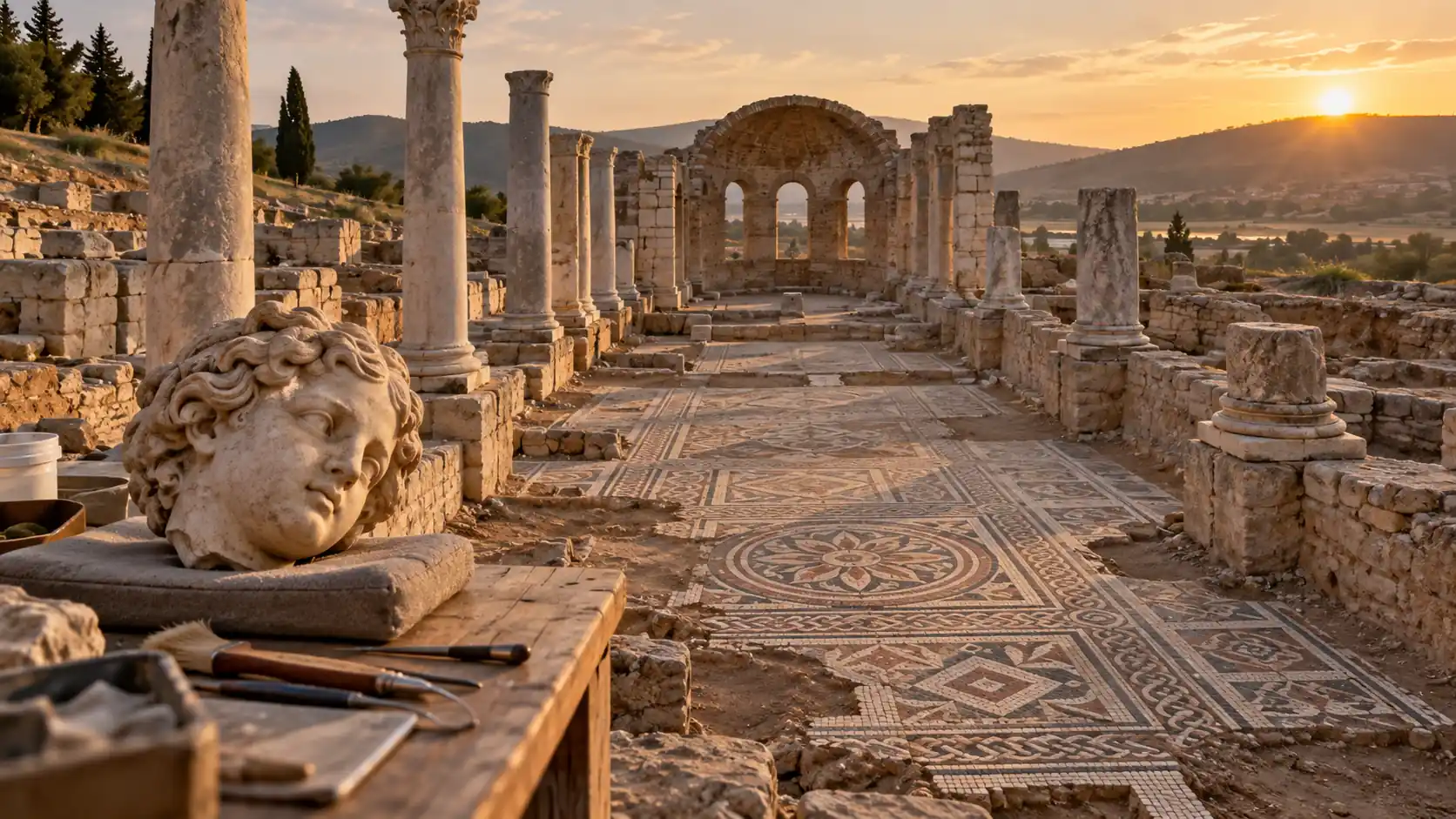
The discoveries were announced on September 7 by Türkiye’s Ministry of Culture and Tourism. The ministry says that about 105 square metres of well-preserved floor mosaic have been brought to light in the basilica’s central nave. The excavation is not finished, so the exposed area is only part of the pavement that once covered the building.
In a side room known as the pastophorion, the team also found a marble head representing Eros, the Greek and Roman god associated with love and desire. The ministry dates the head to the second half of the second century AD, around AD 150–200. That places it close to the date proposed for the basilica’s first construction phase, rather than the later period represented by the mosaic.
The two objects therefore belong to different chapters. The head belongs to the Roman Imperial setting in which the basilica was first built. The mosaic belongs to a later building phase, when the city’s public and religious life was changing.
A city at a crossroads
Pompeiopolis stood in ancient Paphlagonia, in the interior of the southern Black Sea region. A heritage guide produced by the Kastamonu Provincial Directorate of Culture and Tourism describes the city as a Roman centre founded in 64 BC and named for the general Pompey. Its position connected the settlement to the wider political and commercial world of northern Anatolia.
That long history matters because the basilica was not a single-use building frozen in time. The Turkish ministry says its first construction phase may date to the second half of the second century AD, based on the architecture, stratigraphic evidence and associated finds. Later alterations changed the building’s form and function.
The basilica’s sequence is still being reconstructed. A Roman public building could be adapted as the city’s institutions changed, and the ministry connects the later architectural elements and floor decoration with Pompeiopolis’s growing importance as a Christian centre. The city became a bishopric in the fifth century, but the mosaic itself is dated to the fourth century. That distinction is essential: the floor may belong to the period in which Christian influence was becoming more visible, yet the excavation has not produced a single label explaining exactly when or why every alteration was made.
Why the mosaic matters
The newly exposed pavement is made from geometric compositions rather than a single scene. Geometry can look less dramatic than a mythological panel, but it can tell archaeologists a great deal about a building. The size of the floor, its position in the central nave, the materials used and the way it meets walls and thresholds can help identify how a space was organised and how much labour its patrons could command.
The ministry describes the mosaic as unusually well preserved and says conservation work has already been carried out to protect the exposed surface. The central nave has not been completely excavated. As more of the floor emerges, archaeologists may be able to determine whether the patterns continue in a regular programme, change near important architectural features or belong to several repair phases.
Those details can turn a beautiful floor into a record of decisions. A new pavement may have marked a renovation, a change in the building’s status or a response to damage. Without the rest of the nave and its stratigraphic relationships, it would be too early to choose among those possibilities.
Why an Eros head was in a basilica
The Eros head raises a different question. The sculpture was found in the pastophorion, a room beside the apse that served a practical role in the basilica. Its discovery does not prove that the later Christian community worshipped Eros, nor does it show that the statue originally stood in the same building. Ancient sites often contain reused, moved or redeposited objects, and the findspot is only one part of the evidence.
What the head does provide is a physical link to the city’s earlier artistic environment. Its date fits the proposed first phase of the basilica and shows that Roman-era imagery was present in Pompeiopolis before the later mosaic was laid. The sculpture may have been part of an earlier display, moved during a renovation or carried into the room with building material. That question of older material taking on a new life is also central to our account of spolia at Sardis. The excavation record and conservation study will be needed to distinguish those possibilities.
This is where the two discoveries become more interesting together. The mosaic records a later investment in a large public interior. The Eros head preserves an earlier visual language. One shows a surface being built; the other preserves a face from a previous generation. Read together, they suggest a city repeatedly altering its monuments as its civic and religious identity shifted.
What the excavation can still tell us
The 2026 campaign is continuing with excavation, documentation and conservation. The ministry’s immediate goals include exposing and recording the rest of the mosaic, clarifying the basilica’s plan and tracing its different periods of use.
The next discoveries may be less photogenic than the Eros head. A threshold, a repair line, a drain or a layer of collapsed roofing could establish when a room changed purpose. Soil around the sculpture may reveal whether it fell where it stood or was deposited later. Small finds, mortar samples and the relationship between the floor and the walls may ultimately provide the chronology that a single object cannot.
For now, Pompeiopolis offers a compelling glimpse rather than a finished story. A fourth-century mosaic is emerging from a basilica whose earliest phase belongs to the Roman Imperial period, while a second-century Eros head looks back toward the city’s earlier artistic world. The real question is not simply what the archaeologists found. It is how many times this building—and the community around it—was given a new meaning.