Forecasting a solar storm is a little like watching a wave leave a distant coast and trying to guess when it will reach the beach. Scientists can see a coronal mass ejection (CME) leave the Sun, but its speed and shape can change as it crosses space. By the time it reaches Earth, the warning may still be measured in hours rather than minutes.
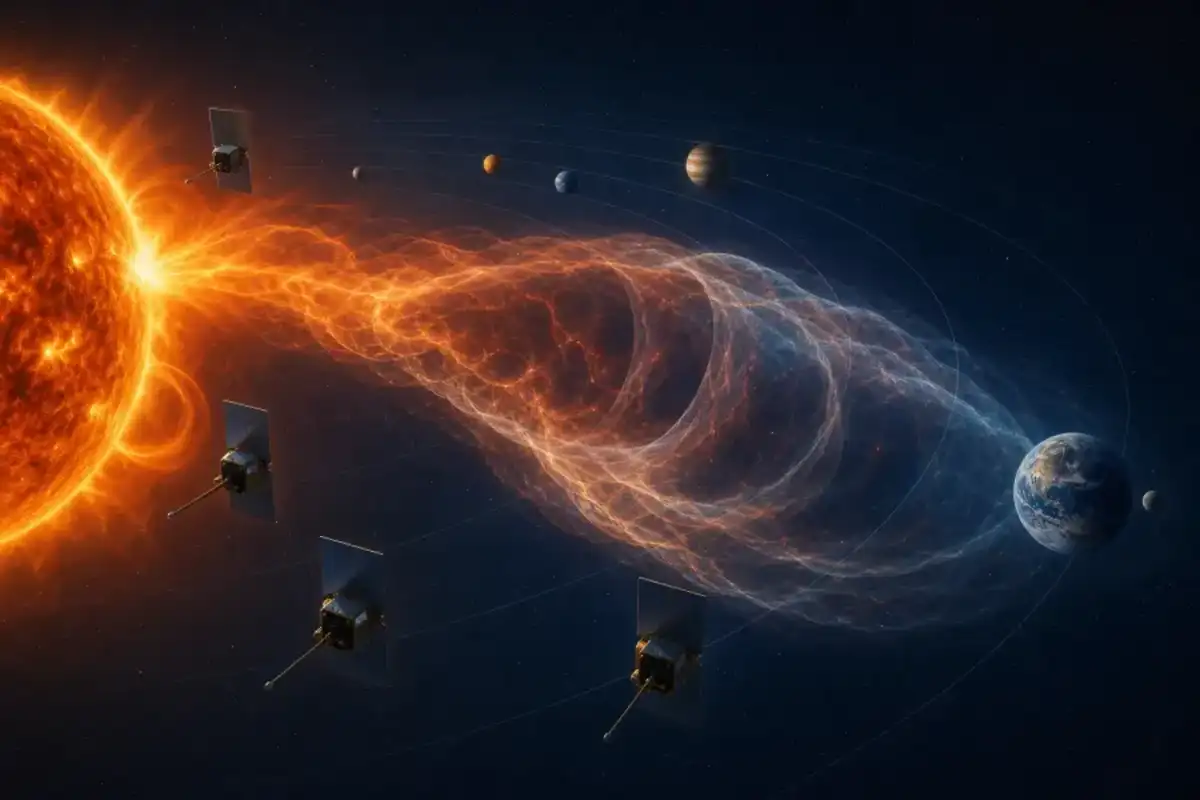
NASA’s PUNCH mission has now shown how that gap could shrink. In an initial proof-of-concept test, researchers used continuous images of a CME to predict its arrival near Earth to within 30 minutes. Current methods commonly leave forecasters with an uncertainty of about five hours.
Following the eruption after it leaves the Sun
PUNCH stands for Polarimeter to Unify the Corona and Heliosphere. The mission uses four small spacecraft in low Earth orbit, working together as a wide-field camera. Instead of concentrating on the bright solar disk, PUNCH observes the faint outer atmosphere and the material moving away from the Sun.
That wider view matters because a CME can expand, slow down or develop internal structure during its journey. Before PUNCH, a CME could be tracked in detail for only part of the trip. Forecasters then had to estimate what happened during the rest of the distance using limited observations and computer models.
PUNCH takes a new image roughly every four minutes. In the test described by NASA, the team followed a CME that left the Sun on May 31, 2025. Twelve hours after the eruption, the model predicted that the storm would arrive eight hours later. The predicted time was ultimately within half an hour of the actual arrival.
Why half an hour matters
Solar storms can disturb radio communication, satellite operations and navigation systems. Powerful events can also drive currents through long power lines. The damage depends on the strength and orientation of the magnetic field carried by the CME, but timing still matters: operators need to know when to move satellites into safer modes or adjust systems on the ground.
A forecast that narrows the arrival time from five hours to 30 minutes would not remove every uncertainty. It would give engineers a better idea of when the disturbance is about to begin, while leaving room to monitor the storm’s magnetic field as it approaches. The result is a more useful warning rather than a promise of perfect prediction.
The first result is a test, not the final system
NASA describes the result as an initial demonstration, and the underlying research is still under review in the journal Space Weather. The test used one CME and a model that the researchers say was relatively simple. More events will be needed to learn how the method performs when eruptions travel at different speeds or cross paths with other solar activity.
The images also show that CMEs are more structured and clumpy than a smooth cloud of plasma. That detail could improve both arrival-time estimates and our understanding of how solar material moves through the inner solar system.
PUNCH is not replacing ground-based space-weather centres. It is adding a longer, clearer view of the journey between the Sun and Earth. If later tests confirm the early result, the mission could give those forecasters a much firmer clock to work with when the next major solar eruption heads our way.
The practical benefit would arrive before a storm reaches its peak. A warning can give satellite teams time to change operating modes, help airlines assess radio conditions on polar routes and allow grid operators to compare the forecast with measurements from their own instruments. Those decisions still depend on the storm’s magnetic field, which PUNCH does not measure directly. Its contribution is narrower and more precise timing: knowing when the cloud of solar material is likely to arrive makes the other measurements easier to interpret.
For historical context, see Curiosmos’ account of the Carrington Event and the warning signs of severe space weather.