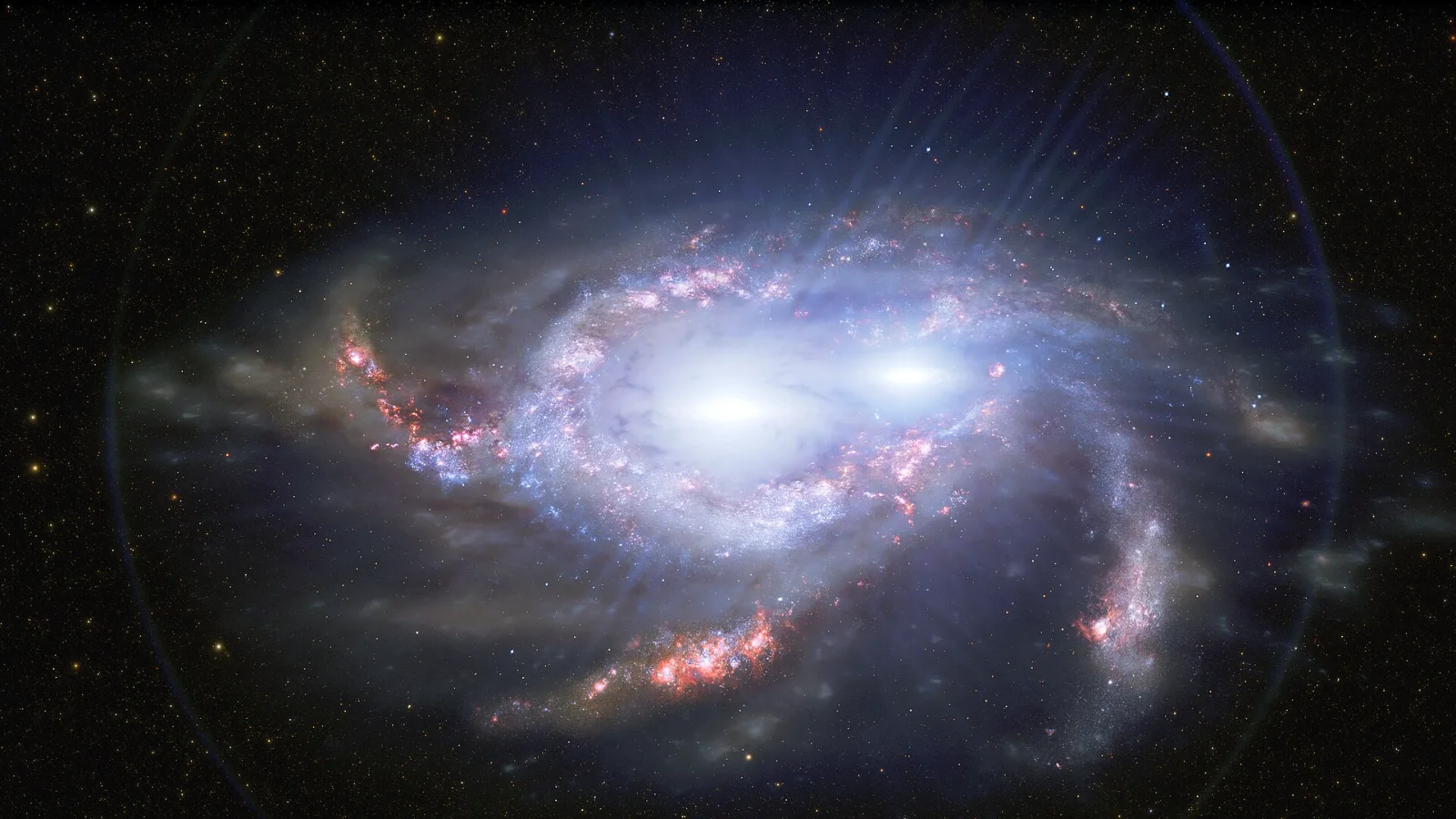
Astronomers have found two feeding supermassive black holes just 18,100 light-years apart, seen as they were about 900 million years after the Big Bang. The pair, catalogued as J1602+4228AB, is the most distant close quasar pair ever observed and only the third known quasar pair from that early era, the period astronomers call cosmic dawn.
One black hole weighs about 1.5 billion times the mass of the Sun, the other about 400 million. “There is no definitive theoretical explanation” for how black holes this big formed so early, said lead researcher Silvia Onorato of NSF NOIRLab.
At a glance
- Distance in time: seen 900 million years after the Big Bang, when the universe was about a thirteenth of its current age.
- Separation: 18,100 light-years, about a fifth of the Milky Way’s diameter.
- Published: The Astrophysical Journal Letters, November 2026.
How they found it
The pair turned up in the Aether survey, led by Emanuele Paolo Farina of NSF NOIRLab and the Gemini Observatory, which uses the James Webb Space Telescope’s near-infrared spectrograph to study 200 quasars from the early universe, about 43 percent of all those known from the period.
Follow-up with the Gemini North telescope on Maunakea, Hawaiʻi, resolved the object into two distinct quasars with its GNIRS spectrograph, and the GMOS instrument added more data. Conditions were “so clean and sharp that we managed to collect the data in only two nights,” Onorato said.
Why it is a puzzle
A quasar is a supermassive black hole swallowing gas so fast that the material around it outshines its entire galaxy. Finding two of them, both already enormous and close together this early, is hard to square with how quickly black holes are thought to grow.
The team’s tentative explanation is that the pair sits in an unusually dense knot of early matter, where frequent galaxy collisions kept funnelling gas toward both black holes.
There is one alternative still to rule out: a single quasar split into two images by gravitational lensing. The two spectra differ, which favours two separate objects, but the researchers say lens modelling is still needed to close the question.
A Hawaiian name
The pair also has a Hawaiian name, Nāpōwawāʻenakaulua, created by Larry Kimura through the A Hua He Inoa naming programme run with the ʻImiloa Astronomy Center of Hawaiʻi and the University of Hawaiʻi.
How big is big?
The heavier black hole, at 1.5 billion solar masses, is about 350 times more massive than Sagittarius A*, the black hole at the centre of our own galaxy, which weighs about 4.3 million suns. Both had reached their size within the universe’s first billion years.
The distance between them, 18,100 light-years, is shorter than the distance from the Sun to the centre of the Milky Way, about 26,000 light-years. That closeness makes the pair a rare snapshot of two giant black holes growing side by side in the early universe.
Sources2
- Onorato et al., “Nāpōwawā‘enakaulua: A Close Quasar Pair at Cosmic Dawn in the Aether Survey”, The Astrophysical Journal Letters 1011 (2): L59, 2026, doi:10.3847/2041-8213/aeb11f
- AURA / NSF NOIRLab release via ScienceDaily, 23 November 2026