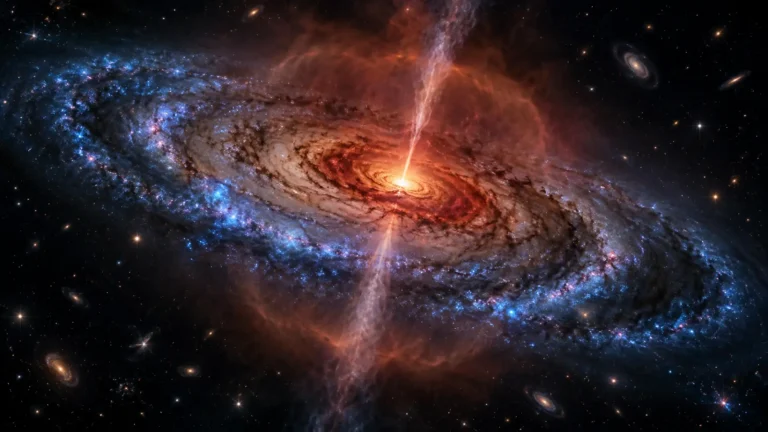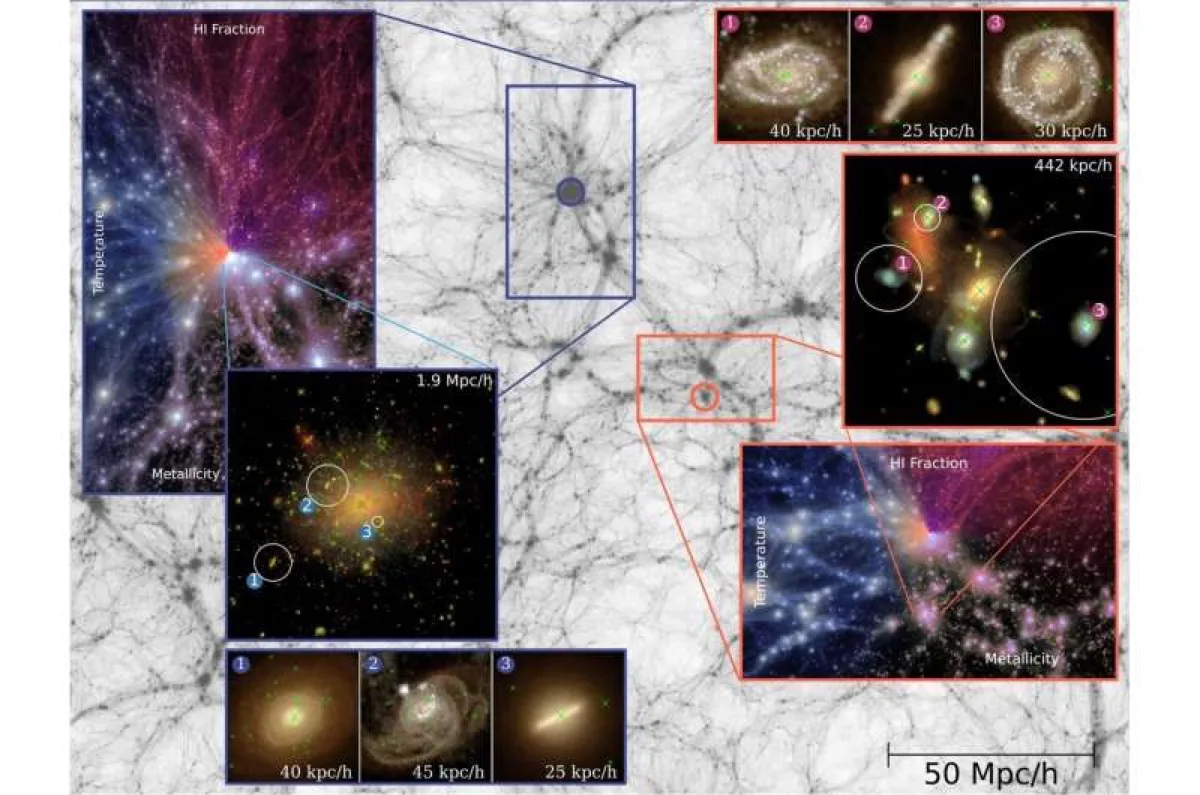
Researchers have completed one of the largest computer simulations of cosmic history yet assembled. Called ASTRID, it follows the growth of galaxies and black holes from the universe’s early days to the present, giving astronomers a virtual laboratory for testing ideas that cannot be replayed in the real sky.
The simulation begins at a redshift of 99, when the universe was still close to its first stages of structure formation, and evolves forward to the present day. Over roughly 13.5 billion years, it tracks gravity, gas, stars, and black holes as they gather into galaxies and interact across the expanding cosmos.
ASTRID contains 166 billion particles in a volume about 815 million light-years across. The calculations were carried out with the Frontera supercomputer at the Texas Advanced Computing Center. Each stored snapshot of the evolving model can occupy around 30 terabytes, which gives a sense of the scale of the project.
The timing is important because NASA’s James Webb Space Telescope is finding massive black holes at surprisingly early times. Those observations challenge simple accounts of how the first black-hole seeds formed and grew so quickly. Researchers can now compare those observations with different starting conditions inside ASTRID and see which histories produce similar galaxies.
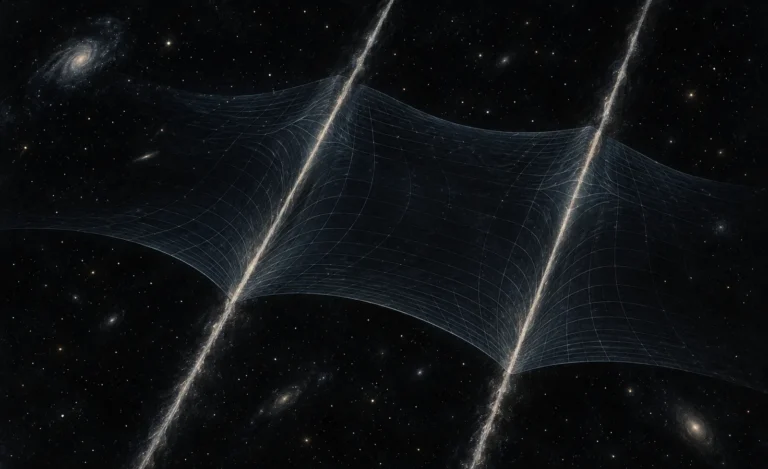
The simulation also follows galaxy mergers and the gradual sinking of black holes toward galactic centres. Its dynamical-friction models improve estimates of how long those encounters take. When the black holes eventually merge, the event should release gravitational waves that future observatories such as the Laser Interferometer Space Antenna may detect.
ASTRID is useful for planning those observations. The team can generate predictions for where massive black-hole mergers should occur, what environments host them, and how their gravitational-wave signals might look. It can also produce mock observations for large galaxy surveys, including the Vera C. Rubin Observatory’s Legacy Survey of Space and Time.
A simulation is not a photograph of the universe, and it cannot settle a question simply because it contains more particles. Its value comes from the comparison: researchers change the assumptions, run the history forward, and test the resulting galaxies against measurements from telescopes and detectors. That approach complements the methods used to infer a black hole that cannot be seen directly.
The completed ASTRID data are now available to the research community. That gives other teams a common model for exploring black-hole growth, galaxy formation, and the gravitational-wave events that may soon be observed across cosmic time.