What if the ring around a galaxy is another galaxy entirely? Gravity can bend a distant object’s light into a circle, stretch it into an arc or make the same object appear in several places. Reading those distorted images lets astronomers investigate both the distant source and the matter between it and Earth.
A lens made of gravity
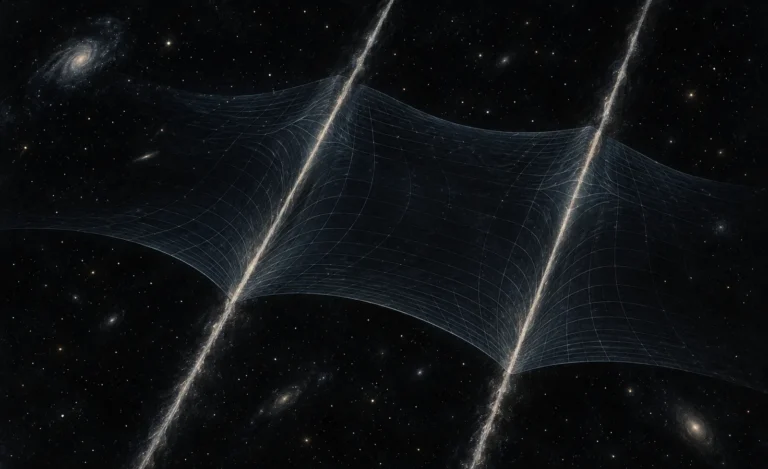
A glass lens changes the path of light as it passes through. A gravitational lens does something similar, but it is made from mass rather than glass. The gravity of a galaxy, galaxy cluster, or even a single star curves the space around it, and light follows that curved path.
The result depends on the alignment between three things: the distant source, the foreground object doing the bending, and the telescope observing from Earth. A small change in that alignment can produce a shifted image, a stretched arc, several separate images, or a nearly complete ring.
Gravitational lensing is a direct consequence of general relativity. It was predicted in the early twentieth century and later confirmed when observations showed that starlight was deflected by the Sun’s gravity. Astronomers now use the effect throughout the universe.
Why the background object can look brighter
The foreground galaxy does not create extra light. It redirects light that would otherwise pass elsewhere. In the right arrangement, some of that light is focused toward us, making the distant source appear brighter or larger than it would without the lens.
That magnification can bring extremely faint galaxies within the reach of telescopes. It also stretches their images into arcs, allowing astronomers to inspect structures that would be too small to resolve at their true distance.
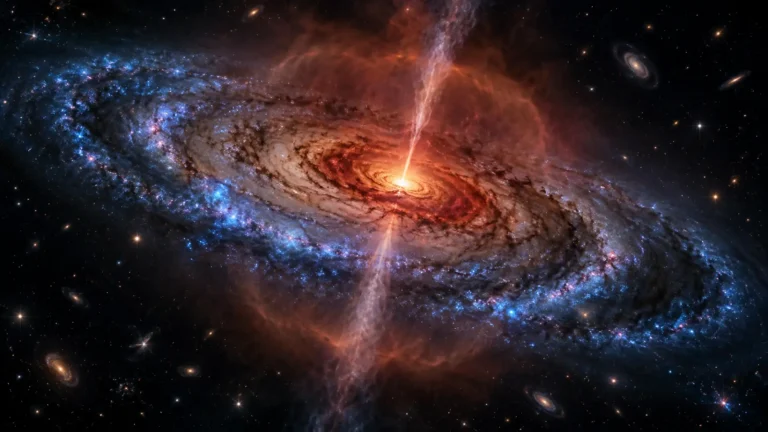
The lens can distort the image even when the background galaxy is not perfectly aligned. A cluster may produce several arcs around its centre, while a smaller lensing galaxy can create a set of separate images of the same background object. Comparing those images can reveal how much mass is concentrated in the foreground system.
What is an Einstein ring?
An Einstein ring forms when the source, the lens, and the observer line up almost exactly. Light from the background object is bent around the foreground mass from every direction, so the telescope sees a circle of light around the lensing galaxy.
Perfect alignment is rare, which is why complete rings are unusual. Most systems produce partial rings or curved arcs. The name comes from Albert Einstein’s general theory of relativity, which predicted the effect even though the technology needed to observe it did not yet exist.
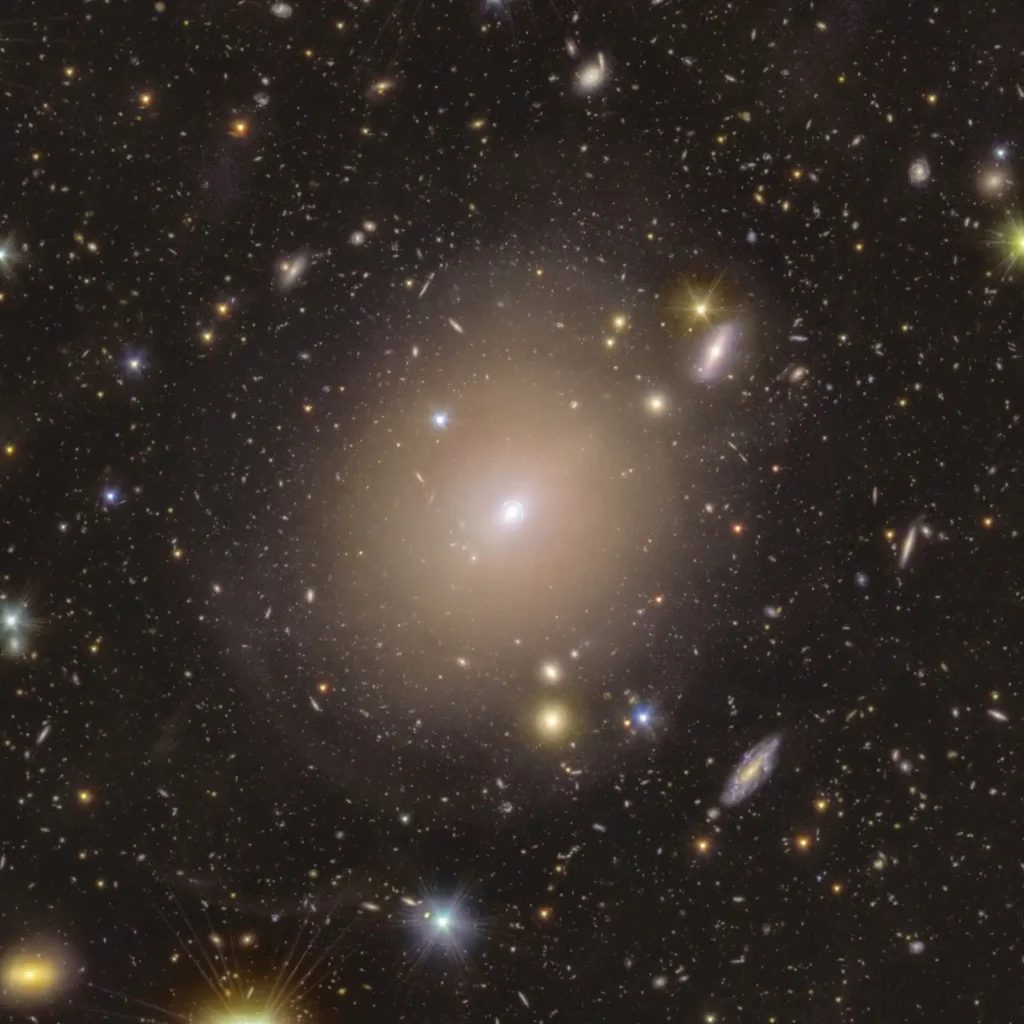
A striking example surrounds NGC 6505, a galaxy about 590 million light-years away. The ring is light from a separate galaxy 4.42 billion light-years away. In ESA’s February 2025 report, researchers described how Euclid revealed this alignment in a galaxy astronomers had known since 1884. The familiar foreground object had been hiding an unfamiliar view of the distant universe.
Lensing can reveal dark matter
The visible stars in a galaxy cluster account for only part of its mass. If a cluster bends background light more strongly than its visible matter could explain, the missing mass can be mapped through the distortion. This is one of the ways astronomers trace dark matter, which does not emit or reflect light in the usual way.
Weak lensing is subtler. Instead of producing obvious arcs, the gravity of many foreground structures slightly stretches the shapes of thousands of background galaxies. The effect is too small to identify in one galaxy, but statistical patterns across a large survey can reveal how matter is distributed.
Strong lensing and weak lensing answer different questions. Strong lensing makes individual systems visible and can magnify distant galaxies. Weak lensing measures the average distribution of mass across enormous regions of space. Together, they turn the shapes of background galaxies into a map of the universe’s structure.
A natural time machine
Light takes time to travel, so a lensed background galaxy is already a view into the past. The lens can make that ancient light easier to detect, giving astronomers a chance to examine galaxies from a period when they were young and still assembling. The same challenge of reading faint light appears in Curiosmos’s report on MoM-BH1, a red early-universe object whose spectrum may reveal a black hole hidden by dense gas.
The geometry can also create different travel paths for light from the same changing object. If a supernova or a variable quasar appears in several lensed images, the flashes may reach Earth at different times. Measuring those delays provides information about the lens and, in some cases, helps constrain the expansion rate of the universe.
Gravitational lensing therefore has several jobs at once. It tests Einstein’s description of gravity, exposes invisible mass, magnifies the distant universe, and turns the space between a galaxy and a telescope into part of the instrument. The effect is not a special trick of one observatory; it is a natural consequence of how matter shapes space and how light moves through it.
Continue reading on Curiosmos
- How Do Astronomers Know a Black Hole Is There If They Cannot See It?
- Webb Found a Hidden Planet in Beta Pictoris by Reading Its Atmosphere
- What Is the Great Attractor Pulling the Milky Way Toward?