The James Webb Space Telescope has identified MoM-BH*-1, a distant object that may be a “black hole star”—a black hole wrapped in a cloud of glowing gas. Its light comes from a time when the universe was less than 660 million years old, and it may help explain Webb’s mysterious little red dots. A different way of studying a black hole appears in our report on the star racing around Sagittarius A*, whose orbit may reveal the black hole’s spin.
The object, named MoM-BH*-1, was identified in observations from the Mirage or Miracle (MoM) survey. Its light began travelling toward Earth when the universe was less than 660 million years old. The discovery, reported in Nature in August 2026, gives astronomers a rare look at a possible early stage in the growth of the giant black holes that later sat at the centres of galaxies.
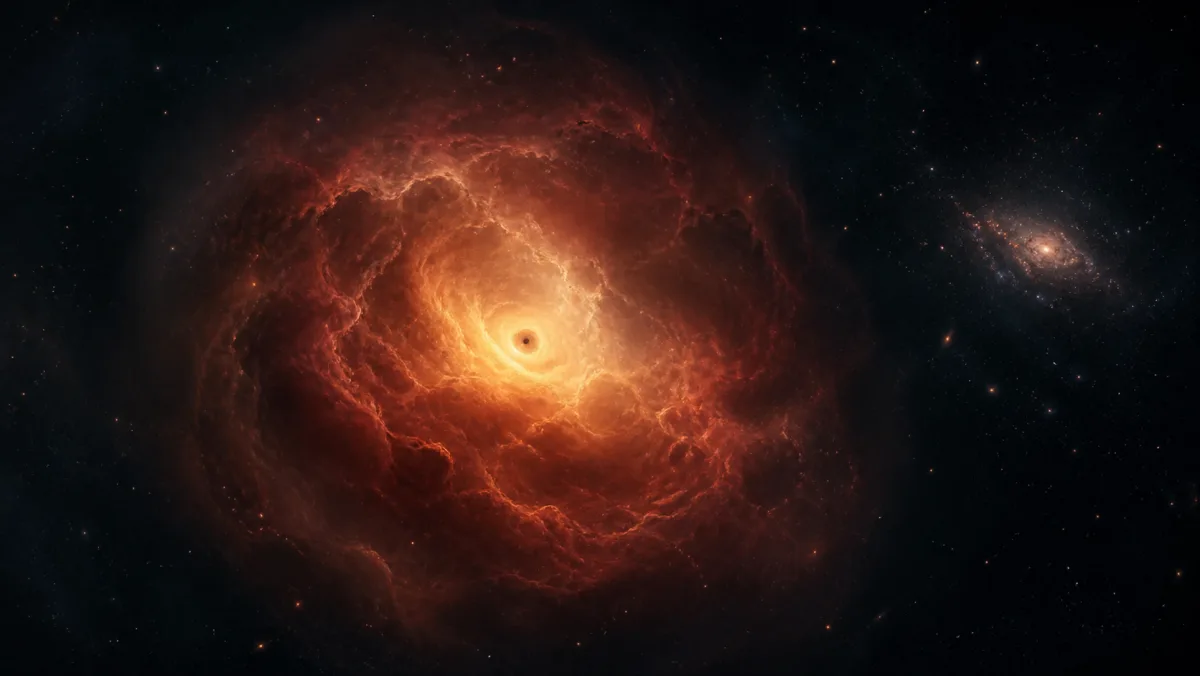
The name “black hole star” is slightly misleading. MoM-BH*-1 is not a normal star with a black hole hidden inside it. The term describes a proposed quasi-star: a black hole wrapped in a huge, dense envelope of gas. Gas falling inward releases enormous energy, while the surrounding cloud processes that light and makes the object appear, from a distance, more like a red star than a conventional active galaxy.
A red point in the early universe
Webb’s discovery of the so-called little red dots in the early universe has opened a new debate about the first billion years of cosmic history. These compact red sources appear in deep JWST images, often at extreme distances. Their spectra contain both star-like features and the broad emission lines associated with material moving around a black hole.
That combination has made them difficult to classify. Some little red dots may be young galaxies whose central black holes are hidden behind gas and dust. Others may be dominated almost entirely by the black hole and its cocoon. Until now, it has been hard to separate the light of the central engine from the faint galaxy that might surround it.
MoM-BH*-1 is useful because it appears to be unusually isolated. The team describes it as the best example yet of a “naked” black hole star: an object whose observed light can be explained by the accreting black hole and its gas envelope, without a bright host galaxy confusing the picture.
That does not mean the object is literally floating in empty space. It lies close to a young galaxy at roughly the same cosmic distance. But the observations suggest that the black hole star has not yet merged with that galaxy. Models presented by the researchers indicate that such a collision could occur in about 100 million years.
Why the gas glows like a star
In a normal star, nuclear fusion supplies the energy that makes its outer layers shine. In a black hole star, the power source is different. Gas spirals toward the black hole, heats up through friction and compression, and releases radiation before it disappears past the event horizon.
The dense gas around the black hole acts like a veil. It absorbs and reprocesses some of the radiation, giving the object a spectrum with features that can resemble those of a hot, compact stellar population. The black hole itself remains hidden inside the cocoon. What Webb detects is the signature of the energized gas around it.
That distinction matters. A bright red point in a Webb image is not automatically a star, a galaxy, or a quasar. Astronomers have to use the object’s spectrum—how its light is distributed across different wavelengths—to work out what is producing the glow.
The MoM survey was designed to look at sources that could easily be misclassified. Some candidates that appear to be distant galaxies turn out to be nearby cool stars or other interlopers. Others, like MoM-BH*-1, may reveal a short-lived phase that has been difficult to find because it existed so early and lasted for such a limited period.
A possible link to the little red dots
The discovery does not prove that every little red dot is a black hole star. It does, however, provide a physical example of how one could produce the strange mix of star-like and black-hole-like signals seen in the Webb population. Curiosmos has also examined how black holes are photographed when the objects themselves cannot be seen directly.
The researchers modelled what might happen if an object like MoM-BH*-1 eventually became embedded in a young galaxy. Once the black hole star merged with its host, the combined light could look very much like the little red dots already being catalogued inside early galaxies.
That offers a possible bridge between two stages of black-hole growth. A dense gas cocoon could first hide a rapidly growing black hole. Later, as the cocoon thinned or the surrounding galaxy became brighter, the black hole could appear more like an ordinary active galactic nucleus. If the accretion continued, it could eventually power a quasar.
This is one reason the discovery matters beyond the object itself. Astronomers still do not know how supermassive black holes became so large so quickly in the early universe. The first galaxies formed only a few hundred million years after the Big Bang, yet some already contained black holes weighing millions or even billions of times more than the Sun.
One possibility is that unusually massive “seeds” formed from the collapse of enormous gas clouds. A quasi-star phase could help such a seed grow rapidly while remaining wrapped in material that regulates, or at least hides, the accretion process. MoM-BH*-1 does not settle that question, but it shows that a black hole surrounded by a star-like envelope is not merely a mathematical idea.
What Webb has—and has not—shown
The phrase “discovered a black hole star” should be handled carefully. MoM-BH*-1 is a strong candidate for the black-hole-star interpretation, not a photograph of a black hole sitting inside a conventional Sun-like star. The evidence comes from the object’s spectrum, its extreme distance, its luminosity, and the way its light can be explained by an accreting black hole hidden within dense gas.
The published Nature analysis adds another clue: MoM-BH*-1’s extreme redness can be explained by dense gas rather than dust, while scattering in that gas may shape the hydrogen lines. If so, the line widths used to estimate the black hole’s mass could make it appear up to two orders of magnitude heavier than it is. What looks like a simple red point is also a test of how light moves through the cocoon around a growing black hole.
Future observations will test whether the object is truly isolated, how massive its black hole is, and how its spectrum changes over time. Webb is also helping refine how telescopes see the past, because every observation of MoM-BH*-1 is a view of an earlier universe. Webb’s infrared instruments can also examine other little red dots and compare them with MoM-BH*-1. If the same pattern appears repeatedly, the black hole-star model will become much harder to dismiss.
For now, the discovery gives astronomers something they have been missing: a nearby example, in cosmic terms, of the proposed engine behind a much larger population. Webb has not simply found another distant red speck. It may have caught a black hole before it became the centre of a mature galaxy.
Sources and further reading
- Naidu et al., “A gas-enshrouded and gas-reddened black hole at cosmic dawn,” Nature (2026)
- Naidu et al., “A ‘Black Hole Star’ Reveals the Remarkable Gas-Enshrouded Hearts of the Little Red Dots”
- NASA: Webb Finds Strongest Evidence Yet for “Black Hole Stars”
- Space.com: Farthest “black hole star” ever found