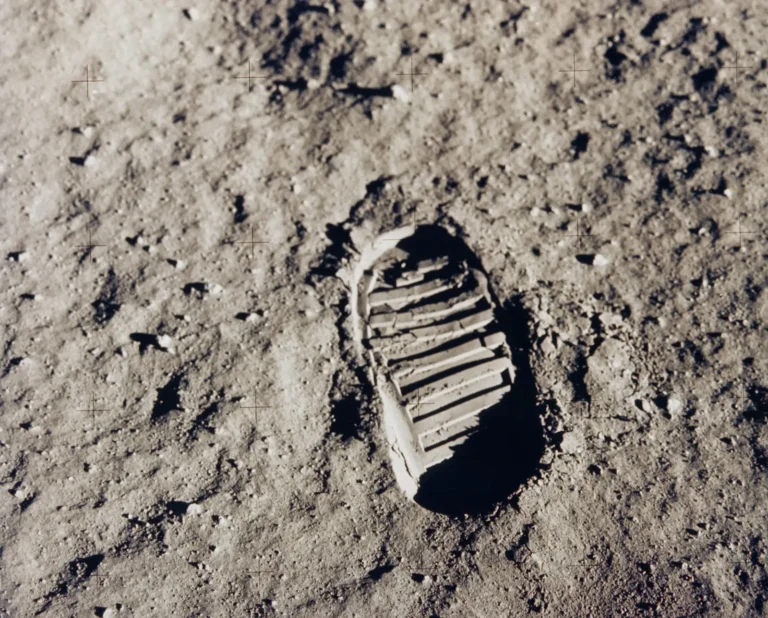
When you look at the Moon, you see it as it was about 1.3 seconds ago. The delay is too short to notice, but the principle is the same for every object in the sky. A telescope receives old light. The farther away the source, the further back in its history we are looking. The same delay is why Webb can study objects such as the possible black-hole star in the young universe.
That is why astronomers describe observatories as time machines. They do not send us into the past. They collect photons that began their journey long before a camera, a mirror or a human eye was ready to receive them.
Light needs time to cross space
Light travels through empty space at 299,792 kilometres per second. That is extraordinarily fast by everyday standards, but the distances between stars and galaxies are so large that the journey still takes years, centuries or billions of years.
One light-year is the distance light travels in one year. It is a unit of distance, not time. If a star is 100 light-years away, the light entering a telescope tonight left that star roughly 100 years ago. A photograph of the star is therefore a record of an earlier state, not a live view.
Everyday examples are already around us
Sunlight takes about eight minutes and 20 seconds to reach Earth. If the Sun vanished, we would continue to see it—and feel its gravity—for a little more than eight minutes before the news arrived by light. The delay is not a weakness in the telescope. It is built into the distance between the observer and the source.
The same idea works on larger scales. The light from Proxima Centauri, the nearest star beyond the Sun, takes just over four years to arrive. When astronomers observe it, they are looking at the star as it was more than four years earlier.
Looking deeper means looking further back
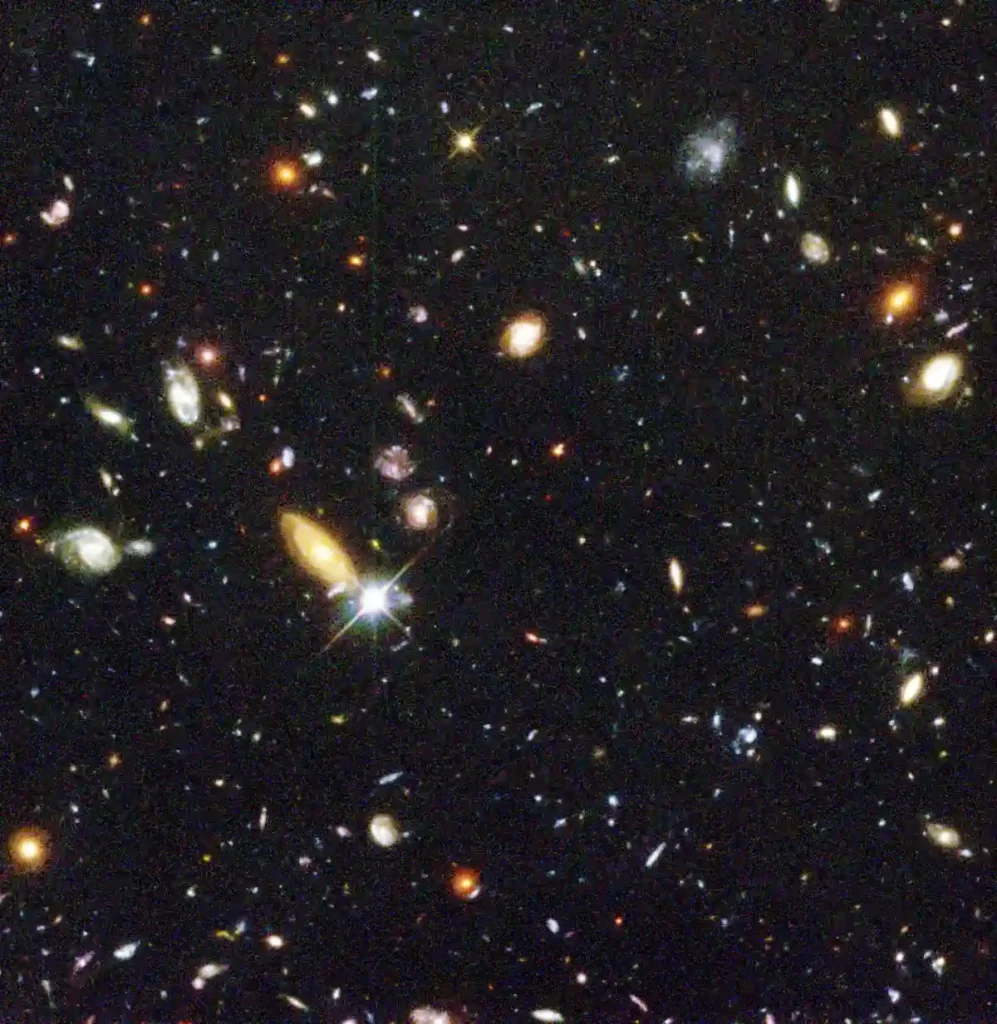
A galaxy one billion light-years away is seen in a state from roughly one billion years ago. A galaxy ten billion light-years away is seen at a much younger stage of cosmic history. The most distant light we observe comes from an early universe in which galaxies were still forming and assembling.
Distance and age are connected, although the expanding universe makes the bookkeeping more complicated than a simple ruler. The number quoted for a galaxy’s distance can depend on whether astronomers mean the time its light travelled, its present-day distance, or another cosmological measure. The underlying fact remains straightforward: light carries a dated message.
Why Webb can see early galaxies
The James Webb Space Telescope observes infrared light. As the universe expands, light from very distant galaxies is stretched toward longer wavelengths, a process called redshift. Infrared instruments are well suited to detecting that older, redder light.
Webb’s deep observations do not show the first galaxies in a single perfect snapshot. They show galaxies at different distances and therefore at different moments in their development. Comparing those populations allows astronomers to trace how the young universe changed.
Curiosmos has also looked at what Webb can learn from a single nearby system in its study of a hidden planet in Beta Pictoris. That work is not a deep-time observation like a distant galaxy, but it uses the same basic advantage: different wavelengths reveal information invisible to ordinary eyesight.
What a telescope actually measures
A telescope does not receive a photograph with an age printed on it. It records the number of photons arriving at each wavelength, along with their direction and arrival time. From that light, astronomers work out temperature, chemical composition, motion and distance. The spectrum of a galaxy can show that its light has been stretched by expansion, while the pattern of absorption lines can reveal the elements in a star’s atmosphere.
Resolution matters as well. A distant galaxy may appear as a small blur even in a powerful observatory, but its combined light still carries information about the stars inside it. Longer exposures allow a detector to collect more of the faint signal, and different instruments reveal parts of the same object that visible light cannot show. Looking into the past is therefore a careful measurement, not a visual trick.
Can we see what an object is doing right now?
Not directly. Astronomers can estimate a distant object’s current condition by combining its old light with models of how stars and galaxies change. If a star is known to evolve over millions of years, researchers can use its age and physical properties to infer what may be happening today. It remains an inference, not a simultaneous view.
For nearby objects, the delay is small enough to ignore in most conversations. For the early universe, the delay is the observation. The telescope is reading a sequence of old signals, each one arriving after a different journey.
The sky is a record of changing light
Astronomy is possible because the universe preserves information in light. The colour, brightness, timing and spectrum of a photon can reveal a star’s temperature, a galaxy’s motion or the chemistry of an atmosphere—even after the photon has travelled for billions of years.
When a telescope points at a distant galaxy, it opens a window onto a previous chapter of that galaxy’s life. The farther the window, the older the scene. Curiosmos’s guide to the observable universe explains why those distances cannot be read as if the cosmos were a static map.