When the James Webb Space Telescope began finding tiny, intensely red sources in the early universe, astronomers were not looking at ordinary galaxies. The objects were so compact that, in some images, they looked almost like red points of light. They became known as “little red dots,” and their declining numbers at later cosmic times has been one of Webb’s more stubborn puzzles.
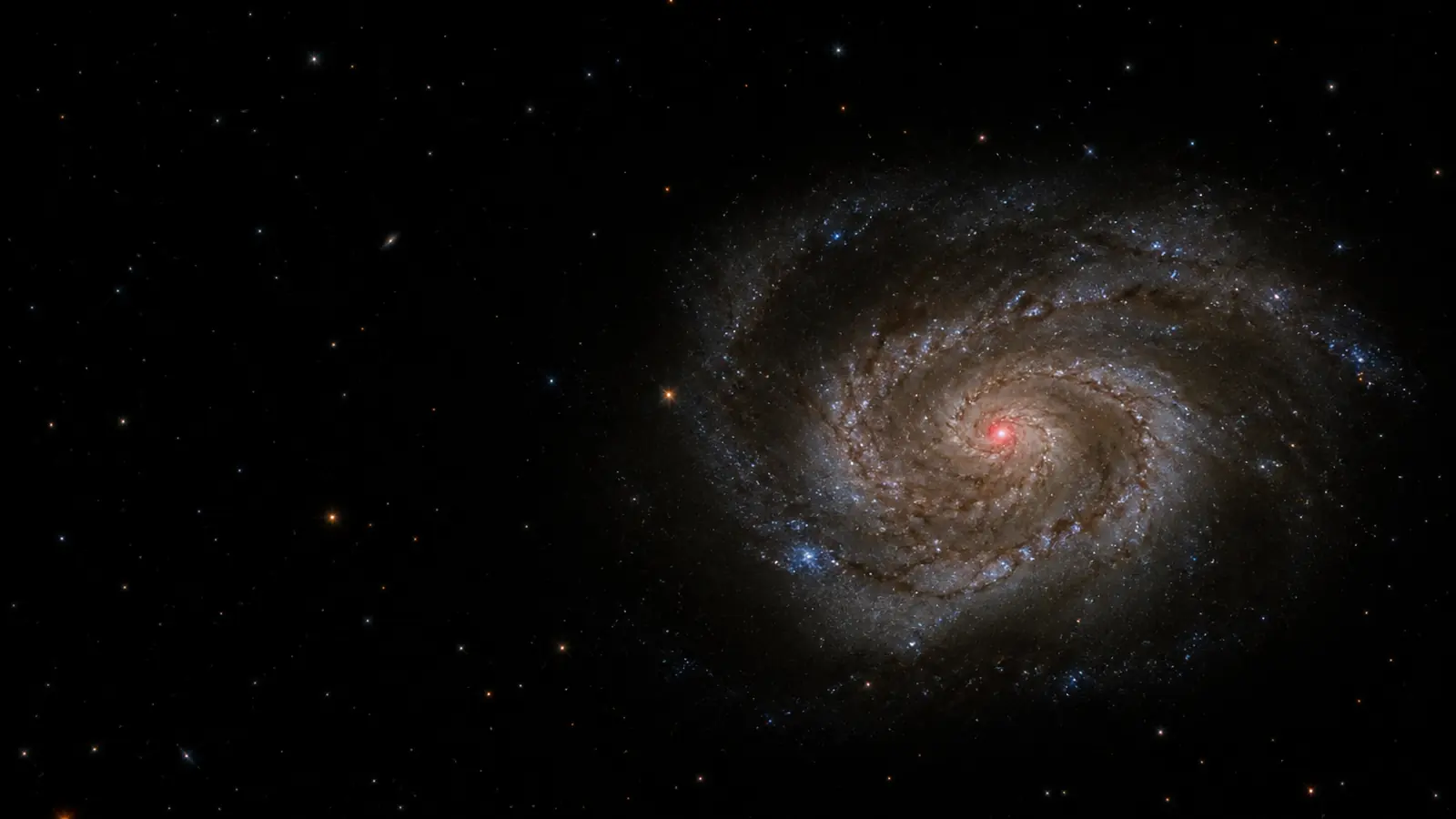
A study released on July 29 may have supplied an important piece of the answer. Researchers examined a lower-redshift spiral galaxy called WISEA J123635.56+621424.2, nicknamed the Saguaro because of its prominent arms. At its centre sits a compact red source that behaves much like the distant little red dots Webb has been finding billions of light-years away.
The Saguaro gives astronomers a way to study the red nucleus alongside the spiral galaxy around it. Could the most distant red dots also have hosts whose faint outer structures are simply beyond our view?
Why little red dots have been so difficult to explain
The objects first drew attention in Webb observations of the high-redshift universe. Their light has travelled for most of cosmic history, so we see them as they were when the universe was young. They are compact, red, and surprisingly common in those early observations, yet far less common at lower redshifts.
Some studies have argued that they are heavily obscured active galactic nuclei—young supermassive black holes wrapped in dust. That idea fits several of their properties, but it leaves a basic question unanswered: if they are a distinct population, where did they go as the universe matured?
The new work suggests that part of the answer may be observational. At enormous distances, a galaxy’s faint outer structure is pushed below the sensitivity of even a powerful telescope. The bright nucleus remains visible, while the host galaxy effectively disappears. A normal galaxy can therefore look like a strange red point simply because we cannot see all of it.
That is why the Saguaro matters. Its red nucleus is close enough in cosmic terms for Hubble and Webb to resolve the surrounding spiral. The same galaxy can then be digitally shifted to the greater distances where the original little red dots are observed. When the researchers perform that test, much of the host fades away and the centre takes on the appearance of a high-redshift little red dot.
The Saguaro’s hidden centre
The galaxy lies at redshift 2, corresponding to roughly 3.3 billion years after the Big Bang. That still places it deep in the universe’s past, but it is much closer than the earliest little red dots.
Researchers combined ultraviolet observations from Hubble with Webb’s infrared data. They also considered X-ray measurements from NASA’s Chandra X-ray Observatory. The compact centre is brighter in ultraviolet and infrared light than in visible wavelengths, matching an important characteristic of the distant sources.
Chandra detected weak X-ray emission from the nucleus. That is consistent with a heavily obscured active galactic nucleus, in which a growing supermassive black hole is hidden behind gas and dust. The signal is faint, and the researchers are careful not to treat one galaxy as a universal template. Still, it helps explain why many little red dots are so difficult to detect in X-rays.
The picture is not of a bare black hole floating in empty space. It is a bright, active centre embedded in a larger galaxy whose outer parts are easy to miss when viewed from the early universe.
Where could the family tree lead?
The study’s central idea is that little red dots may represent a phase rather than a permanent type of galaxy. As an active black hole grows and the surrounding galaxy evolves, the compact red nucleus could become part of a more familiar galactic system. In that sense, the Saguaro may be one branch on the family tree of the early sources Webb has uncovered.
There is an important qualification. The Saguaro is a single case study. The researchers do not claim that every little red dot is simply a normal galaxy seen at the wrong distance, and the observations do not settle the debate over the objects’ true nature. More low-redshift examples are needed, along with larger searches through Webb’s archive.
Each telescope adds a different part of the same scene. Comparing those views lets astronomers explore a connection that a single image would leave hidden.
Webb’s infrared vision shows the compact source and the dust around it. Hubble supplies the ultraviolet view of the host galaxy. Chandra tests whether a hidden accreting black hole is producing X-rays. Together they turn a mysterious point into a place with a history.
The discovery also gives the little red dots a more familiar setting. They may not be isolated curiosities at the edge of the observable universe. They could be the bright, obscured centres of galaxies passing through a short-lived stage of growth—one that becomes harder to recognise as the universe gets older.
For readers trying to understand how astronomers reconstruct the universe’s past, Curiosmos has also examined why the observable universe can be 93 billion light-years across even though the cosmos is about 13.8 billion years old, and how the James Webb Space Telescope reads the atmospheres of distant planets.