The Nancy Grace Roman Space Telescope is already travelling away from Earth, but the launch was only the opening scene. Since liftoff on August 30, NASA has been unfolding the observatory piece by piece: solar panels and a sunshade first, then the high-gain antenna, then the visor that will protect the telescope’s view. Why so much choreography after the rocket has done its work?
Because Roman cannot begin its survey until the spacecraft can power itself, talk to Earth and keep unwanted heat and light away from its instruments. The sequence is an engineering story, but it is also the beginning of the science. Each successful deployment removes one more condition that could prevent the telescope from seeing the faint universe it was built to study.
The observatory had to become larger than its rocket fairing
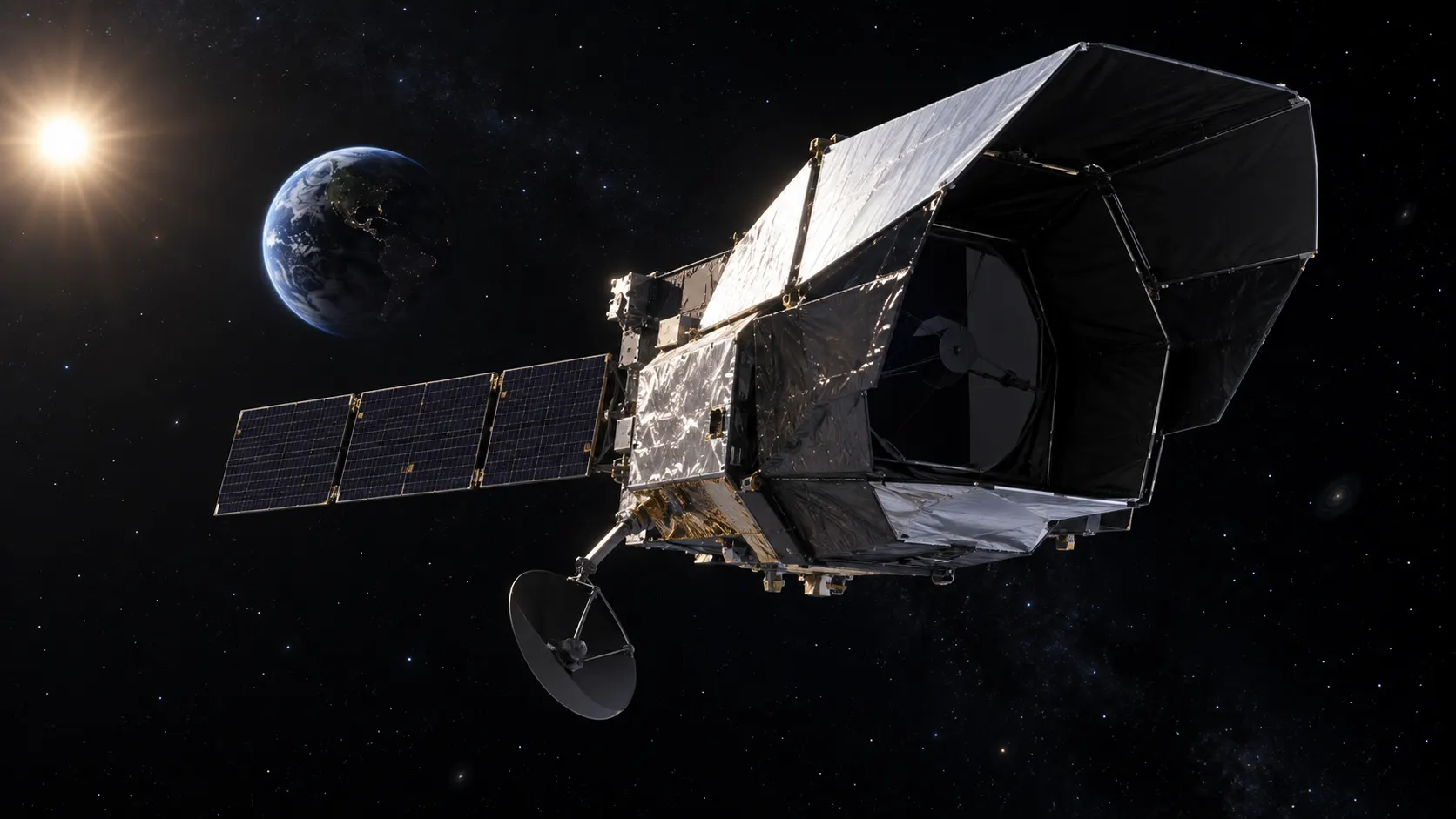
Roman left Earth folded into the compact shape required by its Falcon Heavy launch vehicle. NASA says the solar panels and sunshade deployed about an hour and 23 minutes after launch. The panels provide power, while the sunshade helps keep the observatory’s sensitive systems in the right thermal environment.
The spacecraft then opened the high-gain antenna. It is about 5.6 feet wide but weighs only 24 pounds, thanks to its carbon-composite construction. That unusual combination matters because Roman must carry a large communications system without carrying unnecessary mass all the way to its destination.
The antenna will send Roman’s data to ground stations in New Mexico, Australia and Japan. NASA says the system can transmit at up to 500 megabits per second. A telescope that surveys huge areas of sky will collect an enormous amount of information; seeing a distant galaxy is only useful if the observation can reach the scientists who will analyse it.
What does the visor actually do?
The next deployment was Roman’s deployable aperture cover, a large visor-like sunshade released by three booms. It is designed to keep unwanted light out of the telescope’s opening and to help shield the primary mirror from the environment around the spacecraft.
This is easy to mistake for a cosmetic detail. It is not. Infrared observations are vulnerable to heat, and faint sources can disappear when stray light raises the background. The visor is part of the observing system itself: it helps create the dark, stable conditions in which Roman’s detectors can measure very weak signals.
The question is not simply whether the telescope can open. It is whether it can open into an environment quiet enough for the measurements that come next.
Why is Roman travelling to L2?
Roman is making a roughly three-month journey to the Sun–Earth Lagrange Point 2, about one million miles from Earth. At L2, the gravity of the Sun and Earth, combined with the spacecraft’s motion, allows Roman to follow Earth around the Sun in a stable halo orbit without using fuel as quickly as it would elsewhere.
The location also gives the observatory a broad, relatively unobstructed view of the sky. Earth will not repeatedly pass in front of its target field, and the Sun, Earth and Moon can remain on the shielded side of the spacecraft. For an infrared telescope, that thermal arrangement is part of the reason L2 is useful.
Roman’s destination therefore shapes what it can see. The orbit is not an address chosen after the science is finished; it is one of the conditions that makes the science possible.
The first images are still months away
NASA describes the period between launch and science operations as commissioning. Engineers turn systems on, adjust them, calibrate the instruments and check that the observatory performs as expected. The Coronagraph Instrument has powered on, and NASA says the Wide Field Instrument will follow after additional preparations. The commissioning campaign is expected to last about three months, with the first images anticipated in early 2027.
That wait may feel long after the spectacle of launch, but it is where the mission becomes trustworthy. Roman is designed to survey the infrared universe with a field of view at least 100 times wider than Hubble’s and may measure light from a billion galaxies over its lifetime. Its wide surveys will probe dark energy and the growth of cosmic structure, while its coronagraph will test techniques for seeing giant exoplanets and dusty disks beside much brighter stars.
What if the most important moment in a space telescope’s life is not the first photograph, but the quiet sequence that makes the photograph possible? Roman’s antenna, sunshade and visor have now turned that question into a journey we can follow in real time.
Sources and further reading
- NASA Science: Roman Space Telescope’s Antenna and Visor Deployed
- NASA Science: Roman Commissioning
- NASA Science: Nancy Grace Roman Space Telescope mission overview
Related Curiosmos coverage: NASA’s Hubble tracks a new decagon around Saturn’s south pole, Hubble finds a superbubble filled with young stars, and Webb finds 27 small worlds beyond Neptune.