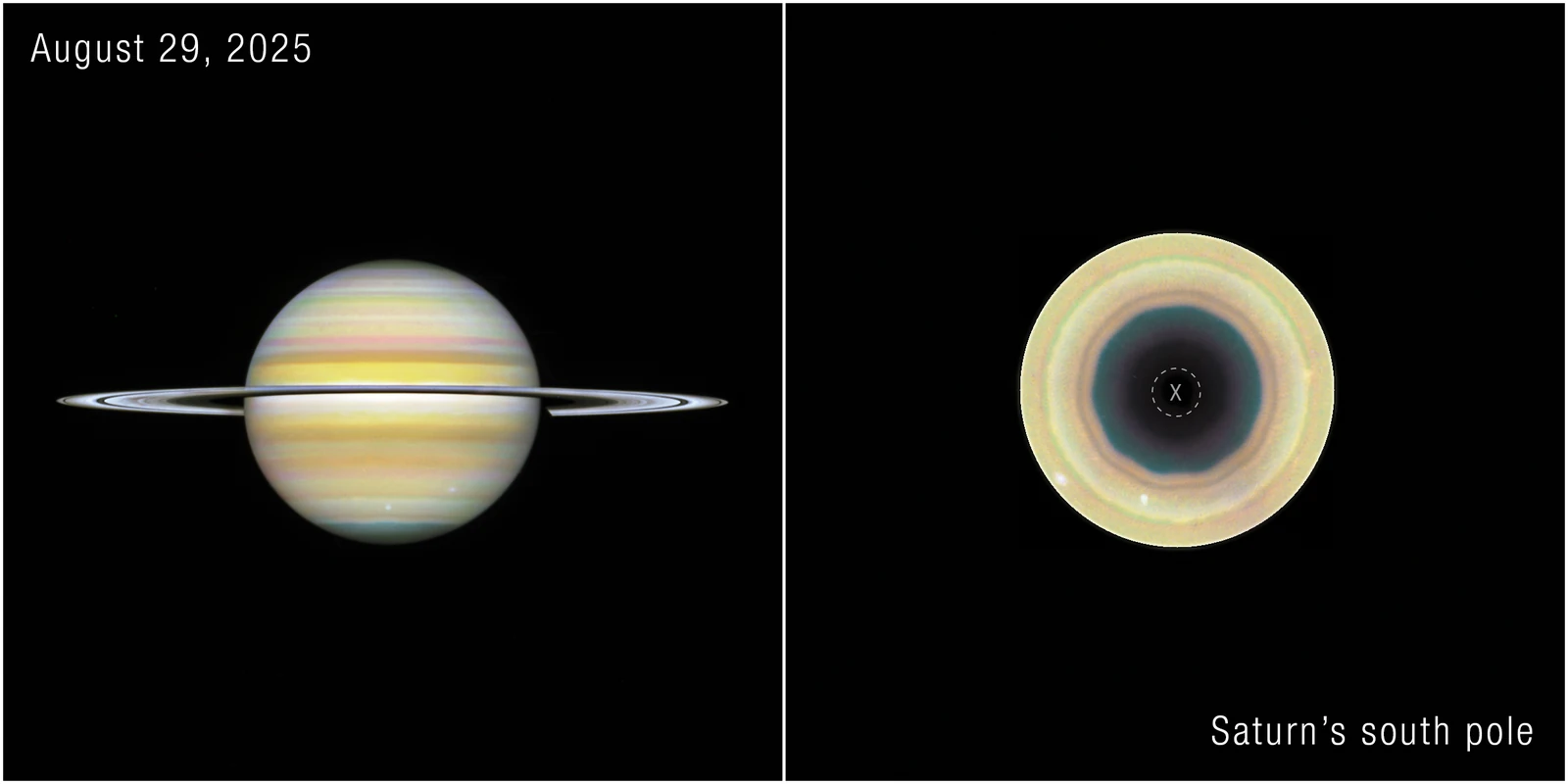
Hubble has found a growing ten-sided atmospheric wave around Saturn’s south pole—the first large regular-sided jet seen there.
Saturn has long been known for a strange shape in its clouds. A vast hexagon circles the planet’s north pole, holding its form for more than four decades. Now astronomers have found something that looks as if Saturn is trying a different piece of geometry at the opposite end of the planet.
NASA’s Hubble Space Telescope has revealed a giant, evolving atmospheric wave with ten sides around Saturn’s south pole. The feature is called a decagon, and it appears to be strengthening in observations that reach back to 2023. What if we are watching a planetary weather pattern take shape rather than simply discovering one that was already complete?
What did Hubble see at Saturn’s south pole?
The Saturn decagon is not a solid object and it is not a storm with a sharp edge like a drawing on a map. It is a wave embedded in one of Saturn’s powerful jet streams. Hubble images show a regular ten-sided pattern around the pole, with the wave extending through several layers of the atmosphere.
That vertical reach matters. A pattern that appears at one cloud level might be a temporary surface feature. A structure visible at different wavelengths can reveal motion and organization at different altitudes. NASA says the decagon’s apparent position shifts slightly between filters because each wavelength probes a different height in Saturn’s atmosphere.
The observations were made through Hubble’s Outer Planet Atmospheres Legacy program, or OPAL. The program photographs the outer planets repeatedly, allowing researchers to compare changes over years instead of treating a planet as a single frozen picture.
Why did astronomers notice it only recently?
Saturn’s seasons gradually brought its south pole back into view from Earth. Observers first noticed a subtle undulating band in ground-based images in 2024. Newer images from 2025 made the pattern look more convincing, and Hubble supplied the sharpness needed to follow it across the planet’s rotation.
The archive then provided an important surprise. Hubble data show hints of the feature as far back as 2023, even though it was not yet a clear ten-sided pattern. Cassini, which observed Saturn from orbit between 2004 and 2017, did not reveal a comparable long-lived structure at the south pole. The decagon may therefore have formed, or become organized, sometime after Cassini’s mission ended.
That does not mean the wave appeared in a single afternoon. The available observations only tell us that the pattern was absent or too subtle to recognize in earlier data and became distinct later. Its exact beginning remains an open question.
Is it Saturn’s southern version of the famous hexagon?
The resemblance is striking, but the two patterns are not twins. Saturn’s north-polar hexagon has persisted for at least forty years and is associated with a powerful jet stream. The new southern feature has ten sides, looks less settled, and appears to be changing.
The north and south poles also experience different seasonal lighting and atmospheric conditions as Saturn travels around the Sun. Those differences may help explain why one pole hosts a stable hexagon while the other now shows a growing decagon. Researchers need longer observations and atmospheric models before they can say whether the new wave will settle into a durable pattern.
The comparison is useful precisely because it is not perfect. Two regular shapes on the same planet give scientists a natural experiment. Which parts of the pattern come from Saturn’s rotation? Which depend on the depth of the jet stream, seasonal temperature changes or interactions between neighbouring winds?
Could the decagon last for decades?
No one knows yet. NASA describes the feature as evolving and says continued Hubble and James Webb observations, together with computer models, will be needed to understand how it formed and how long it may survive.
The apparent size is enormous. It is a planetary-scale atmospheric wave, not a small vortex that can be tracked for a few days and then forgotten. But size does not guarantee stability. A jet-stream pattern can strengthen, shift, break apart or reorganize as the surrounding atmosphere changes.
That uncertainty is part of what makes the discovery valuable. If the decagon fades quickly, it will reveal something about short-lived disturbances in a giant planet’s atmosphere. If it persists and becomes more regular, it may provide a rare test of the mechanisms that maintain Saturn’s north-polar hexagon.
What can Saturn’s weather teach us about Earth?
Saturn is far larger and colder than Earth, and its atmosphere is made mostly of hydrogen and helium. Its weather cannot simply be used as a direct model for a hurricane or jet stream here. Yet the physics of rotating fluids connects them.
Fast rotation can organize moving gas into bands and jets. Where those jets meet, waves can form and travel. Experiments with rotating fluids and computer simulations help researchers ask why some patterns become polygonal and why others remain irregular. Saturn offers a natural laboratory at a scale impossible to reproduce in an Earth-based weather system.
The decagon also shows why repeated observations matter. A single photograph could reveal a beautiful shape, but not whether it is new, stable or changing. OPAL’s long record turns an image into a time series. It lets astronomers ask when the pattern began, how quickly it strengthened and whether it is tied to Saturn’s seasons.
What happens next?
Hubble will continue to watch the southern hemisphere as Saturn’s seasonal geometry changes. Webb may add information at infrared wavelengths, while atmospheric simulations can test whether the wave can arise from known jet-stream dynamics.
The next observations could answer a deceptively simple question: does Saturn have a second long-lived polygon, or did we catch a temporary pattern while it was still forming?
For now, the south-polar decagon is a reminder that the planets are not finished illustrations. Their atmospheres move, reorganize and sometimes reveal structures that were hidden simply because no one had been watching at the right time. Saturn’s famous hexagon may no longer be the only geometric surprise in its clouds—and the new shape may be telling us how quickly a giant planet can change.
Sources and related reading
- NASA’s Hubble report: NASA’s Hubble Tracks New Decagon Encircling Saturn’s South Pole
- NASA image record: Decagon on Saturn’s South Pole
- Research paper: A decagon wave around Saturn’s south pole
- Related Curiosmos reading: How Fast Does Light Travel? The Cosmic Speed Limit Explained
Image: Hubble views of Saturn and its south-polar decagon. NASA, ESA, STScI, Agustin Sánchez-Lavega (UPV), Amy Simon (NASA-GSFC), Michael Wong (UC Berkeley); image processing by Alyssa Pagan.