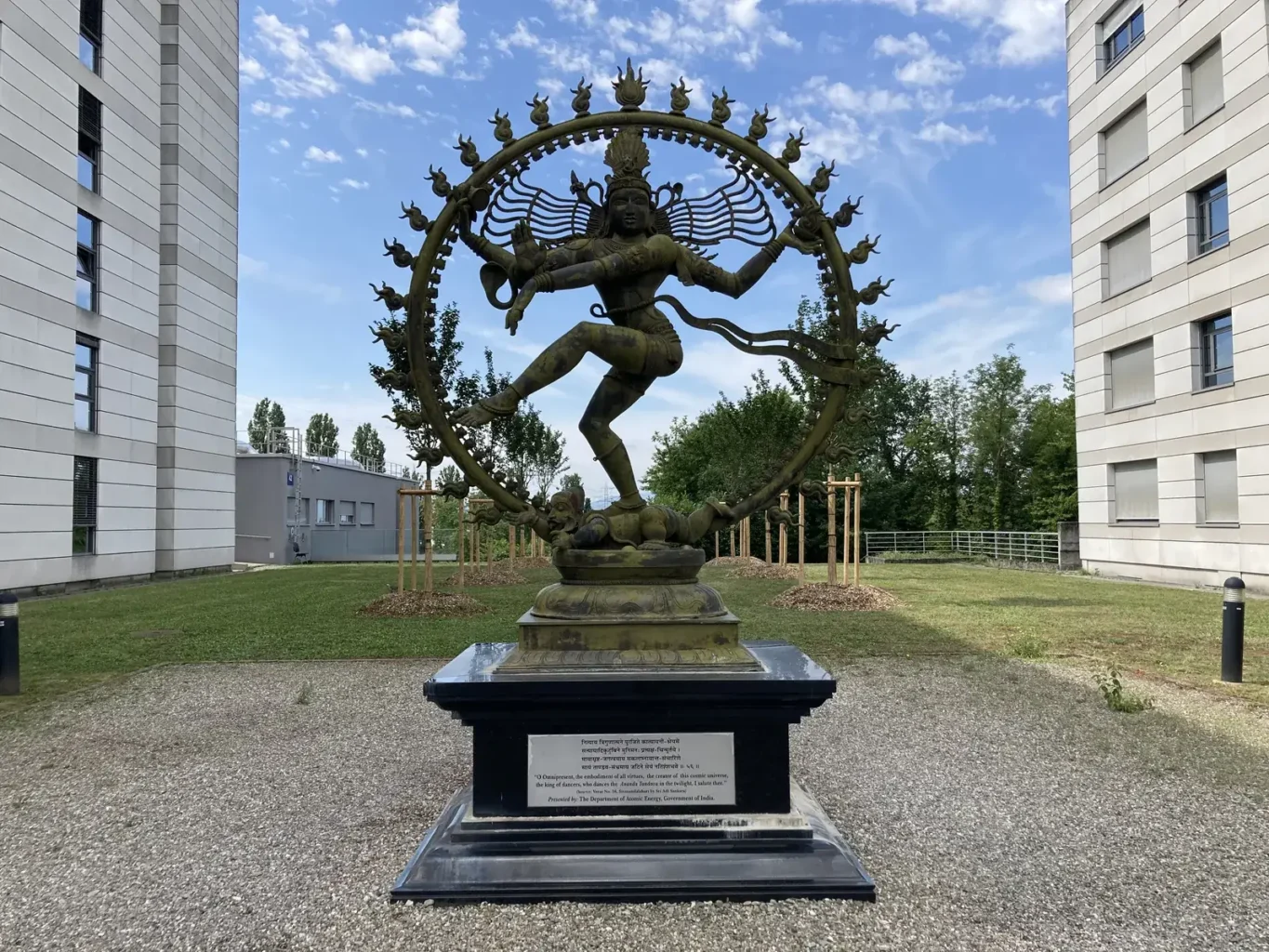
A figure dances inside a ring of flames at CERN. One hand holds a drum, another a flame, and a raised foot balances the movement. For visitors to a particle-physics laboratory, Shiva Nataraja is an unexpected sight.
The statue arrived through a very earthly connection. It was unveiled on 18 June 2004 as a gift celebrating CERN’s long collaboration with India. The choice of figure, however, opens an interesting question: why did a religious image of cosmic creation and destruction find a home among physicists?
Its story becomes easier to follow when we look at the statue’s symbols, the record of the gift and the particular comparison made by physicist Fritjof Capra.
The gift has a documented history
CERN’s photographic record of the unveiling identifies the statue as a gift from its Indian collaborators. It describes an association that began in the 1960s and records the people present at the ceremony, including CERN director-general Robert Aymar.
The record also explains how the sculpture was made in India. A wax model was enclosed in a mould. The wax was melted out, molten metal filled the space it left, and the cooled sculpture was polished and given an antique finish.
That process supplies an appealing connection of its own. The object outside the laboratory is the product of skilled material work: a temporary model becomes a metal form through carefully controlled changes of state. The antique surface belongs to a modern statue made for the gift.
Capra’s contemporary account gives its height as two metres and attributes the gift to the Indian government. His account and CERN’s record describe the same June unveiling from different perspectives.
Reading the dance
Nataraja is Shiva as Lord of the Dance. A late eleventh-century Chola bronze in the Metropolitan Museum of Art provides a useful guide to the imagery. Its curators describe a form that brings creation, preservation and destruction together within a cycle of time.
The drum in the upper right hand is associated with the sound of creation. The flame in the upper left represents destruction. A lower hand makes a reassuring gesture, while the raised foot offers refuge. Beneath the standing foot is a small figure associated with illusion or ignorance.
These details are easy to miss if the statue is reduced to “a god of destruction.” There is destruction in the image, but also creation, reassurance and release. Its balance allows those meanings to appear together.
The museum’s educators’ guide draws attention to another contrast: flying hair conveys movement, while the face remains calm. Stillness and action occupy the same figure.
Readers familiar with the religious significance of Om and sacred sound will recognise why a drum can carry more meaning here than a simple musical accompaniment. The statue uses objects and gestures to express ideas about the cosmos.
Capra’s comparison with particle physics
Capra wrote about Shiva’s dance and modern physics in a 1972 article, then developed the comparison in The Tao of Physics, first published in 1975. His 2004 account explains that quotations from the book appear on the plaque beside the CERN statue.
He compared the repeated processes of creation and destruction in the religious image with the changing world described by subatomic physics. Visitors encounter his interpretation on the plaque beside the statue.
Could an old image help someone picture an unfamiliar scientific idea? Certainly: movement, transformation and recurring processes offer a route into a subject that is difficult to visualise. Such a comparison can make us curious enough to ask how the physical process actually works.
The metaphor offers a starting point for imagining restless matter. To describe what particles actually do, physicists turn to measurements and predictions; the drum, flame and dancing figure give Capra another language in which to picture that activity.
What the setting adds
The statue makes a meeting visible. An Indian sculptural tradition, an international scientific collaboration and a physicist’s metaphor all occupy the same space. They reached that space by different routes.
Knowing those routes gives a visitor more to look at. The drum and flame explain why creation and destruction enter the discussion. The casting record shows the work behind the object. The plaque tells us whose interpretation connects it with particles.
A visitor can begin with the drum and flame, then turn to the plaque and the story of the gift. In those few steps, the statue takes us from an Indian workshop to a religious tradition and an international scientific partnership.