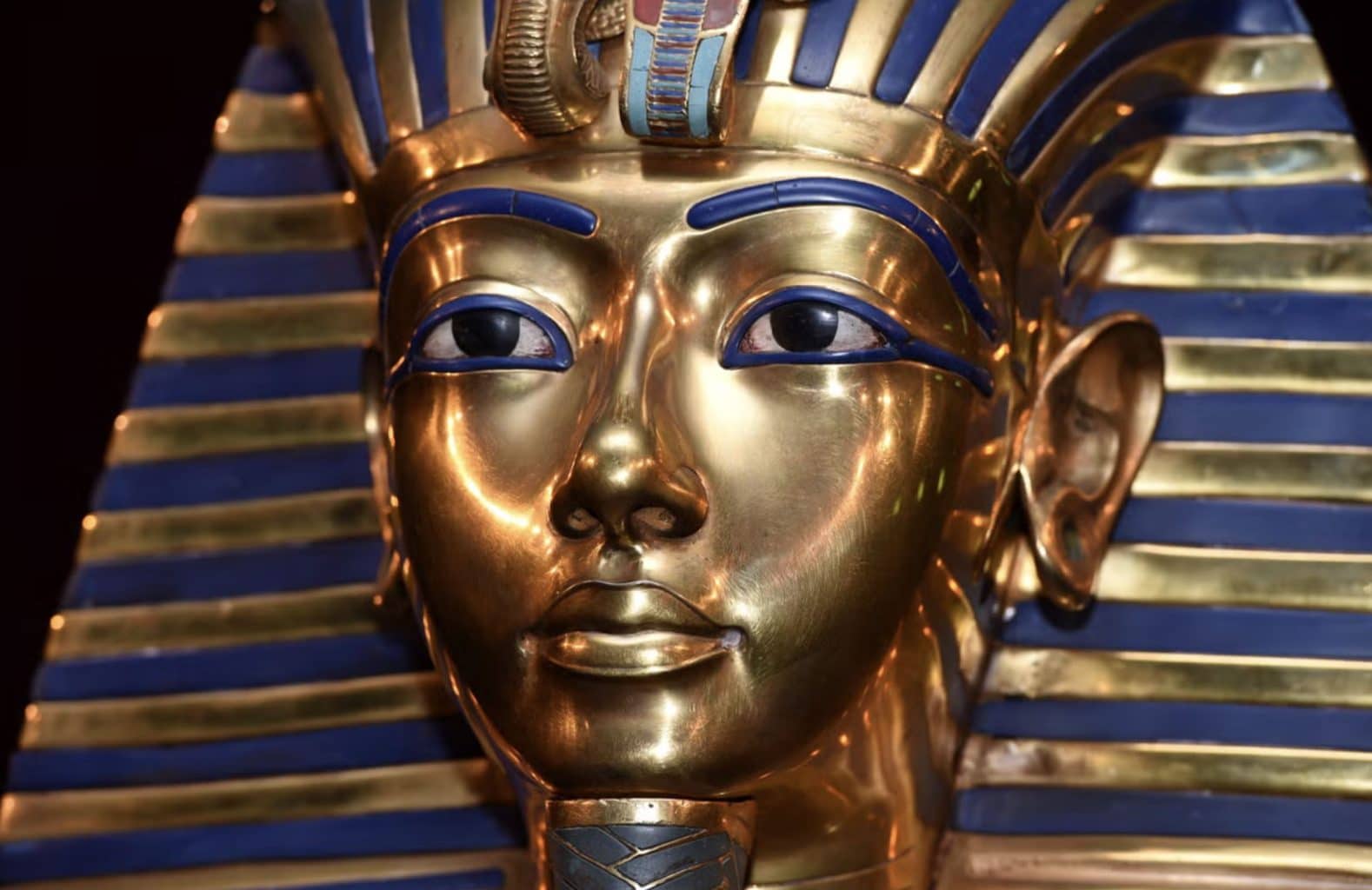
Tutankhamun’s golden face is instantly recognizable. Yet the construction of his burial mask has raised a remarkable question: could part of it have been made for another ruler? Egyptologist Nicholas Reeves developed that proposal by examining the mask’s separate components and inscription, identifying the royal woman Neferneferuaten as a possible original owner. His study of the mask explores how an earlier royal object might have been adapted for Tutankhamun.
The question leads directly into the goldsmiths’ workshop: how were the parts made, joined and inscribed? Those details have produced different interpretations among researchers.
A Closer Look at the Craftsmanship
The Grand Egyptian Museum’s catalogue describes a gold mask with glass and stone inlays, found over the king’s head and shoulders. Its face presents an idealized likeness recognizable in his other portraits. The protective inscription on the back links parts of the mask to Egyptian gods, giving the object a role in the king’s afterlife as well as a royal identity.
The pierced ears are an especially intriguing detail. Reeves examined gold-foil inserts covering the openings and compared them with other royal images. His argument concerned how earrings were represented in royal art: the fully drilled holes could once have held ornaments. He connected this feature with the possibility of an earlier owner.
What a Technical Examination Found
Christian Eckmann, Katja Broschat and Tom Hardwick examined the reuse proposal in a 2023 study, drawing on intensive examination of the mask in 2015. They considered the manufacturing process and what changing its face and inscription would require. Their published abstract concludes that the evidence does not establish a transfer from one owner to another. The debate therefore turns on how researchers read the workmanship and inscription, rather than a shared conclusion that the mask belonged to someone else.
Theories Point to Nefertiti
Reeves identified Neferneferuaten with Nefertiti and proposed that the mask was adapted for Tutankhamun. That reconstruction would connect a familiar masterpiece with the succession of rulers after Akhenaten. The ownership question is investigated through the object itself—its manufacture, imagery and inscriptions.
The circumstances of the burial provide another line of investigation. A Harvard-led investigation of brown spots on the tomb walls suggested that microbial growth could have developed when the chamber was sealed while its painted surfaces were still damp. This offers a possible clue to the speed of the burial preparations.
Tragedy and Turmoil
A 2010 study in JAMA investigated the royal family using imaging and genetic tests. Its authors reported several skeletal abnormalities and evidence of malaria in Tutankhamun, proposing a combination of illness and bone disease as a possible explanation for his death. Other researchers subsequently questioned that interpretation in correspondence published by the journal.
These investigations add to the portrait of a young king whose short life left an extraordinary archaeological record. The mask brings that wider history into a single object, combining royal imagery with the technical skill of the people who made it.
The ownership question makes the mask interesting at a second scale: beyond its famous face lie joins, inscriptions and choices made by its goldsmiths. These are the details researchers examine when reconstructing the history of the object.
As archaeologists and historians continue to piece together the mysteries of Tutankhamun’s life and death, one thing is clear: the golden mask remains an enduring testament to the artistry and intrigue of the ancient world.