After a Tibetan monk died, his companions wrapped his body in a yellow robe. Over the following days, they said, it seemed to grow smaller beneath the cloth. When they lifted it, they reported that he had disappeared.
The monk was Khenpo A Chö, and the reported events drew Catholic priest and Tibetan Buddhism scholar Francis V. Tiso into an investigation. His interviews became part of Rainbow Body and Resurrection, published in 2016.
Those who knew Khenpo A Chö understood his death through a Tibetan Buddhist tradition known as the rainbow body. Their accounts raise an extraordinary question about the relationship between spiritual practice and the physical body.
A body said to return to light
The Tibetan term jalu is commonly translated as rainbow body. In Dzogchen accounts, a highly accomplished practitioner’s body is said to dissolve into light, wholly or partly, through spiritual realisation.
Scholar Michael Sheehy explains the tradition through its understanding of the elements. Earth, water, fire, air and space form the body; at death, their dissolution can be understood as a return to radiance. Reports of rainbow body give that transformation a visible form.
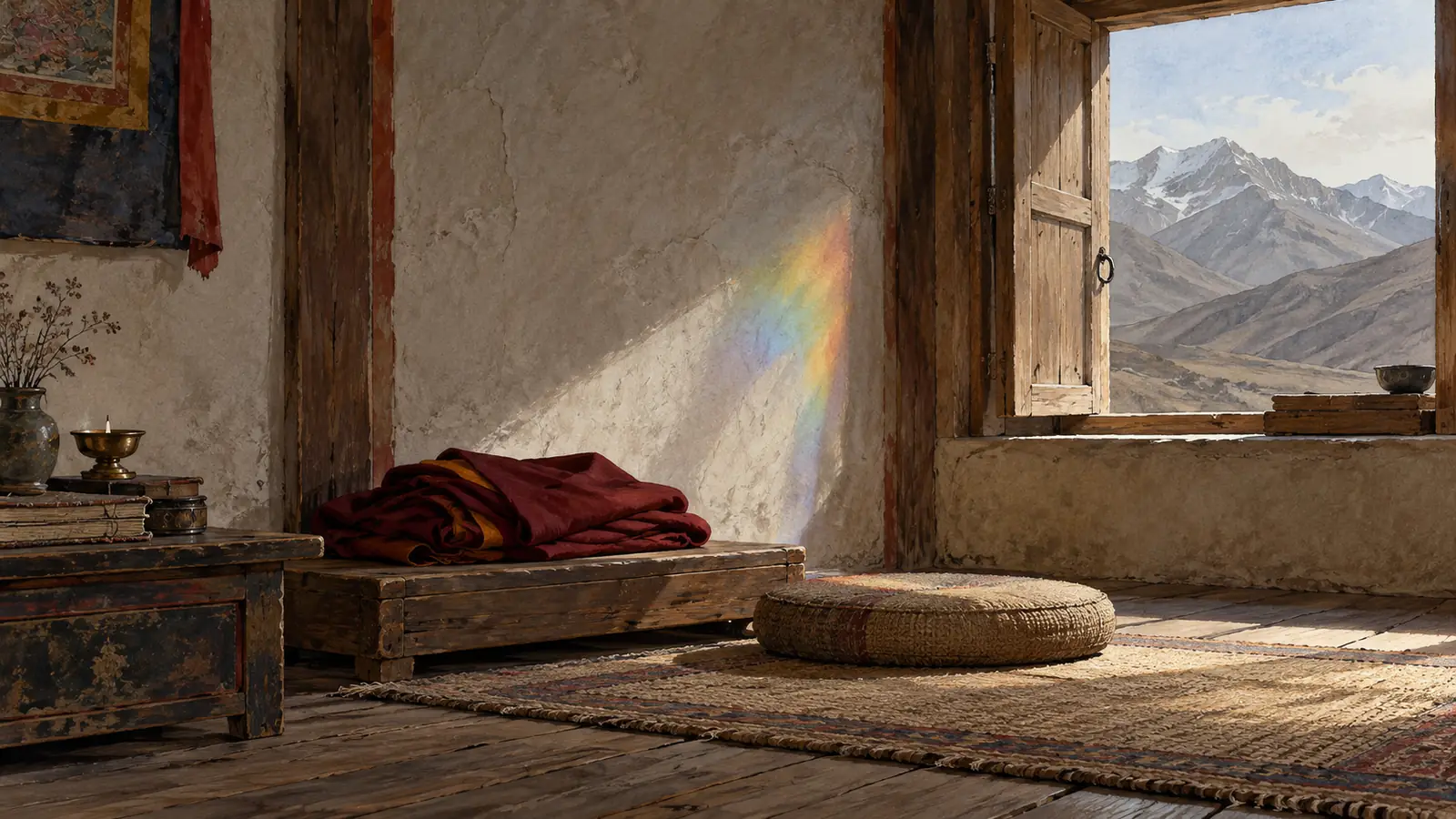
The descriptions vary. Some concern a body becoming much smaller; others describe almost complete disappearance, with hair and nails remaining. Sheehy also records reports of fragrance and rainbows accompanying the death. Within the tradition, these are recognised signs of a practitioner’s attainment.
Traditional texts place the idea within a much larger account of awareness and liberation. A Dzogchen lineage prayer by Khenchen Ngawang Palzang, translated with Tibetan text and explanatory notes by Lotsawa House, invokes realised teachers and refers to great transference into rainbow body. Its surrounding verses concern meditation and the nature of mind.
In these traditions, the reported transformation belongs to a lifetime of practice and to teachings about the nature of mind.
The people Tiso went to find
Tiso travelled to eastern Tibet to speak with people who had known the monk. A 2002 report on his investigation names three people he interviewed: the monk’s nephew Lama Norta, a young disciple named Sonam Gyamtso, and Lama A-chos, a spiritual companion.
They described a rainbow above the hermitage before the death and more rainbows afterward. The 2002 report says they saw the covered body diminish over several days and that, after seven days, the cloth was removed and no body remained. These details come from their accounts as reported there; Tiso arrived after the events.
Scholar Michael Sheehy dates the monk’s life to 1918–1998, as does the 2002 report. The publisher’s description of Tiso’s book gives 1999 as the death year. The difference is a reminder to check the chronology when following accounts of the case.
The publisher describes Tiso’s book as an investigation involving eyewitness interviews and a wider comparison with Christian resurrection traditions. The reported disappearance belongs to those witness accounts. Tiso was investigating it afterward.
His book draws on interviews and field journals. Those accounts preserve the experiences of the people he met, while leaving questions about the sequence of events and the records available at the time.
The people around the monk
Tiso returned to these questions in a methodological paper published online in 2018 in the Journal of Religion and Health. The accessible abstract frames his work as anthropological research into spiritual attainment, death and dying.
He argues that investigating paranormal claims requires attention to their social setting. A respected person’s death involves relatives, disciples and fellow practitioners, each with a particular relationship to the person and to the events being described.
In a later Wonderstruck interview, Tiso emphasises the community around Khenpo A Chö. He describes the reported death as confirming, for those people, what the monk’s life and practice had represented.
Each person knew the monk differently. Listening to those relationships helps explain why the reports meant so much to his community, as well as how the story travelled beyond Tibet.
From Tibetan practice to Christian resurrection
Religious studies scholar M. Maria Turek, reviewing the book for Reading Religion, asks for more detail about the social world around Khenpo A Chö. Her concern is how the fieldwork was collected and interpreted, particularly as the book moves into broad comparisons between religions.
Those comparisons can be fascinating. They also leave a very specific Tibetan story to investigate on its own terms. Similar language about light in two traditions does not, by itself, tell us how either reported event occurred.
Curiosmos has previously explored another Buddhist account of unusual light: Xu Yun’s descriptions of the wisdom lamps. The rainbow-body tradition concerns a different kind of experience, centred on the practitioner and the body at death.
The accounts carry two stories at once: the extraordinary events the witnesses described, and a life of practice that gave those events meaning. Both brought Tiso to the mountains of eastern Tibet.
Sources
- Gail Bernice Holland, The Rainbow Body, Institute of Noetic Sciences Review 59, March–May 2002, reporting Tiso’s investigation and interviews.
- Francis V. Tiso, Rainbow Body and Resurrection, North Atlantic Books, 2016; publisher’s description consulted alongside the reviews below.
- Francis V. Tiso, Methodology in Research on the Rainbow Body, Journal of Religion and Health 58, 725–736, 2019; published online November 15, 2018. Abstract and publication record consulted.
- Michael Sheehy, Investigating the Rainbow Body, Buddhadharma/Lion’s Roar.
- Khenchen Ngawang Palzang, Dzogchen Lineage Prayer, translated by Joseph McClellan, Lotsawa House, 2026.
- M. Maria Turek, review of Rainbow Body and Resurrection, Reading Religion, October 12, 2016.
- Francis Tiso, Light, Death, and Mystical Ecstasy, Wonderstruck interview transcript.