A motorway project near Veyre-Monton, south of Clermont-Ferrand, uncovered a stone landscape beneath the soil. French archaeologists found about 30 standing stones, a cairn and a carved figure. Later, someone pushed many of the menhirs into pits.
The discovery gives the site two histories: people built a prominent monument in a mountain pass, then another community altered or buried it. Archaeologists can trace those actions in the ground, even though they cannot recover the reasons for them.
A line of stones through a mountain pass
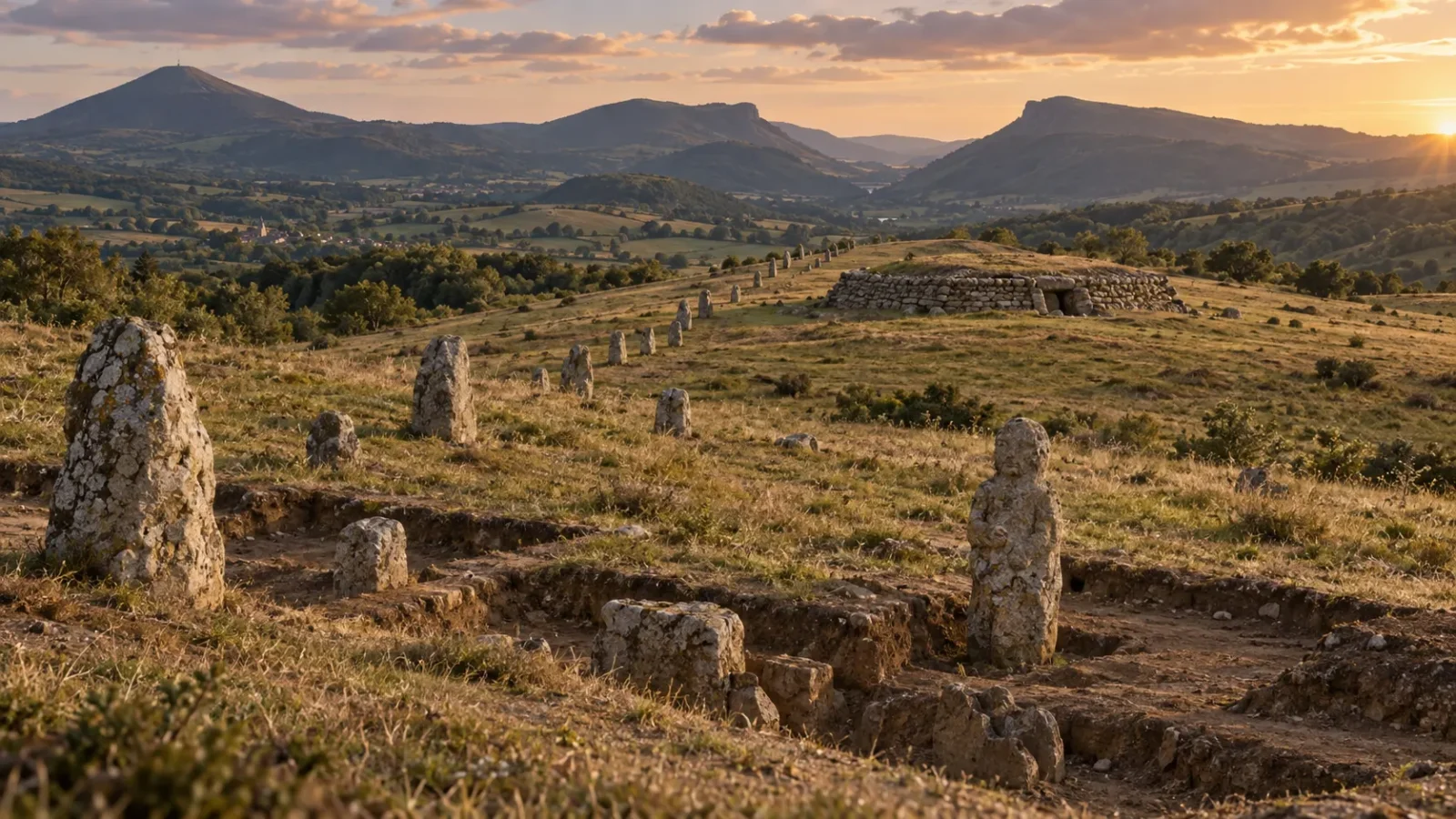
Before the A75 motorway was widened, France’s National Institute for Preventive Archaeological Research, INRAP, excavated 1.6 hectares near Veyre-Monton. The main alignment extended for at least 150 metres through the area, and may have continued beyond it. A second line of larger blocks, a small horseshoe arrangement and a stone circle formed part of the same complex.
Keep exploring
Continue with Curiosmos
Most menhirs stood between one and 1.6 metres high. The alignment followed a north-south axis near a pass through the volcanic landscape. Stones at the higher northern end stood farther apart; farther south they became smaller and more closely spaced.
The blocks came from more than one possible basalt source, including the plateaus of Le Crest and Corent, both with evidence of prehistoric occupation. Most weighed less than a tonne, but moving them still took planning and labour. Their placement made sense in this pass, where people travelling through the landscape could see the line.
A carved figure and a nearby burial
One stone stood apart from the others. Made from limestone rather than basalt, it was shaped into a rough human form. INRAP describes a rounded projection like a head, simple shoulders, two small breasts and a worn chevron that may represent arms or a belt.
It is the only known statue-menhir from Auvergne. Researchers have compared its form with examples from southern France, Brittany and Switzerland. Those comparisons help place the carving in a wider conversation about prehistoric stone figures; they do not establish that its makers travelled from any of those regions.
A rectangular cairn stood nearby, enclosing the burial of a large man. His body had been placed in a wooden container that has not survived. The cairn measured about 14 by 6.5 metres and contained roughly 30 tonnes of stone brought from several kilometres away.
The burial adds another layer to the landscape. The alignment, carved figure and tomb may not all have been built at the same moment, but they occupied the same place. Dating their sequence is part of the remaining work.
When the monuments were put underground
Excavators found that many menhirs had been pushed into large pits. Some were broken or covered with earth. Stones from the cairn were removed and thrown into a nearby trench.
INRAP has suggested deliberate iconoclasm: someone may have wanted the monuments taken out of sight after a change in community or belief. The excavation shows the stones were moved; it cannot identify the motive. They may have been rejected, reused or cleared away as the landscape changed.
Either way, hiding the stones took effort. The pits preserve a later decision as clearly as the standing alignment preserves an earlier one.
A broad date, not a single moment
Few finds from Veyre-Monton provide a precise date for the complex. INRAP places its activity broadly between the Neolithic and Bronze Age, using comparisons with other sites. Radiocarbon analysis of the buried man and rare animal remains may help narrow the sequence.
The menhirs, statue, cairn and burial could represent different stages. Treating them as one project would hide the very changes the excavation revealed. The monument is also sometimes compared with Carnac, but resemblance does not prove a single culture or shared purpose across western Europe.
Veyre-Monton is a local landscape shaped over time: stones quarried from nearby plateaus, a figure cut from limestone, a burial marked by a cairn and a later effort to bury the monuments. Future dates and stone-source studies may show how long each stage lasted and who used the pass.
For another example of how communities used stone to mark their surroundings, see Curiosmos’ report on stone circles and the sky before writing.