At Hierapolis in southwestern Türkiye, a fissure in the ground released gas that could kill animals. Ancient visitors knew the place as the Ploutonion, a sanctuary linked to Pluto and Kore, the underworld gods. Writers described it as an entrance to Hades.
The name belonged to a religious landscape built around a physical danger. Carbon dioxide rose from the ground; architecture and ritual gave the opening a place in the city’s story.
A sanctuary over a natural vent
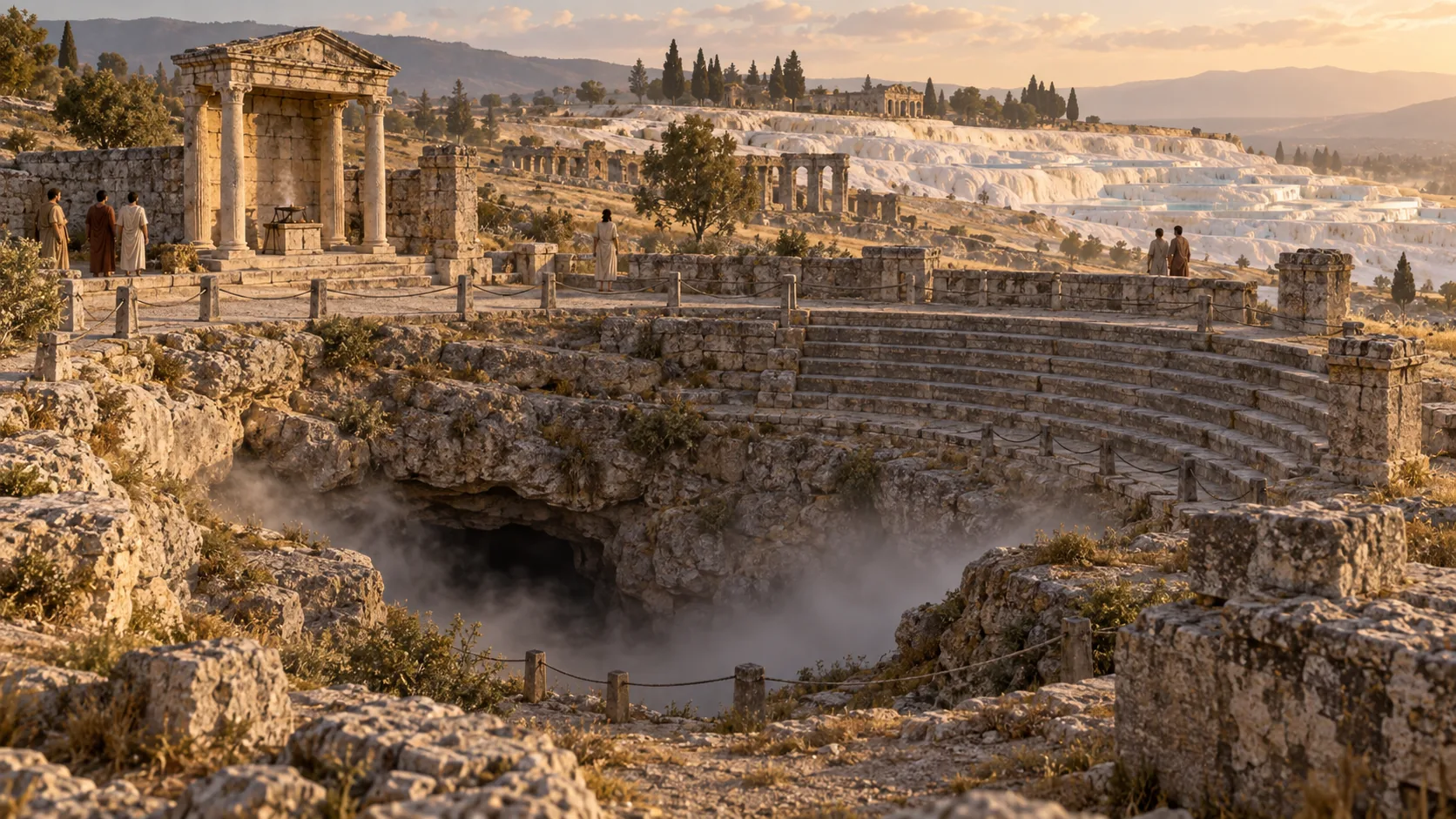
Hierapolis stood beside the hot springs and white terraces of modern Pamukkale. The Ploutonion formed part of a sanctuary with a theatre-like structure above a cave and a narrow opening where gas emerged. Italian archaeologists identified the complex during excavations.
Its setting was not an accidental backdrop. Visitors could approach the opening and watch a dangerous natural feature within a controlled ceremonial space. The builders turned a cave and a stream of gas into a place associated with the boundary between the living and the dead.
Carbon dioxide close to the ground
Researchers measured gas concentrations at the site with portable analysers. Their 2019 study found carbon dioxide building up at dangerous levels in the low area near the cave. The gas can pool close to the ground under some conditions, where it displaces oxygen. An animal with its head near the surface could be overcome while a person standing nearby remained in cleaner air.
The Ploutonion lies in a region shaped by geological faults and hot water. The same activity that feeds Hierapolis’ springs also releases gases. Modern instruments can identify the hazard; the ancient visitors encountered it through its effects.
Why priests seemed untouched
Ancient accounts say that animals died near the opening while priests associated with the cult survived. Height offers one possible explanation. If the gas was most concentrated near the floor, a person standing on a raised spot could remain above the densest layer for a time.
Someone familiar with the site might also have known where the gas gathered and when to approach. That does not prove exactly how a ceremony was performed. A modern measurement records conditions during a particular visit; it cannot reproduce every ancient event. But it gives a physical explanation for the contrast described in the old accounts.
Strabo and Pliny helped preserve the Ploutonion’s reputation as a route to the underworld. Their descriptions were shaped by the stories people told about the sanctuary. The texts show how the place was remembered, while archaeology and gas measurements tell us what was built and what came out of the ground.
Geology and belief at Hierapolis
Archaeological work at the site has examined ceramics, sculpture and animal remains, helping researchers trace how the sanctuary changed through the Hellenistic and Roman periods. These finds place the gas vent within a larger ritual complex, rather than treating it as a curious hole on its own.
People did not need a laboratory explanation to notice that animals could die near the opening and that the air behaved differently there. They understood the experience through their religious world. The sanctuary made that interpretation public and repeatable.
Modern measurements explain one part of the scene. They do not decide what the Ploutonion meant to every visitor or establish that ancient people described it exactly as it happened. The site brings together a hazardous natural process, a carefully arranged sanctuary and stories about the underworld. Each leaves a different kind of evidence.
Curiosmos has compared similar myths across ancient cultures. At Hierapolis, the landscape itself helps explain why one place could inspire such a powerful story.
Sources
- Italian Ministry of Foreign Affairs, archaeological mission at Hierapolis.
- Pfanz et al., “Deadly CO2 gases in the Plutonium of Hierapolis,” Archaeological and Anthropological Sciences.
- Italian National Research Council, “The Ploutonion of the archaeological site of Hierapolis.”
- UNESCO World Heritage Centre, Hierapolis-Pamukkale.
- De Grossi Mazzorin and Minniti, research on animal remains from the Ploutonion.