Brown dwarfs twice Jupiter’s mass have appeared in the young star-forming region IC 348, raising a deceptively simple question: how small can an object be and still form like a star? The James Webb Space Telescope has now found brown dwarfs with masses as low as roughly twice that of Jupiter. One of them may even be surrounded by a disk—the kind of structure from which planets can grow.
These objects are not stars. A star becomes a star when its core grows hot and dense enough to fuse ordinary hydrogen into helium. Brown dwarfs form through the collapse of gas, like stars do, but they never reach that threshold. They occupy the uneasy middle ground between the smallest stars and the largest planets, which is exactly why astronomers keep looking for the lower limit.
Why IC 348 is such a useful laboratory
IC 348 lies about 1,000 light-years away in the Perseus star-forming region and is only about five million years old. That youth helps the search. Brown dwarfs are still warm from their formation, so they glow brightly in infrared light even though they do not shine through sustained hydrogen fusion.
The team first surveyed the cluster with Webb’s Near-Infrared Camera, or NIRCam, looking for faint red objects whose colours and brightness separated them from ordinary stars and distant galaxies. The most promising candidates were then examined with Webb’s Near-Infrared Spectrograph, NIRSpec. Spectroscopy turns a point of light into a set of chemical and physical clues: temperature, composition and signs of an atmosphere can be tested rather than guessed from an image.
How small is “small” here?
The new observations reached objects weighing about two times Jupiter’s mass. That is only around 0.19 percent of the Sun’s mass. Earlier Webb observations in the same cluster had identified free-floating brown dwarfs at three to four Jupiter masses; the deeper work now pushes the known population lower.
A mass comparison can be misleading if it is treated as a definition. Jupiter is a planet because it orbits the Sun and formed inside a planetary system. A free-floating brown dwarf can have a similar mass while forming directly from a collapsing cloud. The question is therefore not only how heavy the object is. It is how it came into existence.
Current formation models have an uncomfortable gap. It is relatively easy to make a giant planet in a disk around a star. It is harder to make a cloud with only a few Jupiter masses collapse on its own, because its gravity is weak. The team argues that the IC 348 objects are more likely to be brown dwarfs than planets thrown out of other systems, partly because the cluster is so young and giant planets around its low-mass stars should be rare. More objects will be needed to decide whether that explanation holds.
A disk around an object barely heavier than a planet
One of the lightest brown dwarfs shows signs of a disk. That matters because disks are not just rings of leftover dust: around young stars, they are the environments where planets can assemble. If a disk can persist around an object only a little more massive than Jupiter, it raises a new question. Could very small, star-like objects host their own miniature planetary systems?
The observation does not show a planet in that disk, and it does not tell us how long the disk will survive. It does show that the boundary between “planetary” and “stellar” environments may be more complicated than a simple mass cutoff.
Webb also found a molecule nobody expected
The spectra carried another surprise. Two of the brown dwarfs show an infrared feature attributed to an unidentified hydrocarbon, a molecule made from hydrogen and carbon. A similar signature has appeared in the atmospheres of Saturn and Titan and in gas between the stars, but this is the first reported detection of that feature in an object outside the Solar System.
Atmospheric models for brown dwarfs did not predict it. That does not mean the chemistry is alien in the science-fiction sense; it means the models are being asked to describe a colder, younger and lower-mass regime than they were built for. New observations will have to determine which molecule is responsible and whether it appears in other small brown dwarfs.
What the image can—and cannot—tell us
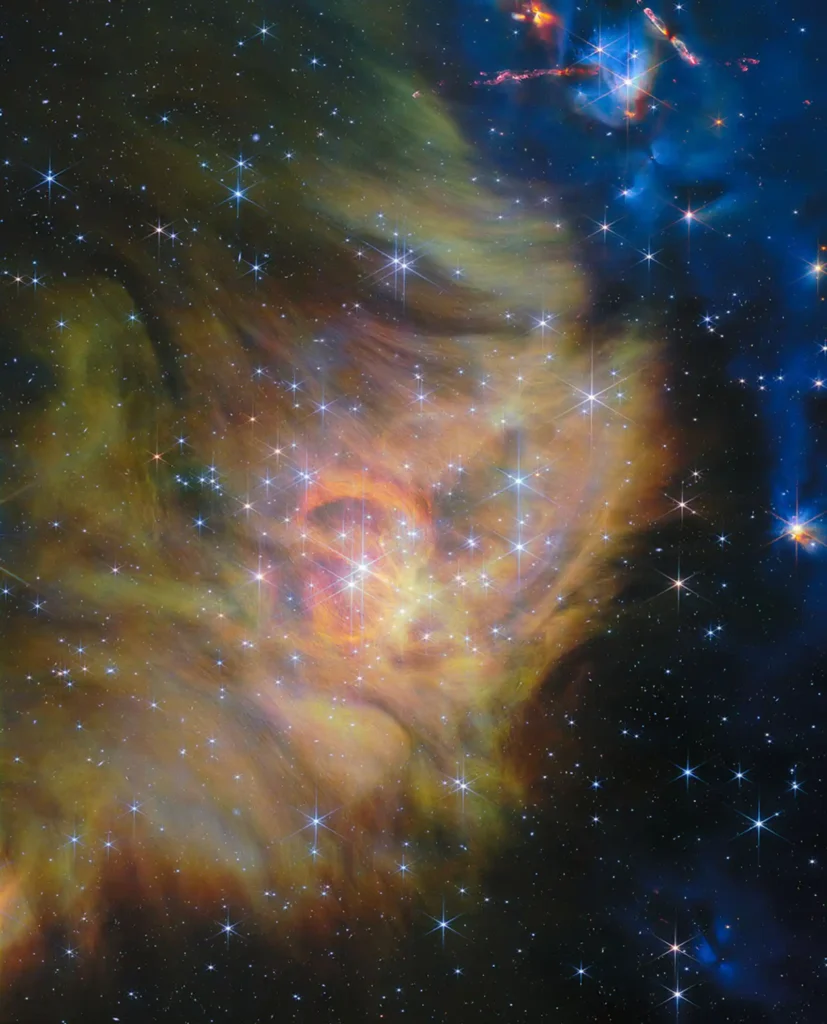
Webb’s image of IC 348 is spectacular because it shows glowing gas, newborn stars, jets and a field of distant galaxies in one crowded scene. The discovery itself came from the less glamorous work behind that picture: selecting candidates, separating them from background galaxies and reading their spectra. The image reveals the neighbourhood; the spectrum tests the objects inside it.
That combination is why the result reaches beyond a new record. If objects with two Jupiter masses really can form through the star-making process, then theories of star formation must explain how gravity works at its smallest scale. If some turn out to be rogue planets instead, astronomers will have to trace a different history. Either way, the smallest lights in IC 348 are asking a large question: where does a star stop being a star?
Sources and further reading
- NASA Science: NASA’s Webb Reveals Dynamic Panorama of Star Formation
- NASA Science: Webb Identifies Tiniest Free-Floating Brown Dwarf
- Luhman et al., Astrophysical Journal Letters (2026)
- How Do Telescopes Work? The Real Reason Bigger Mirrors See Fainter Worlds
- How Do We Know an Exoplanet Has an Atmosphere?